
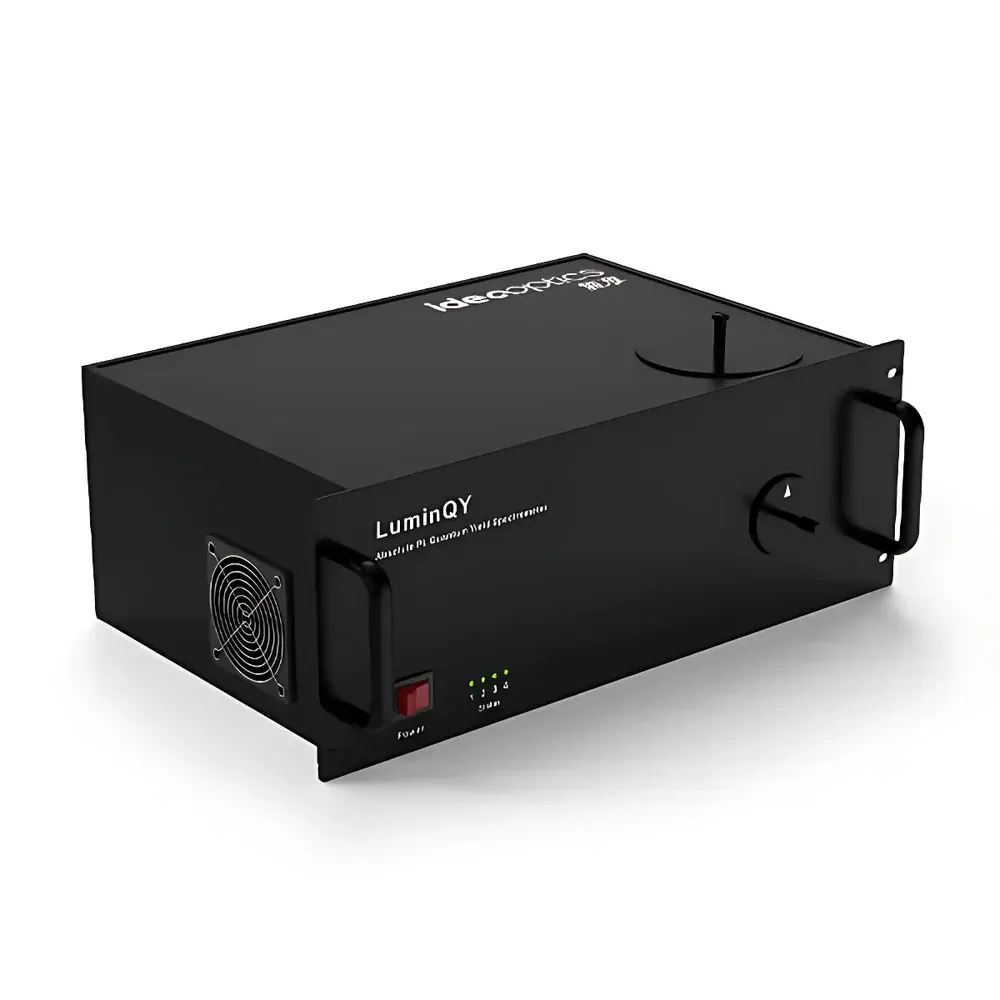
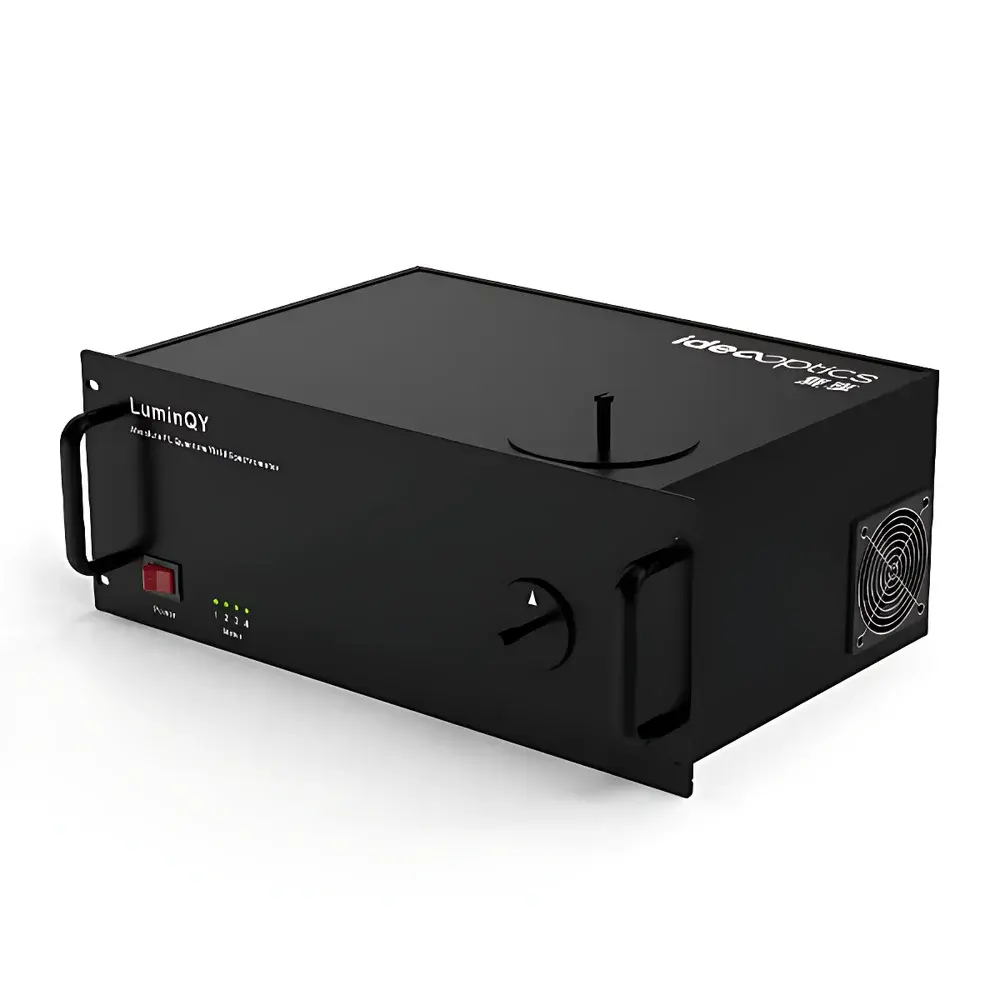
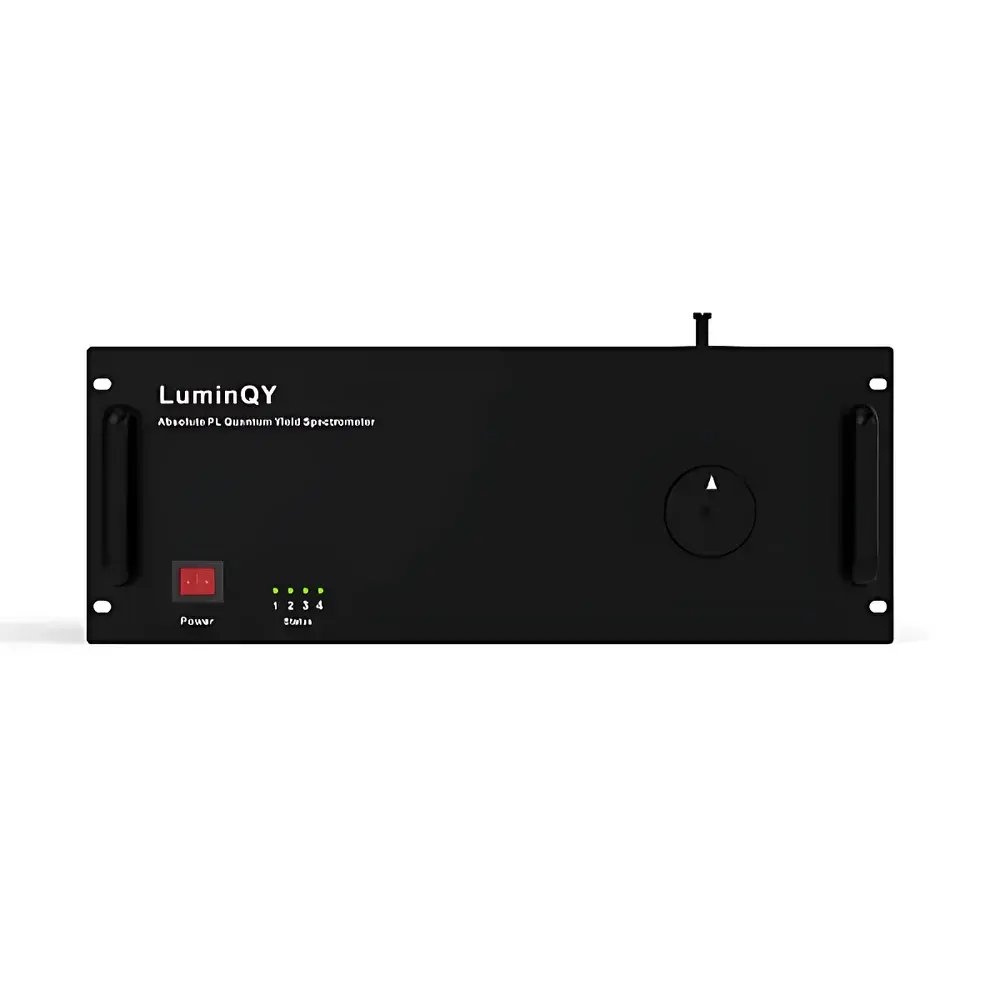
IdeaOptics LuminQY Fluorescence Quantum Yield Measurement System
| Brand | IdeaOptics |
|---|---|
| Origin | Shanghai, China |
| Manufacturer Type | Original Equipment Manufacturer (OEM) |
| Product Origin | Domestic (China) |
| Model | LuminQY |
| Pricing | Available Upon Request |
| PLQY Range | 0.01–100% |
| Excitation Intensity Range | 0.001–10 Suns |
| Spectral Bandgap Coverage | 0.8–2.1 eV |
| Excitation Wavelengths | 520 nm & 785 nm |
| Detection Range | 400–1650 nm |
Overview
The IdeaOptics LuminQY Fluorescence Quantum Yield Measurement System is a purpose-built optical characterization platform engineered for quantitative photoluminescence (PL)-based evaluation of perovskite photovoltaic (PV) materials and thin-film devices. It operates on the principle of absolute photoluminescence quantum yield (PLQY) determination via calibrated integrating sphere spectroscopy combined with simultaneous spectral excitation control and bias-tunable sample environment. Unlike conventional steady-state fluorescence spectrometers, the LuminQY integrates optoelectronic feedback loops to quantify not only PLQY but also derived thermodynamic and recombination-relevant parameters—including quasi-Fermi level splitting (QFLS), implied open-circuit voltage (iVoc), and optically predicted power conversion efficiency (optical PCE)—all under non-destructive, non-device conditions. This enables rapid, in-line assessment of film quality, interfacial integrity, and bulk defect density prior to full device fabrication, significantly accelerating R&D cycles in perovskite solar cell development.
Key Features
- Integrated dual-wavelength excitation (520 nm and 785 nm) with independent intensity control, enabling selective probing across varying perovskite bandgaps—from wide-bandgap top cells (e.g., ~1.8 eV) to narrow-bandgap bottom absorbers (e.g., ~1.2 eV) in tandem architectures.
- Full-spectrum detection from 400 nm to 1650 nm, supporting both visible and near-infrared PL emission analysis required for mixed-halide and low-dimensional perovskites.
- Automated, motorized stage and optical path alignment, coupled with “one-click” acquisition protocols, ensuring high repeatability and minimizing operator-induced variability across multi-sample campaigns.
- Externally accessible electrical bias interface integrated into the sample stage, permitting controlled application of reverse/forward bias during PL measurement to decouple radiative vs. non-radiative recombination pathways under operational carrier injection conditions.
- Layer-resolved QFLS and iVoc mapping capability—enabling spatially resolved quantification of bulk and interfacial recombination losses in incomplete devices (e.g., perovskite-on-transport-layer stacks), without requiring full electrode deposition or encapsulation.
Sample Compatibility & Compliance
The LuminQY system accommodates standard 25 × 25 mm² and 50 × 50 mm² substrate formats, including glass, ITO/PEDOT:PSS, NiOx, SnO2, and flexible PET-based substrates. It supports ambient, nitrogen-purged, and glovebox-integrated configurations (via optional vacuum feedthroughs). All optical calibration procedures adhere to ISO 11664-7:2023 (Colorimetry — Part 7: CIE color-matching functions) and ASTM E2962-21 (Standard Practice for Determining Photoluminescence Quantum Yield of Solid Materials), ensuring traceable, inter-laboratory comparable results. Data acquisition and metadata logging comply with GLP-aligned audit trail requirements, supporting regulatory documentation for pre-commercial PV material qualification.
Software & Data Management
The proprietary LuminQY Control Suite provides real-time spectral visualization, automated PLQY calculation using reference-standard correction (e.g., quinine sulfate in 0.1 M H2SO4), and batch processing for QFLS/iVoc extraction via Boltzmann inversion of PL spectra. Export formats include CSV, HDF5, and vendor-neutral JSON-LD metadata containers compliant with FAIR data principles. The software architecture supports integration with laboratory information management systems (LIMS) and includes configurable user roles, electronic signatures, and 21 CFR Part 11–ready audit logs for GMP-aligned environments.
Applications
- Quantitative optimization of perovskite composition, crystallization kinetics, and passivation strategies via PLQY and QFLS correlation with device performance metrics.
- Rapid screening of charge transport layers (HTL/ETL) for interfacial recombination suppression using iVoc mapping across film thickness gradients.
- Non-invasive assessment of degradation mechanisms—including halide segregation, phase demixing, and ion migration—via time-resolved PLQY tracking under controlled illumination and bias stress.
- Optical PCE prediction modeling for tandem cell design, leveraging experimentally measured QFLS and absorption profiles to estimate theoretical Jsc/Voc limits prior to monolithic integration.
- Correlative analysis with complementary techniques (e.g., TRPL, SCLC, EQE) to establish unified recombination models for perovskite absorber layers.
FAQ
What standards does the LuminQY system follow for PLQY calibration?
It conforms to ASTM E2962-21 and ISO 11664-7:2023, using NIST-traceable reference standards and sphere-based absolute quantum yield methodology.
Can the system measure PLQY under operational bias conditions?
Yes—the integrated electrical interface supports DC bias application from −5 V to +5 V during PL acquisition, enabling direct observation of field-dependent recombination dynamics.
Is layer-by-layer QFLS mapping possible on incomplete devices?
Yes—QFLS can be extracted from individual perovskite films deposited on functional transport layers, without metal electrodes or full device architecture.
Does the software support automated reporting for regulatory submissions?
Yes—audit-trail-enabled reports include raw spectra, calibration certificates, instrument configuration logs, and user authentication records, suitable for FDA or IEC 61215-compliant documentation.
What is the minimum detectable PLQY value with stated uncertainty?
The system achieves reliable quantification down to 0.01% PLQY with ≤±3% relative standard deviation at 1% PLQY level, verified against certified luminescent reference materials.
Related Products





