
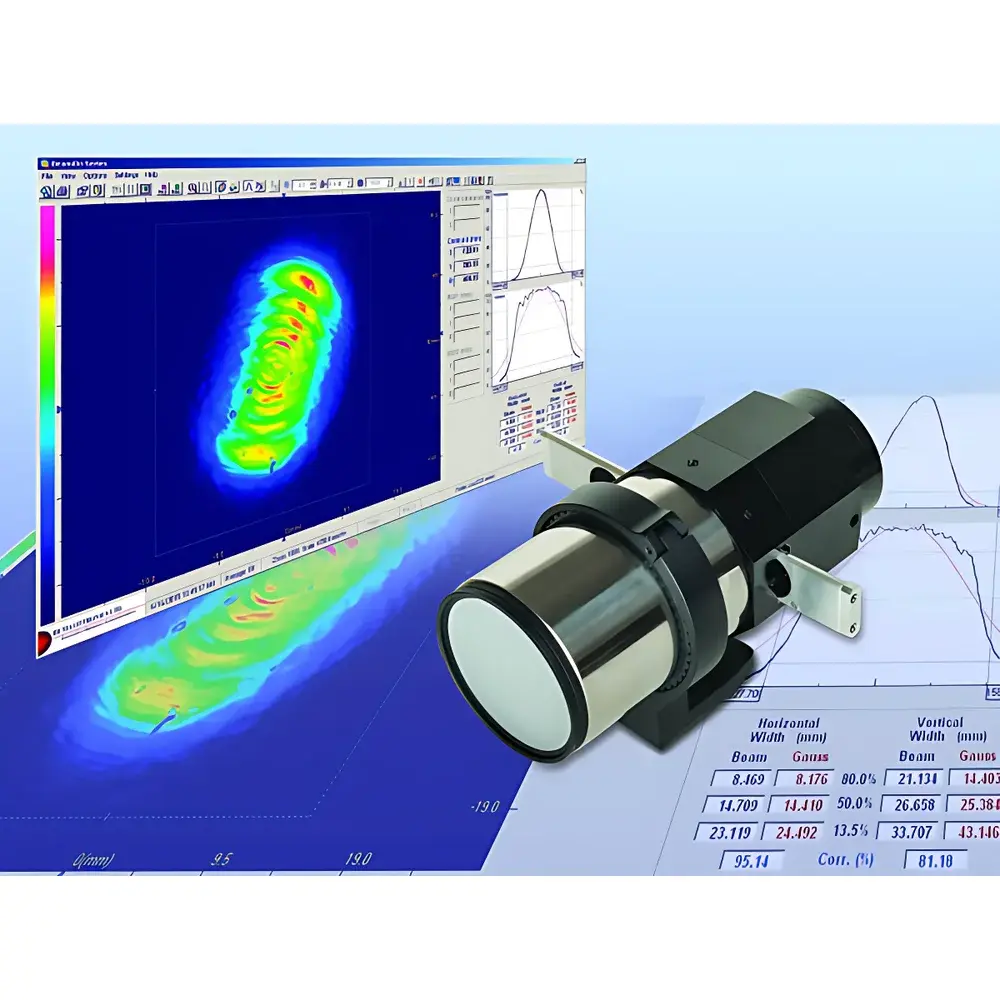
Beam On LA Laser Beam Profiler by Duma Optronics
| Brand | Duma Optronics |
|---|---|
| Origin | Israel |
| Model | Beam On LA |
| Spectral Range | 350–1310 nm (VIS–NIR) |
| Max Power Density | 100 J/cm² or 100 W/cm² |
| Max Frame Rate | 25 Hz |
| Image Resolution | 720 × 576 pixels |
| Shutter Speed | 1/50 to 1/100,000 sec (9 steps) |
| Gain Control | 6–60 dB (16 steps) |
| Optical Dynamic Range | up to 1×10¹⁰ (with ND1000 filter + software-controlled shutter/gain) |
| Sensor Active Area | 58 mm × 45 mm |
| Minimal Detectable Beam Size | ≥5 mm |
| Sensitivity | 0.1 μW/cm² @ 633 nm |
| Saturation Limit | 100 W/cm² (with NG1000 filter) |
| Damage Threshold | 100 J/cm² |
| Triggering | Adjustable threshold-based pulse capture (1–100 Hz pulsed lasers) |
| Null Mode | CW background subtraction |
| Sensor Weight | 1.1 kg (incl. cable) |
Overview
The Beam On LA Laser Beam Profiler, engineered by Duma Optronics in Israel, is a high-precision CCD-based beam analysis system specifically designed for the real-time characterization of large-diameter laser and intense pulsed light (IPL) beams. Unlike standard beam profilers constrained by small active sensor areas, the Beam On LA features an unusually large 58 mm × 45 mm active detection surface—enabling full-field profiling of beams with diagonal dimensions up to 60 mm. Its optical architecture leverages a scientific-grade progressive-scan CCD sensor operating across the visible to near-infrared spectrum (350–1310 nm), supported by hardware- and software-coordinated electronic shuttering, programmable gain, and neutral density filtration to maintain linearity and dynamic range under extreme irradiance conditions (up to 100 J/cm² for pulsed operation or 100 W/cm² for CW). The system operates on the principle of direct intensity mapping: incident photons are converted into spatially resolved charge distributions, digitized at 720 × 576 resolution, and processed using calibrated centroid, second-moment (D4σ), and Gaussian-fitting algorithms compliant with ISO 11146-1:2005 and ISO 13694 standards.
Key Features
- Large-format CCD sensor with 58 mm × 45 mm active area—optimized for oversized beams common in IPL systems, excimer lasers, and industrial CO₂ beam delivery verification.
- Real-time 2D and 3D beam visualization at up to 25 Hz frame rate, supporting both continuous-wave and low-repetition-rate pulsed sources (1–100 Hz).
- Three user-definable rectangular Regions of Interest (ROIs), each independently analyzed for power density, centroid position, and beam width (D4σ, knife-edge, or FWHM).
- Integrated CW Null mode for automatic background subtraction—critical for stable measurements in ambient-light-sensitive environments or when monitoring low-contrast thermal drift effects.
- High optical dynamic range (>1×10¹⁰) achieved via synchronized control of ND1000 filtering, 9-step mechanical shutter, and 16-step electronic gain—ensuring quantitative fidelity across orders of magnitude in irradiance.
- Triggered acquisition with adjustable intensity threshold for reliable single-pulse capture and frame rejection during non-lasing intervals—essential for reproducible pulsed laser QA/QC.
Sample Compatibility & Compliance
The Beam On LA accommodates free-space collimated or focused beams with minimum diameters ≥5 mm and maximum diagonal extents ≤60 mm. It is compatible with CW, quasi-CW, and nanosecond-to-millisecond pulsed sources—including IPL lamps, Nd:YAG harmonics, diode-pumped solid-state (DPSS) lasers, and broadband UV–NIR sources. All measurement outputs—including beam width, ellipticity, M² estimation (when used with optional beam propagation kit), power per ROI, and centroid stability—are traceable to NIST-calibrated reference targets. The system supports audit-ready data logging in accordance with GLP and GMP frameworks, and its software architecture allows configuration of user roles, electronic signatures, and metadata stamping aligned with FDA 21 CFR Part 11 requirements for regulated manufacturing environments.
Software & Data Management
The proprietary BeamGage® Professional software (v6.x or later) provides full instrument control, real-time analysis, and export-ready reporting. It supports time-stamped video recording (AVI/MPEG-4), snapshot capture with embedded calibration metadata, and batch processing of stored sequences. All numerical results—including RMS beam width, peak irradiance, flatness uniformity (Top-Hat ratio), and beam propagation history—are exportable to CSV, XML, or MATLAB-compatible formats. Software modules include automated pass/fail thresholding against user-defined specification limits, multi-system synchronization for parallel beam monitoring, and playback annotation tools for root-cause analysis of beam instability events.
Applications
- Quality assurance of IPL devices in dermatology and aesthetic medicine—verifying uniformity, spot size consistency, and temporal pulse shape fidelity across clinical treatment heads.
- Alignment validation and long-term stability monitoring of multi-kilowatt industrial laser delivery optics, especially where beam clipping or hot-spot formation risks exist.
- Characterization of high-energy UV excimer beams (e.g., KrF, ArF) used in photolithography mask inspection and thin-film ablation processes.
- Centroid tracking and inter-beam distance metrology in multi-source optical systems—such as laser array coupling into fiber bundles or free-space optical interconnects.
- Calibration support for radiometric sensors and integrating spheres requiring spatially resolved input beam validation prior to absolute power measurement.
FAQ
What is the smallest beam diameter the Beam On LA can accurately resolve?
The system is specified for beams ≥5 mm in minimum dimension; sub-5 mm beams may be measured but require careful optical magnification and recalibration—consult Duma Optronics application engineering for custom imaging configurations.
Can the Beam On LA measure M² without additional hardware?
No—M² determination requires beam propagation data acquired at multiple axial positions; the Beam On LA must be paired with a motorized translation stage and collimation optics (sold separately) to comply with ISO 11146-2:2005.
Is the sensor cooled, and how does it handle thermal drift during extended CW measurements?
The CCD is uncooled but thermally stabilized via passive heatsinking and real-time background nulling; for >5-minute CW runs, periodic auto-nulling or external temperature-controlled enclosures are recommended.
Does the system support USB 3.0 or GigE interface?
It uses a dedicated Camera Link interface with included frame grabber; USB 3.0 and GigE variants are available under OEM customization agreements.
Are calibration certificates provided with shipment?
Yes—each unit ships with a factory calibration report traceable to NIST standards, including spatial uniformity map, spectral responsivity curve, and pixel pitch verification.





