
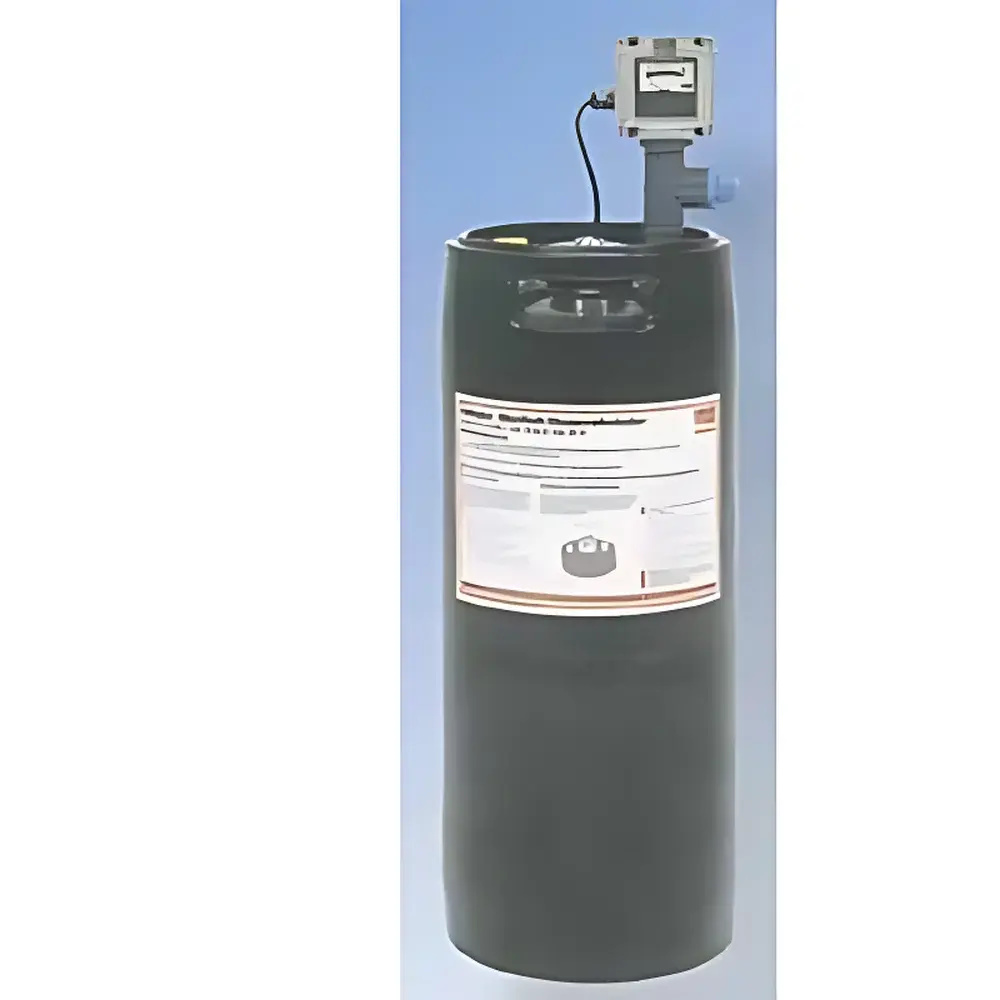
Behr Coated Stainless Steel Mixed-Bed Ion Exchange Cartridge System
| Origin | Germany |
|---|---|
| Manufacturer Type | Authorized Distributor |
| Origin Category | Imported |
| Model | Behr Coated Stainless Steel Mixed-Bed Ion Exchange Cartridge System |
| Purity Grade | ASTM Type I Ultra-Pure Water |
| Resistivity | 18.2 MΩ·cm @ 25°C |
| Heavy Metals & Soluble Silica | < 0.1 ppb |
| Total Organic Carbon (TOC) | < 3 ppb |
| Microbial Count / Endotoxins | < 0.001 EU/mL |
| Particles (>0.1 µm) | < 1 particle/mL |
| Max. Flow Rate | 500 L/h |
| Operating Pressure | Up to 10 bar (permanent) |
| Conductivity Monitoring Threshold | 20 µS/cm (configurable limit switch) |
| Enclosure Material | V4A (1.4404/1.4435) stainless steel with vulcanized polyurethane coating |
| Structural Protection | Vulcanized elastomeric collars at top/bottom |
| Integrated Conductivity Sensor | Pre-installed, supports local display and remote signal output (4–20 mA or digital interface) |
Overview
The Behr Coated Stainless Steel Mixed-Bed Ion Exchange Cartridge System is an engineered solution for continuous production of ASTM Type I ultra-pure water in laboratory and pilot-scale analytical environments. Designed for integration into multi-stage purification trains—typically downstream of reverse osmosis (RO) and upstream of UV oxidation or ultrafiltration—the system employs a dual-resin mixed-bed configuration (strong acid cation and strong base anion exchange resins) housed within a pressure-rated, corrosion-resistant cartridge vessel. Its core function relies on stoichiometric ion exchange kinetics to remove residual ionic contaminants—including Na⁺, Cl⁻, Ca²⁺, SO₄²⁻, silica species, and trace heavy metals—achieving resistivity up to 18.2 MΩ·cm at 25°C and TOC levels below 3 ppb. The system operates under dynamic flow conditions without requiring external pressure regulation, accommodating variable municipal or RO feed pressures while maintaining consistent hydraulic distribution across the resin bed via an integrated flow-distribution manifold.
Key Features
- V4A (1.4404/1.4435) stainless steel housing with vulcanized polyurethane coating—provides long-term resistance to pitting, crevice corrosion, and surface oxidation in humid or chloride-rich ambient environments.
- Structurally reinforced design: vulcanized rubber collars at top and base absorb mechanical shock during handling and installation; recessed ergonomic handle enables safe manual transport without compromising vessel integrity.
- Full-pressure compatibility: certified for continuous operation at 10 bar (145 psi), eliminating need for pressure-reducing valves when connected directly to building water mains or high-output RO systems.
- Integrated conductivity monitoring: factory-calibrated sensor with analog (4–20 mA) and/or digital output supports real-time water quality verification and automated endpoint detection.
- Configurable endpoint control: programmable limit switch triggers electromagnetic valve closure at user-defined conductivity threshold (default: 20 µS/cm), ensuring consistent batch-to-batch purity and preventing resin exhaustion breakthrough.
- Optimized hydraulic design: precision-machined distributor plate ensures uniform flow velocity and minimizes channeling, maximizing effective resin utilization and extending service life per cartridge.
Sample Compatibility & Compliance
The system is compatible with deionized (DI) or RO permeate feedwater meeting minimum inlet specifications: pH 5.0–8.5, total dissolved solids (TDS) < 50 ppm, free chlorine < 0.1 ppm, and particulate load < 1 µm. It complies with ISO 3696:1987 (Water for analytical laboratory use) and ASTM D1193-20 (Standard Specification for Reagent Water), supporting production of Type I water required for HPLC mobile phase preparation, ICP-MS calibration, cell culture media formulation, and semiconductor wafer rinsing. The conductive loop and endpoint logic architecture are designed to support GLP/GMP audit trails when integrated with compliant SCADA or LIMS platforms. While not inherently 21 CFR Part 11–compliant, its analog/digital outputs facilitate validated data capture in regulated environments when paired with qualified acquisition hardware and software.
Software & Data Management
The Behr system operates as a standalone hardware module but interfaces seamlessly with third-party laboratory infrastructure. Conductivity signals are transmitted via industrial-grade 4–20 mA current loop or optional RS-485 Modbus RTU protocol, enabling integration into PLC-based water management systems or centralized monitoring dashboards. No proprietary software is required for basic operation; however, OEM-configurable parameters—including alarm thresholds, hold times, and valve actuation delays—may be adjusted using handheld configurators or web-enabled gateways compliant with IEC 62443 cybersecurity guidelines. All endpoint events (e.g., conductivity breach, valve closure) generate timestamped digital logs suitable for inclusion in electronic batch records when connected to validated data historians.
Applications
- Final polishing stage in central ultra-pure water (UPW) distribution systems for analytical laboratories.
- Point-of-use (POU) purification for critical instruments including LC-MS, GC-MS, and atomic absorption spectrometers.
- Preparation of reagent-grade solvents and standards in QC/QA labs adhering to USP and EP 2.2.43 water quality requirements.
- Support of low-particulate applications such as nanofiltration membrane testing and microfluidic device cleaning.
- Backup or redundancy modules in GMP-compliant pharmaceutical water systems where resin-based polishing must meet strict microbial and endotoxin limits (<0.001 EU/mL).
FAQ
What feedwater quality is required to achieve Type I water performance?
Feed must be pre-treated by RO or EDI to reduce TDS to <50 ppm and eliminate oxidants (e.g., chlorine, ozone); residual hardness and silica must remain below resin capacity limits to avoid premature exhaustion.
Can this unit be installed vertically or horizontally?
Installation must be vertical only—orientation is critical for uniform resin packing and laminar flow distribution; horizontal mounting invalidates performance certification and voids warranty.
How often does the mixed-bed cartridge require replacement?
Service life depends on feedwater ionic load and daily throughput; typical ranges are 1,200 L (E10dK), 2,800 L (E28dK), or 6,000 L (E60dK) at 10°dH hardness—monitoring conductivity trend is essential for predictive maintenance.
Is the polyurethane coating FDA-compliant for pharmaceutical use?
The coating meets EU Regulation (EC) No. 1935/2004 for food-contact materials and is inert under standard UPW operating conditions; full USP Class VI biocompatibility documentation is available upon request for GMP validation.
Does the system include validation documentation (DQ/IQ/OQ)?
Factory test reports (including pressure test certificates, conductivity calibration records, and material traceability) are supplied; site-specific IQ/OQ protocols must be developed per client’s validation master plan and executed with qualified personnel.



