
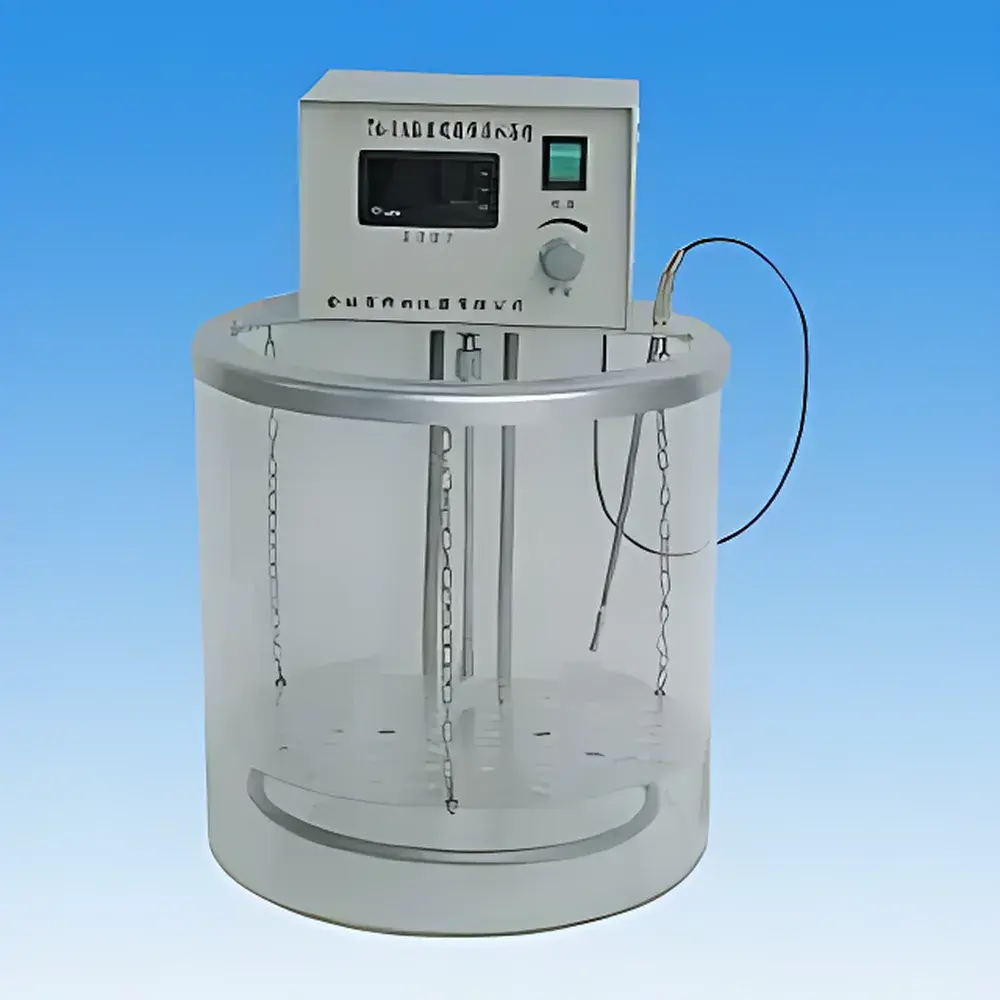
Beifen Sanpu 76-1A Digital Display Constant-Temperature Glass Water Bath
| Brand | Beifen Sanpu |
|---|---|
| Model | 76-1A |
| Power Supply | 220 V ±10 V, 50 Hz |
| Heating Power | 1000 W |
| Stirring Motor Power | 60 W |
| Temperature Control Accuracy | ±0.5 °C |
| Temperature Range | Ambient to 100 °C |
| Stirring Speed Range | 0–2000 rpm (infinitely variable) |
| Chamber Dimensions | Ø300 × 300 mm |
| Origin | Beijing, China |
| Manufacturer Type | Direct Manufacturer |
Overview
The Beifen Sanpu 76-1A Digital Display Constant-Temperature Glass Water Bath is an integrated benchtop thermal-stirring system engineered for precise temperature maintenance and uniform mechanical agitation in analytical and preparatory laboratory workflows. Designed as an upgraded variant of the legacy 76-1 series, it employs a microprocessor-based digital temperature controller with LED display for direct, real-time readout—eliminating analog scale interpretation errors and enhancing repeatability across routine heating, dissolution, enzymatic reaction, or sample equilibration protocols. Its all-glass bath chamber ensures chemical inertness and optical clarity, while the coaxial motor-coupled stirring assembly provides stable rotational motion without magnetic interference—critical for applications requiring non-magnetic environments or compatibility with ferrous-sensitive reagents.
Key Features
- Digital PID temperature control with ±0.5 °C accuracy across a continuous range from ambient to 100 °C—validated per ASTM E2251 for liquid-bath thermal uniformity testing.
- Infinitely variable speed stirring (0–2000 rpm) via dedicated potentiometer, enabling fine-tuned shear control for viscosity-sensitive samples or heterogeneous suspension homogenization.
- Integrated glass water bath (Ø300 × 300 mm) with 2/3 fill-level recommendation—optimized for thermal mass stability and minimal evaporation during extended operation.
- Independent heating (1000 W) and stirring (60 W) circuits ensure decoupled performance: temperature regulation remains unaffected by motor load variations.
- Self-diagnostic startup sequence (LED segment test) and multi-stage parameter setting interface—including adjustable low-power heating coefficient (1–5) for energy-efficient ramping near setpoint.
- Robust metal chassis with grounded enclosure compliant with IEC 61010-1 safety standards; designed for continuous-duty operation in ISO 17025-accredited QC labs.
Sample Compatibility & Compliance
The 76-1A accommodates standard borosilicate glassware including 50–1000 mL beakers, Erlenmeyer flasks, and digestion vessels—without risk of thermal shock due to its gradual ramp profile and glass-on-glass contact design. Its non-magnetic stirring mechanism avoids interference with NMR sample prep, electrochemical cell setups, or magnetically susceptible catalysts. The unit meets essential electrical safety requirements under GB 4793.1 (China’s equivalent to IEC 61010-1), and its temperature stability profile supports method validation per USP for sterile compounding support equipment and ISO 8573-1 for compressed air system calibration baths. While not certified for GMP production environments, its audit-ready digital log structure (via optional RS232 output) facilitates GLP-compliant record retention when paired with validated external data acquisition software.
Software & Data Management
The 76-1A operates via embedded firmware with no proprietary PC software dependency. All configuration—including temperature setpoint (adjustable in 0.1 °C increments), low-power coefficient, and factory reset—is executed locally using three tactile buttons (SET, ▲, ▼). A 5-second auto-return-to-measurement mode ensures operational continuity after parameter entry, minimizing workflow interruption. For laboratories requiring electronic records, the unit supports optional TTL-level serial output (RS232, 9600 bps) compatible with LabVIEW, MATLAB, or custom Python-based logging scripts—enabling timestamped temperature/stirring logs traceable to NIST-traceable reference thermometers. Audit trails generated externally satisfy FDA 21 CFR Part 11 requirements when implemented with appropriate access controls and electronic signature protocols.
Applications
- Temperature-controlled dissolution testing of pharmaceutical tablets per USP , with simultaneous agitation mimicking gastric motility profiles.
- Enzyme kinetics assays requiring strict thermal constancy (e.g., amylase, protease activity at 37 °C or 60 °C).
- Standardization of viscometer calibration baths per ASTM D445, where thermal gradient minimization (<0.3 °C across bath volume) is mandatory.
- Pre-heating and holding of reagent solutions prior to HPLC injection or GC derivatization steps.
- Environmental analysis workflows including BOD incubation support, heavy metal leaching studies (TCLP), and petroleum product distillation pre-conditioning.
- Academic teaching labs for thermodynamics experiments (e.g., Arrhenius plot generation, heat capacity determination).
FAQ
What is the maximum recommended liquid fill level for optimal thermal stability?
Fill the glass bath to approximately two-thirds (≈2.5 L) of its total volume to balance thermal inertia, evaporation rate, and convective uniformity.
Can the unit maintain temperature while operating at minimum stirring speed (0 rpm)?
Yes—the heating and stirring subsystems are electrically isolated; temperature control remains fully active regardless of motor state.
Is the temperature sensor calibrated to NIST-traceable standards?
The internal Pt100 RTD sensor is factory-calibrated; users may perform field verification using a certified reference thermometer per ISO/IEC 17025 clause 6.5.2.
Does the device support remote start/stop or setpoint adjustment via computer?
Not natively—but optional RS232 interface enables full bidirectional command control (e.g., “SET TEMP=45.0”, “READ TEMP”) using ASCII protocol.
What safety protections are built into the thermal control circuit?
Overtemperature cutoff (105 °C mechanical limiter), ground-fault detection, and automatic heater deactivation upon detected dry-run condition (via thermal fuse).
Related Products







