
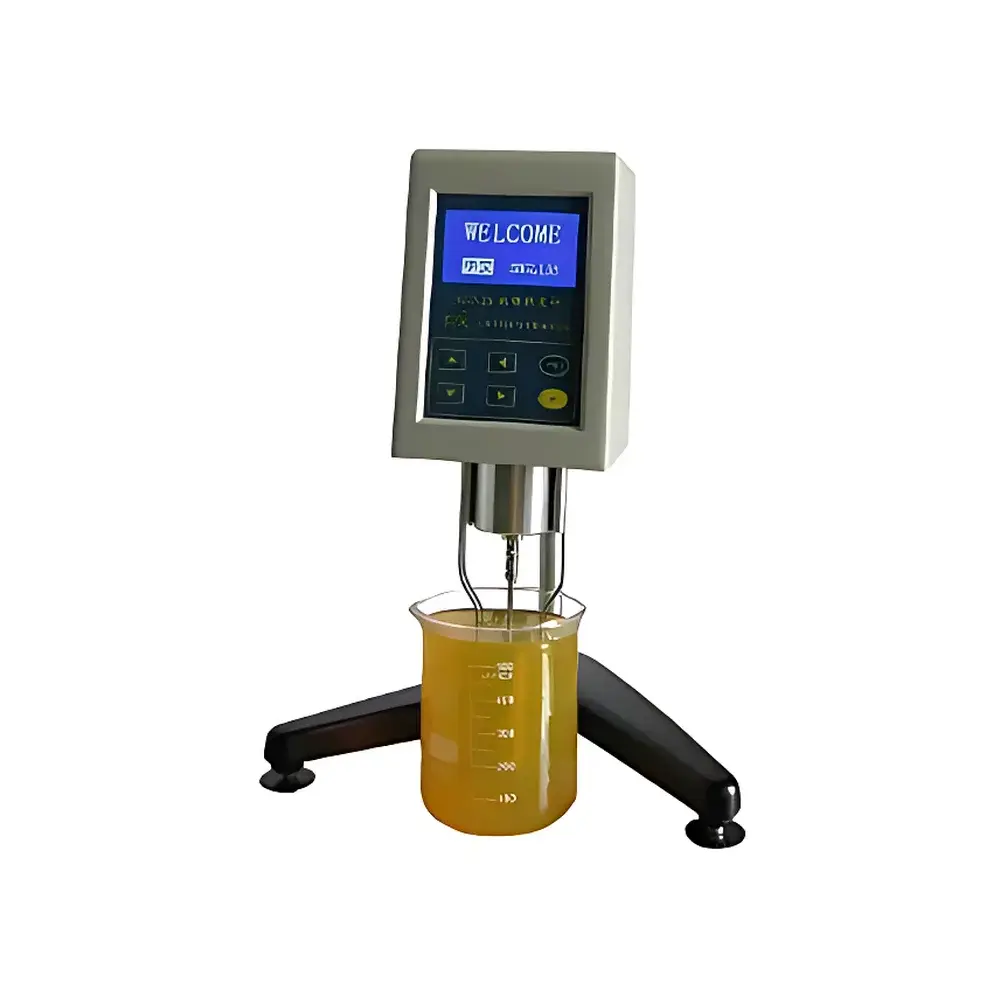
Beifen Sanpu NDJ-8S Digital Rotational Viscometer for Mineral Oil Testing
| [Brand | Beifen Sanpu |
|---|---|
| Origin | Hebei, China |
| Manufacturer Type | Direct Manufacturer |
| Instrument Type | Rotational Viscometer |
| Viscosity Range | 10–2×10⁶ mPa·s |
| Rotors | #1–#4 (standard), #0 optional |
| Speed Settings | 0.3, 0.6, 1.5, 3, 6, 12, 30, 60 rpm |
| Accuracy | ±2% for Newtonian fluids |
| Power Supply | AC 220 V ±10%, 50 Hz ±10% |
| Operating Temperature | 5–35 °C, RH ≤80% |
| Dimensions | 370 × 325 × 280 mm |
| Weight | 6.8 kg] |
Overview
The Beifen Sanpu NDJ-8S Digital Rotational Viscometer is a precision-engineered instrument designed for reliable viscosity characterization of mineral oils, lubricants, and other industrial fluids under controlled laboratory or quality control conditions. Based on the Couette principle of rotational rheometry, the NDJ-8S measures dynamic viscosity by quantifying the torque required to rotate a calibrated spindle (rotor) at a defined angular velocity within a stationary fluid sample. The resulting viscous drag is converted into a digital viscosity reading (in mPa·s) via high-resolution torque sensing and real-time microprocessor-based signal processing. Unlike capillary or falling-ball methods, rotational viscometry enables direct measurement of both Newtonian viscosity and apparent viscosity of non-Newtonian fluids—critical for assessing shear-thinning behavior in lubricating oils, polymer-modified bitumens, and formulated coatings. Its extended low-speed capability (down to 0.3 rpm) supports accurate characterization of highly viscous or time-dependent materials, while its wide dynamic range (10–2×10⁶ mPa·s) accommodates applications from light hydraulic oils to heavy residual fuels.
Key Features
- Microprocessor-controlled rotational drive system with eight discrete speed settings (0.3, 0.6, 1.5, 3, 6, 12, 30, and 60 rpm) for precise shear rate selection
- Four standardized spindles (#1–#4) enabling 32 unique rotor–speed combinations; optional #0 spindle available for sub-1 mPa·s measurements
- High-contrast blue-backlit LCD display showing real-time viscosity value, selected rotor number, rotational speed, % full-scale indication, and stability status
- Integrated torque sensor with analog-to-digital conversion and automatic zero compensation for improved repeatability
- Rugged mechanical architecture with aluminum alloy housing and precision-machined bearing assembly for long-term dimensional stability
- No external PC or software required for basic operation—fully self-contained measurement interface with intuitive button navigation
Sample Compatibility & Compliance
The NDJ-8S is validated for use with transparent to opaque Newtonian and non-Newtonian liquids across diverse industrial sectors—including petroleum refining, lubricant formulation, paint & coating QC, pharmaceutical excipient testing, and food-grade oil verification. It complies with fundamental principles outlined in ASTM D2983 (low-temperature viscosity of lubricants), ISO 3219 (rotational viscometry of polymer solutions), and GB/T 265 (Chinese national standard for petroleum product kinematic viscosity determination). While not inherently 21 CFR Part 11 compliant in standalone mode, the instrument supports GLP/GMP-aligned documentation when paired with external data logging systems that implement audit trails, electronic signatures, and secure user access controls. Sample volume requirements are minimal (typically 15–20 mL depending on rotor geometry), and temperature control is achieved externally using standard water baths or Peltier-equipped sample holders (not included).
Software & Data Management
The NDJ-8S operates as a stand-alone viscometer without proprietary software dependency. All measurement parameters—including rotor ID, speed, viscosity, and %FS—are displayed and retained on-screen during active measurement. For traceable data archiving, users may manually record values or integrate the instrument into broader LIMS/QMS workflows via RS-232 serial output (optional interface module). When connected, raw torque and timing signals can be captured at 10 Hz sampling frequency, supporting post-acquisition analysis of transient flow behavior (e.g., thixotropy recovery, yield stress estimation). Exported datasets conform to CSV format and are compatible with Excel, MATLAB, or industry-standard statistical process control (SPC) platforms. No firmware updates or cloud connectivity are implemented—ensuring deterministic performance and minimizing cybersecurity exposure in regulated environments.
Applications
- Mineral oil and base stock viscosity grading per API RP 14E and ISO 8503-2 specifications
- Quality assurance of turbine, hydraulic, and gear oils during batch release testing
- Stability evaluation of emulsified cutting fluids and metalworking lubricants
- Formulation development of asphalt binders and polymer-modified bitumens
- Viscosity profiling of cosmetic emulsions, pharmaceutical suspensions, and edible oils
- Monitoring thermal degradation of used lubricants via trending of viscosity drift over service life
FAQ
What is the minimum measurable viscosity with the NDJ-8S?
The standard configuration (with #1 rotor at 60 rpm) achieves a lower limit of 10 mPa·s. With the optional #0 rotor and lowest speed (0.3 rpm), viscosity down to approximately 0.1 mPa·s can be measured.
Is calibration traceable to national standards?
Yes—calibration is performed using NIST-traceable silicone oil standards (e.g., Cannon N47, N100, N1000) prior to shipment. Certificate of Conformance includes uncertainty values per ISO/IEC 17025 guidelines.
Can the NDJ-8S measure yield stress?
No—it does not provide controlled-stress ramping or oscillatory functionality. Yield stress estimation requires extrapolation from multiple low-shear-rate points or complementary instrumentation such as a controlled-stress rheometer.
How often should routine verification be performed?
Daily verification with a certified reference fluid is recommended before first use and after any environmental shift exceeding ±5 °C. Full recalibration is advised annually or after mechanical impact.
Does the instrument support continuous monitoring or timed readings?
It provides instantaneous readings only. Time-resolved viscosity tracking requires external data acquisition hardware interfaced via RS-232.



