
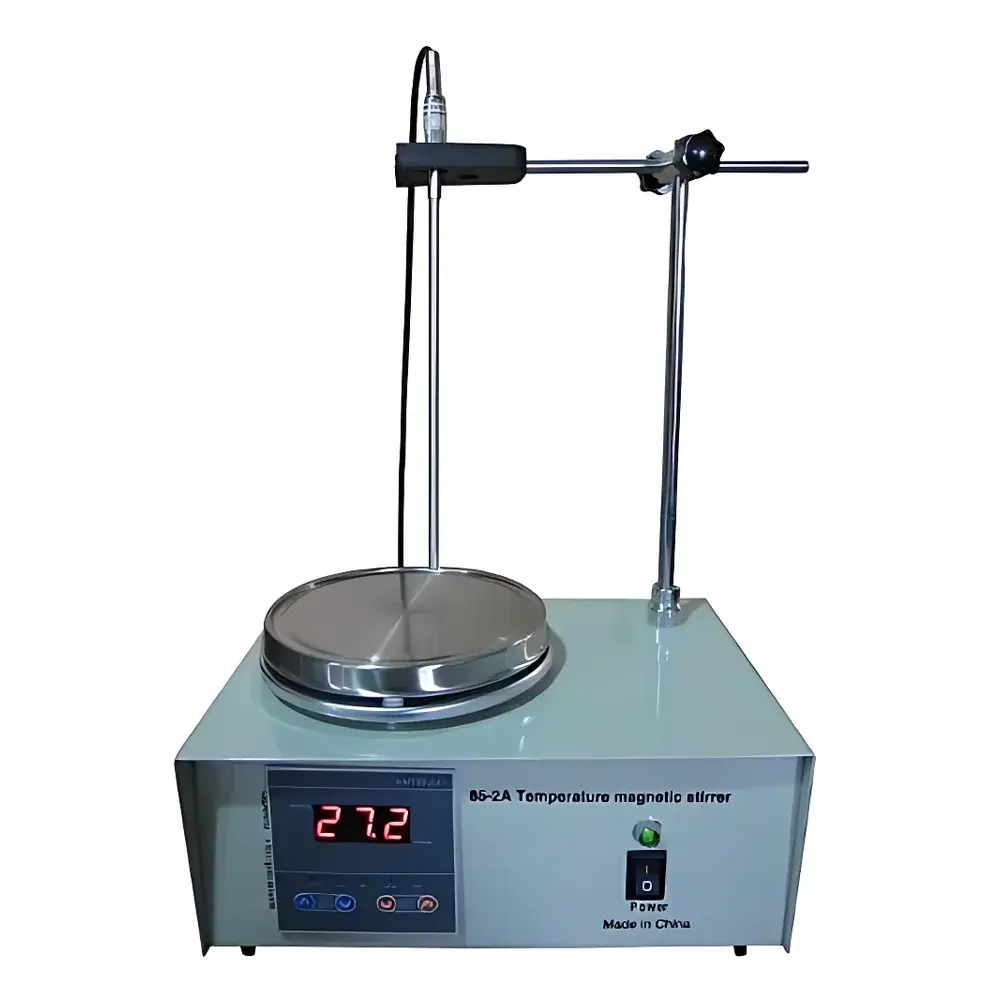
Beifen Sanpu 85-2A Digital Display Magnetic Hotplate Stirrer (Export Model)
| Brand | Beifen Sanpu |
|---|---|
| Origin | Beijing, China |
| Manufacturer Type | Direct Manufacturer |
| Country of Origin | China |
| Model | 85-2A |
| Power Supply | 220 V / 50 Hz |
| Motor Speed Range | 0–2400 rpm (99-step digital adjustment) |
| Motor Power | 15 W |
| Heating Power | 300 W |
| Temperature Control Range | Ambient to 99.9 °C (digital LED display) |
| Construction | Cold-rolled steel housing with high-temperature epoxy powder coating |
| Safety | Grounded design, thermal cut-off protection, non-operational heating interlock |
Overview
The Beifen Sanpu 85-2A Digital Display Magnetic Hotplate Stirrer is an entry-level yet robust benchtop laboratory instrument engineered for precise temperature-controlled mixing in academic, industrial, and quality control laboratories. It operates on the principle of magnetic coupling—where a rotating permanent magnet beneath the ceramic-coated aluminum plate induces synchronous rotation of a PTFE- or glass-coated magnetic stir bar immersed in the sample vessel. Integrated resistive heating elements provide uniform thermal distribution across the plate surface, while microprocessor-based PID temperature control ensures stable setpoint maintenance within ±0.5 °C under typical load conditions. Designed specifically for international markets, the 85-2A meets IEC 61010-1 safety requirements for laboratory electrical equipment and complies with RoHS directives for hazardous substance restrictions.
Key Features
- 99-step digitally adjustable speed control (0–2400 rpm), enabling fine-tuned optimization for low-viscosity aqueous solutions up to moderate-thickness polymer dispersions
- LED-display digital temperature controller with 0.1 °C resolution and ambient-to-99.9 °C operating range—ideal for applications requiring gentle warming during dissolution, titration prep, or reagent equilibration
- Durable cold-rolled steel chassis with high-temperature epoxy powder coating for long-term resistance to chemical splashes, humidity, and mechanical abrasion
- Brushless permanent-magnet DC motor rated for >10,000 hours of continuous no-load operation; low-noise, vibration-free performance suitable for shared lab environments
- Interlocked safety architecture: heating function automatically disables when stirring stops or if the unit detects abnormal thermal rise; grounding terminal included per IEC 61010-1
- Non-slip ceramic-aluminum top plate with concentric alignment markings to ensure optimal stir bar centering and torque transfer efficiency
Sample Compatibility & Compliance
The 85-2A accommodates standard laboratory glassware including 50–1000 mL beakers and Erlenmeyer flasks. Compatible stir bars range from 15 mm to 40 mm in length, with PTFE-coated variants recommended for acidic or alkaline media. The unit is validated for use with aqueous, organic, and mild solvent-based systems—but not intended for volatile, flammable, or highly corrosive solvents without external fume hood integration. From a regulatory standpoint, its design supports GLP-compliant workflows: digital temperature and speed settings are manually entered and visually confirmed, with no data logging capability—making it appropriate for non-audited preparatory steps in ISO/IEC 17025-accredited labs. It does not meet FDA 21 CFR Part 11 requirements due to absence of electronic audit trail or user authentication.
Software & Data Management
The 85-2A is a standalone analog-digital hybrid instrument with no embedded software, network interface, or data export functionality. All operational parameters—including target temperature and selected rpm—are set via front-panel push-button controls and displayed on a dual-digit LED screen. No firmware updates, remote configuration, or PC connectivity are supported. This architecture minimizes failure points and eliminates cybersecurity exposure, aligning with institutional IT policies that restrict networked peripherals in core analytical zones. Users maintain full manual control and visual verification at every stage—consistent with SOP-driven environments where traceability relies on handwritten logbooks or LIMS-integrated procedural documentation.
Applications
- Preparation of calibration standards and buffer solutions in environmental testing labs (e.g., EPA Method 300.0, ASTM D1129)
- Homogenization of catalyst suspensions prior to XRD or SEM sample mounting
- Controlled warming of culture media in microbiology QA/QC workflows
- Facilitation of solid-phase extraction (SPE) cartridge conditioning steps
- Accelerated aging studies of coatings and adhesives under isothermal agitation
- Supporting ASTM E2913-22 (Standard Practice for Determining the Stability of Emulsions) via reproducible shear input at defined temperatures
FAQ
What is the maximum recommended vessel size for stable operation?
For consistent stir bar engagement and thermal uniformity, use vessels ≤800 mL with flat-bottom geometry. Larger volumes require extended stabilization time and may exceed effective torque delivery at higher viscosities.
Can this unit be used with flammable solvents like acetone or ethanol?
No. The 85-2A lacks explosion-proof certification and intrinsic safety design. Operation with flammable liquids must occur inside a certified fume hood with additional spark mitigation measures.
Is the temperature probe removable or integrated?
The stainless-steel temperature probe is permanently affixed and non-removable; it is calibrated at the factory and not field-serviceable.
Does the unit include over-temperature protection?
Yes—a redundant bimetallic thermal cutoff interrupts power if plate surface temperature exceeds 110 °C, independent of the digital controller.
What maintenance is required for long-term reliability?
Wipe the plate surface with isopropyl alcohol after each use; inspect stir bars for coating integrity quarterly; verify grounding continuity annually per institutional electrical safety protocols.



