
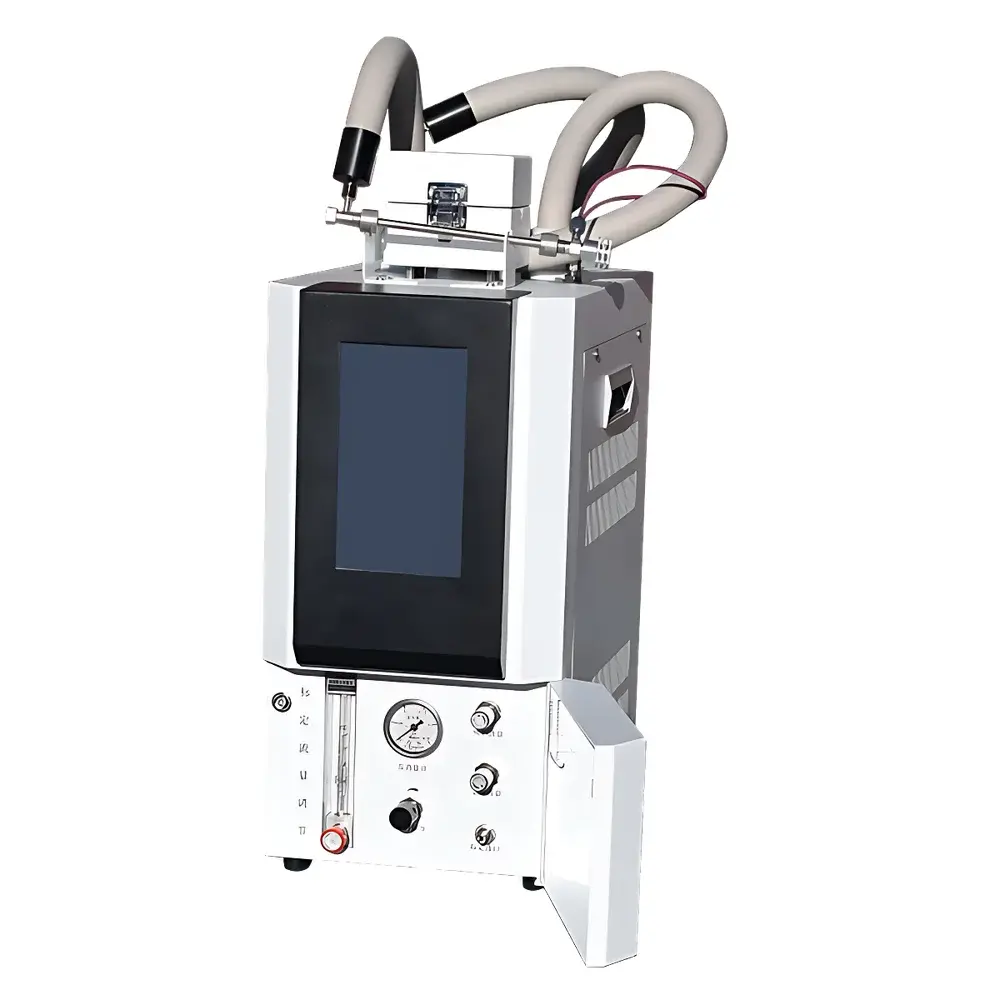
Beifen Sanpu ABTDS-3430 Dual-Stage Thermal Desorber with Cryogenic Trap
| Brand | Beifen Sanpu |
|---|---|
| Origin | Beijing, China |
| Manufacturer Type | OEM Manufacturer |
| Instrument Type | Dual-Stage Thermal Desorber |
| Desorption Temperature Range | Ambient to 450 °C |
| Cold Trap Temperature Range | −35 °C to Ambient |
| Desorption Recovery Rate | >99% (compound-dependent) |
| Sample Position Capacity | 1 tube |
Overview
The Beifen Sanpu ABTDS-3430 Dual-Stage Thermal Desorber with Cryogenic Trap is an engineered solution for trace-level volatile organic compound (VOC) and semi-volatile organic compound (SVOC) analysis in environmental, industrial hygiene, and materials testing laboratories. Designed around a two-stage thermal desorption principle—primary thermal release followed by cryofocusing in a Peltier-cooled trap—the instrument enables high-fidelity transfer of analytes into gas chromatography (GC) or GC–MS systems with minimal band broadening. Its core architecture supports quantitative compliance with internationally recognized environmental monitoring standards, including HJ 644–2013, HJ 583–2010, HJ 734–2014, GB/T 18883–2002, and GB 50325–2010. The ABTDS-3430 integrates precise temperature control across four independently regulated zones (primary desorption oven, valve zone, transfer line, and secondary desorption/cryofocus zone), ensuring reproducible analyte release, focusing, and injection without cold spots or memory effects.
Key Features
- Integrated dual-stage desorption workflow: primary thermal release at up to 450 °C followed by cryofocusing at −35 °C to ambient, enabling sharp chromatographic peaks (peak width <3 s) and enhanced sensitivity
- Peltier-based electronic cooling system eliminates reliance on liquid nitrogen or compressed refrigerants—reducing operational cost and increasing laboratory safety
- Four-zone independent temperature control (desorption oven, six-port valve, transfer line, secondary desorption zone), each adjustable in 1 °C increments with accuracy better than ±0.5 °C
- High-inertness sample pathway: all internal tubing and valves constructed from silanized stainless steel or fused silica with deactivation treatment to prevent adsorption, carryover, or catalytic degradation
- Motor-driven high-temperature six-port valve (rated to 240 °C) housed within thermally insulated enclosure to eliminate transmission cold points
- Automated sequence programming: full cycle control—including primary desorption, purge, cryotrap focusing, rapid secondary desorption (>3000 °C/min), GC injection, and post-run backflush—executed via intuitive touchscreen interface
- Dedicated calibration mode with programmable simulated sampling flow (0–160 mL/min) for direct preparation of external calibration curves using standard gas or permeation tubes
- Backflush capability for both transfer line and valve assembly (0–100 mL/min, continuously adjustable) to minimize cross-contamination between samples
- Universal GC interface compatibility: includes mechanically and electrically matched adapters for Agilent, Thermo Fisher, Shimadzu, PerkinElmer, and domestic GC platforms
Sample Compatibility & Compliance
The ABTDS-3430 accepts standard 1/4″ OD adsorbent tubes (≤6.5 mm diameter, ≥150 mm length), compatible with common sorbents including Tenax TA, Carbopack B/C, Carboxen, and graphitized carbon blacks. It supports both single-tube and sequential multi-tube configurations (via optional accessories). The system meets functional requirements for method validation under ISO/IEC 17025 and supports audit-ready operation in GLP- and GMP-regulated environments. While not pre-certified to FDA 21 CFR Part 11, its microprocessor-based logging—recording all temperature setpoints, timing events, valve actuations, and error flags—provides traceable raw data suitable for regulatory review when paired with compliant LIMS or chromatography data systems.
Software & Data Management
Operation is managed via a built-in 7-inch full-color LCD touchscreen running embedded real-time OS. All method parameters—including temperature ramps, dwell times, flow rates, and valve switching sequences—are stored as editable protocols. The interface displays live status animation of the desorption cycle and logs timestamped event records (e.g., “Cold trap reached −35 °C at 14:22:07”). Data export is supported via USB port in CSV format for integration with third-party chromatography data systems (CDS) such as OpenLab CDS, Chromeleon, or GCsolution. No proprietary software installation is required on host PCs; remote triggering is possible via TTL or RS232 signals synchronized with GC start commands.
Applications
The ABTDS-3430 delivers validated performance in regulatory and research applications requiring ultra-trace VOC quantification, including: indoor air quality assessment per GB/T 18883–2002; vehicular cabin emissions testing per HJ/T 400–2007; ambient air monitoring of benzene, toluene, ethylbenzene, and xylenes (BTEX) per HJ 583–2010; building material emission screening per GB 50325–2010; and stationary source stack testing per HJ 734–2014. It is also employed in food packaging migration studies, polymer off-gassing characterization, and forensic fire debris analysis where thermal stability and quantitative recovery of low-concentration analytes are critical.
FAQ
What adsorbent tubes are compatible with the ABTDS-3430?
Standard 1/4″ OD stainless steel or glass tubes (≤6.5 mm outer diameter, ≥150 mm length) packed with Tenax TA, Carbopack series, Carboxen, or mixed-bed sorbents.
Does the instrument support automated batch processing?
The base configuration accommodates one tube per run; optional auto-sampler modules (not included) extend capacity to 20+ positions.
Can the cold trap temperature be set below −35 °C?
No—the Peltier cooling module is rated for a minimum of −35 °C; lower temperatures require external cryogens not supported by this platform.
Is method validation documentation provided?
Yes—factory test reports include temperature uniformity mapping, recovery testing (using benzene/methanol reference), and RSD verification (≤2.5% at 0.05 μg level).
How is system maintenance performed?
Valve seals and transfer-line ferrules are user-replaceable; cold trap cleaning and sorbent tube conditioning protocols are detailed in the operator manual. No routine calibration is required beyond annual verification using NIST-traceable standards.





