
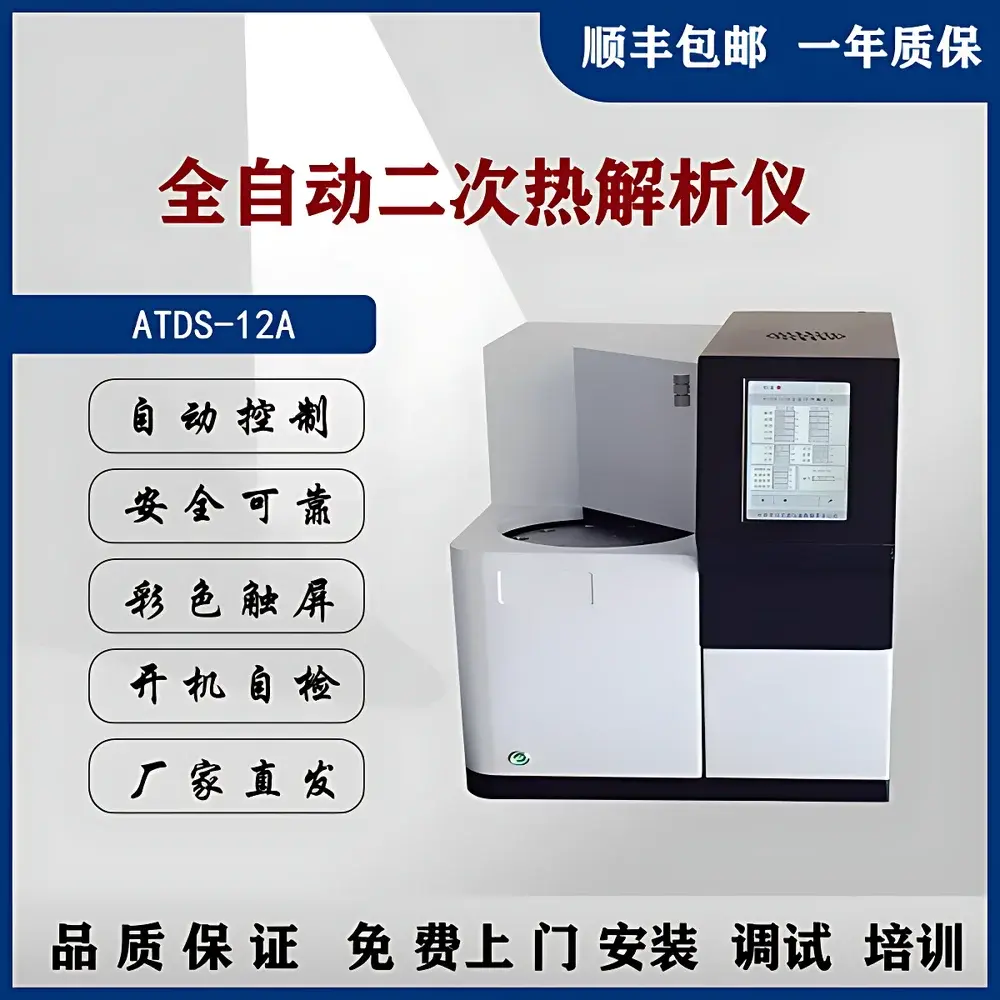
Beifen Sanpu ADTS-12A Fully Automated 12-Position Two-Stage Thermal Desorber
| Brand | Beifen Sanpu |
|---|---|
| Origin | Beijing, China |
| Manufacturer Type | Direct Manufacturer |
| Instrument Type | Two-Stage Thermal Desorber |
| Model | ADTS-12A |
| Automation Level | Fully Automated |
| Primary Desorption Temp Range | Ambient to 450 °C |
| Valve Injection Zone Temp Range | Ambient to 260 °C |
| Transfer Line Temp Range | Ambient to 450 °C |
| Cold Trap Temp Range | −35 °C to Ambient |
| Temperature Control Accuracy | < ±0.5 °C |
| Desorption Recovery Rate | >99% (compound-dependent) |
| Sample Positions | 12 |
| Cold Trap Cooling Method | Semiconductor-based Electronic Cooling |
| Sample Tube Format | 1/4″ OD × 3.5″ (ASTM D6196-compliant) |
| Injection Mechanism | Motor-driven 6-port Valving |
| Dimensions (L×W×H) | 300 × 385 × 550 mm |
| Weight | ~32 kg |
Overview
The Beifen Sanpu ADTS-12A is a fully automated, two-stage thermal desorption system engineered for high-fidelity volatile and semi-volatile organic compound (VOC/SVOC) analysis in environmental, occupational health, food safety, and building material testing laboratories. It operates on the principle of cryo-focused, sequential thermal desorption: analytes pre-concentrated on sorbent tubes are first thermally released from the tube matrix (primary desorption), then refocused in a cryogenically cooled trap (cold trap), and finally rapidly injected—via flash heating—into a coupled gas chromatograph (GC) or GC-MS system. This two-stage architecture significantly enhances sensitivity, peak shape fidelity, and quantitative reproducibility compared to single-stage systems, particularly for low-concentration, high-boiling-point compounds up to 350 °C. Designed for compliance with ISO 16000-6, ASTM D6196, EPA TO-17, and Chinese HJ 644–2013 standards, the ADTS-12A delivers robust performance in routine regulatory monitoring workflows where trace-level accuracy and unattended operation are critical.
Key Features
- Fully automated 12-position sample carousel enabling unattended batch processing—ideal for high-throughput environmental labs conducting indoor air, ambient air, or material emission testing.
- Independent, precision temperature control across four critical zones: primary desorption oven (ambient to 450 °C), valve manifold (ambient to 260 °C), transfer line (ambient to 450 °C), and semiconductor-cooled cold trap (−35 °C to ambient), all adjustable in 1 °C increments.
- High-speed cold trap heating (>3000 °C/min ramp rate) ensures sharp, narrow analyte bands and minimal band broadening during transfer to the GC column.
- Motor-driven 6-port valving provides precise, wear-resistant, and repeatable injection timing—eliminating manual valve actuation errors and supporting method-defined backflush and purge cycles.
- Integrated flow control for both simulated sampling (0–160 mL/min) and post-desorption tube purging (0–500 mL/min), enabling optimization of analyte recovery and carryover mitigation per matrix type.
- Touchscreen interface with intuitive workflow navigation, real-time temperature/pressure monitoring, and method storage—designed for operator efficiency without requiring advanced programming skills.
Sample Compatibility & Compliance
The ADTS-12A accepts standard 1/4″ OD × 3.5″ stainless steel or quartz sorbent tubes (e.g., Tenax TA, Carbopack B/C, Carboxen 1000), compatible with EPA TO-17 and ISO 16000-6 tube specifications. Its validated recovery (>99% for benzene, toluene, ethylbenzene, xylenes, and other priority VOCs at µg-level spiking levels) supports compliance with national and international regulatory reporting requirements. The system’s RSD ≤2.5% (measured at 0.05 µg benzene in methanol) meets GLP data quality criteria for routine QC/QA applications. All temperature and timing parameters are logged with timestamps, facilitating audit readiness under ISO/IEC 17025 and CNAS-accredited laboratory frameworks.
Software & Data Management
The ADTS-12A operates via embedded firmware with local touchscreen control—no external PC required for basic operation. For integrated laboratory data management, it supports RS-232 and USB communication protocols, enabling seamless synchronization with third-party chromatography data systems (CDS) such as Thermo Chromeleon, Agilent OpenLab, or Shimadzu GC Solutions. Method parameters—including desorption times, trap hold durations, and valve sequencing—are exportable/importable as XML files, ensuring version-controlled method transfer across instruments. Audit trail functionality records all user actions, parameter changes, and run completions—supporting compliance with FDA 21 CFR Part 11 when deployed within validated CDS environments.
Applications
- Indoor air quality (IAQ) assessment per HJ 583–2010 and GB/T 18883–2022, including formaldehyde, TVOC, and aldehyde quantification.
- Building material emission testing (e.g., carpets, adhesives, particleboard) per GB 18580–2017 and ISO 16000-9.
- Food packaging migration studies targeting residual solvents and flavor compounds.
- Occupational exposure monitoring in industrial hygiene settings using NIOSH 1501/1600 methods.
- Atmospheric research involving speciated VOC profiling in ambient air canister samples.
FAQ
Is the ADTS-12A compatible with all major GC and GC-MS platforms?
Yes—the system features universal pneumatic and electrical interfaces and has been validated with Agilent, Thermo Fisher, Shimadzu, and PerkinElmer GC systems using standard TO-17-style connections.
Does it support cold trap modulation for enhanced resolution of co-eluting compounds?
No—the ADTS-12A employs a single-stage cryo-focusing trap optimized for sensitivity and reproducibility; it does not include modulator hardware for comprehensive two-dimensional GC coupling.
Can I use non-standard sorbent tubes, such as 1/8″ OD or custom-length formats?
Only 1/4″ OD × 3.5″ tubes are mechanically supported; deviation may compromise seal integrity, temperature uniformity, and desorption efficiency.
What maintenance is required to sustain long-term calibration stability?
Routine maintenance includes quarterly verification of cold trap minimum temperature, annual calibration of thermocouples per ISO 17025 procedures, and periodic replacement of septa and O-rings in the valve manifold.
Is remote monitoring or networked operation possible?
Local Ethernet or Wi-Fi connectivity is not built-in; however, optional OEM integration kits enable connection to lab-wide instrument networks via Modbus TCP or OPC UA upon request.
Related Products



