
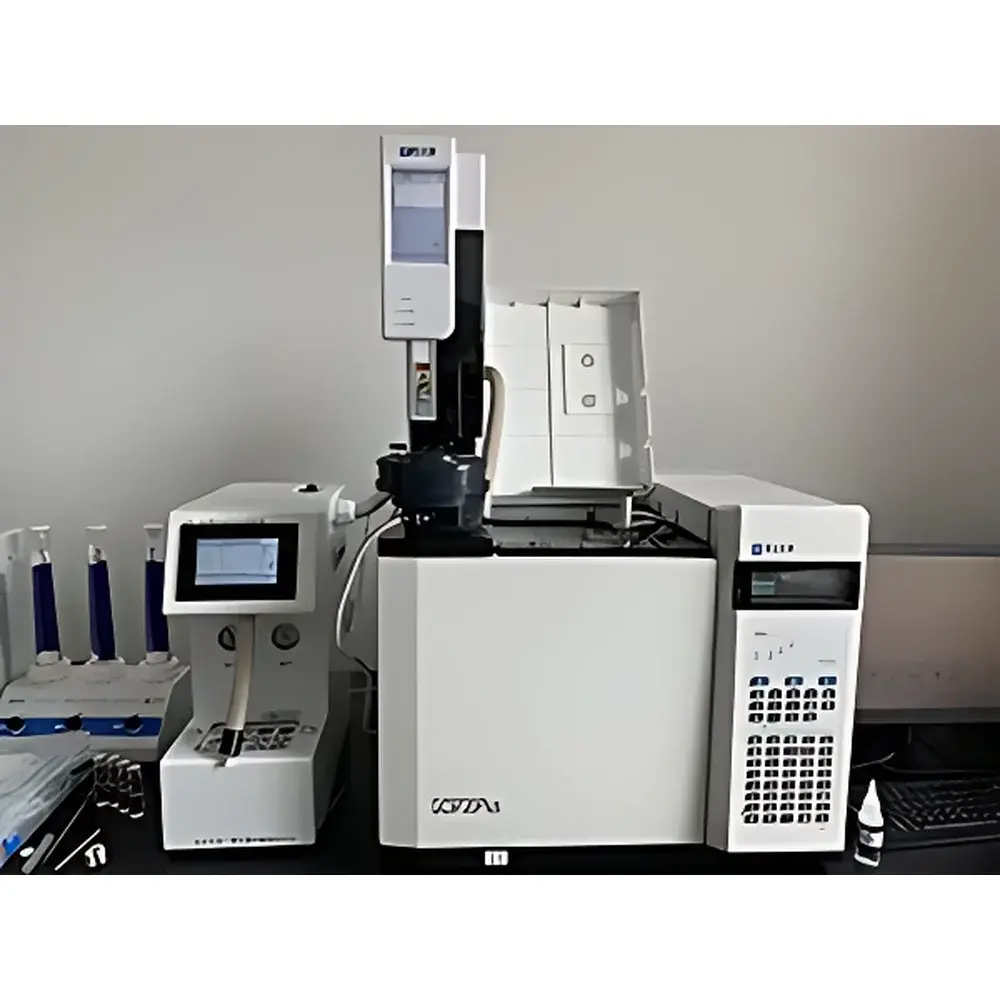
Beifen Sanpu AHS-10A Static Headspace Sampler for Residual Solvent Analysis in Pharmaceuticals
| Brand | Beifen Sanpu |
|---|---|
| Origin | Beijing, China |
| Manufacturer Type | Direct Manufacturer |
| Product Category | Domestic |
| Model | AHS-10A |
| Instrument Type | Static Headspace Sampler |
| Automation Level | Semi-Automatic |
| Vial Heating Range | Ambient to 200 °C (1 °C increments) |
| Valve & Transfer Line Temperature Control Range | 40–220 °C (±1 °C accuracy) |
| Sample Loop Volume | 1 mL |
| Vial Capacity | 12 positions |
| Compatible Vial Sizes | 10 mL or 20 mL |
Overview
The Beifen Sanpu AHS-10A is a precision-engineered static headspace sampler designed specifically for regulatory-compliant residual solvent analysis in pharmaceutical raw materials and finished dosage forms. It operates on the principle of equilibrium headspace sampling: volatile organic compounds—including methanol, ethanol, acetone, and methyl acetate—partition from the liquid or solid sample matrix into the gas phase above it at controlled temperature and time. This vapor-phase aliquot is then transferred via a thermostated valve and transfer line to a gas chromatograph (GC) for separation and quantification. The AHS-10A integrates seamlessly with FID- or TCD-equipped GC systems (e.g., GC-9860) and capillary columns such as DB-624, enabling robust, reproducible quantitation down to pharmacopeial limits (e.g., USP , Ph. Eur. 2.4.24, and ICH Q3C guidelines). Its architecture prioritizes thermal stability, inert flow paths, and minimal carryover—critical for trace-level analysis where detection limits must meet stringent thresholds (e.g., 0.3% for methanol, 0.5% for ethanol, acetone, and methyl acetate in APIs).
Key Features
- Thermally isolated 12-position vial carousel with independent ambient-to-200 °C heating control (1 °C resolution), ensuring precise equilibration across all samples.
- Separately regulated valve and transfer line zone (40–220 °C, ±1 °C stability), eliminating condensation and adsorption losses during sample introduction.
- 1 mL fixed-volume quantitative loop, calibrated for high volumetric repeatability and low inter-run variability.
- Semi-automatic operation with programmable sequence control—supports method-defined incubation, pressurization, sampling, and purge cycles without manual intervention per run.
- Chemically inert stainless-steel and SilcoNert®-treated flow path components minimize analyte degradation and surface adsorption of polar solvents.
- Compact benchtop footprint (W × D × H: 360 × 420 × 450 mm) and low power consumption (<300 W) facilitate integration into QC laboratories operating under ISO/IEC 17025 or GMP environments.
Sample Compatibility & Compliance
The AHS-10A accommodates standard 10 mL and 20 mL crimp-top headspace vials with PTFE/silicone septa, supporting aqueous, semi-solid (e.g., lyophilized powders), and viscous API suspensions. Method development aligns with ICH Q3C(R8) classification of Class 2 and 3 solvents and supports validation per USP (method verification) and (analytical procedure lifecycle). Data integrity is maintained through audit-trail-ready operation logs (when paired with compliant GC software), satisfying FDA 21 CFR Part 11 requirements for electronic records when deployed in regulated environments. Instrument qualification documentation (DQ/IQ/OQ) templates are provided to support GLP and GMP laboratory compliance.
Software & Data Management
While the AHS-10A operates via front-panel keypad and LCD interface, it features RS-232 and optional USB connectivity for synchronization with third-party GC data systems (e.g., Chromeleon, OpenLab CDS, Empower). All method parameters—including vial temperature, equilibration time, pressurization pressure, loop fill time, and injection duration—are fully programmable and stored in non-volatile memory. System event logs record timestamps for each vial position’s cycle start/end, temperature deviations (>±0.5 °C), and valve actuation status—enabling root-cause analysis during OOS investigations. Raw instrument metadata can be exported in CSV format for LIMS integration and trend analysis.
Applications
- Residual solvent testing in active pharmaceutical ingredients (APIs) per USP and Ph. Eur. 2.4.24.
- QC release testing of excipients, intermediates, and sterile injectables for Class 2 solvents (e.g., acetone, ethyl acetate, isopropanol).
- Stability-indicating assays tracking solvent evolution during accelerated storage studies.
- Method transfer between R&D and manufacturing QC labs due to deterministic thermal profiles and mechanical repeatability.
- Supporting compendial methods for ethanol in herbal extracts, methanol in botanical tinctures, and residual dichloromethane in polymer-based medical devices.
FAQ
What regulatory standards does the AHS-10A support for pharmaceutical residual solvent analysis?
It is validated for use with USP , Ph. Eur. 2.4.24, ICH Q3C(R8), and JP 6.03 methodologies.
Can the AHS-10A be used with cryogenic GC injection techniques?
No—it is configured for ambient-temperature loop injection; cryo-focusing requires dedicated cold trap modules not included.
Is the 1 mL loop volume adjustable or replaceable?
The loop is fixed at 1 mL and not user-replaceable; alternative loop sizes require factory modification and recalibration.
Does the system include validation documentation?
Yes—DQ/IQ/OQ protocols, calibration certificates for temperature sensors, and performance qualification test reports are supplied with delivery.
How is carryover mitigated between high-concentration and low-concentration samples?
A programmable post-injection purge cycle (up to 999 s) with carrier gas flow through the loop and transfer line ensures >99.9% removal of residual volatiles.
Related Products



