
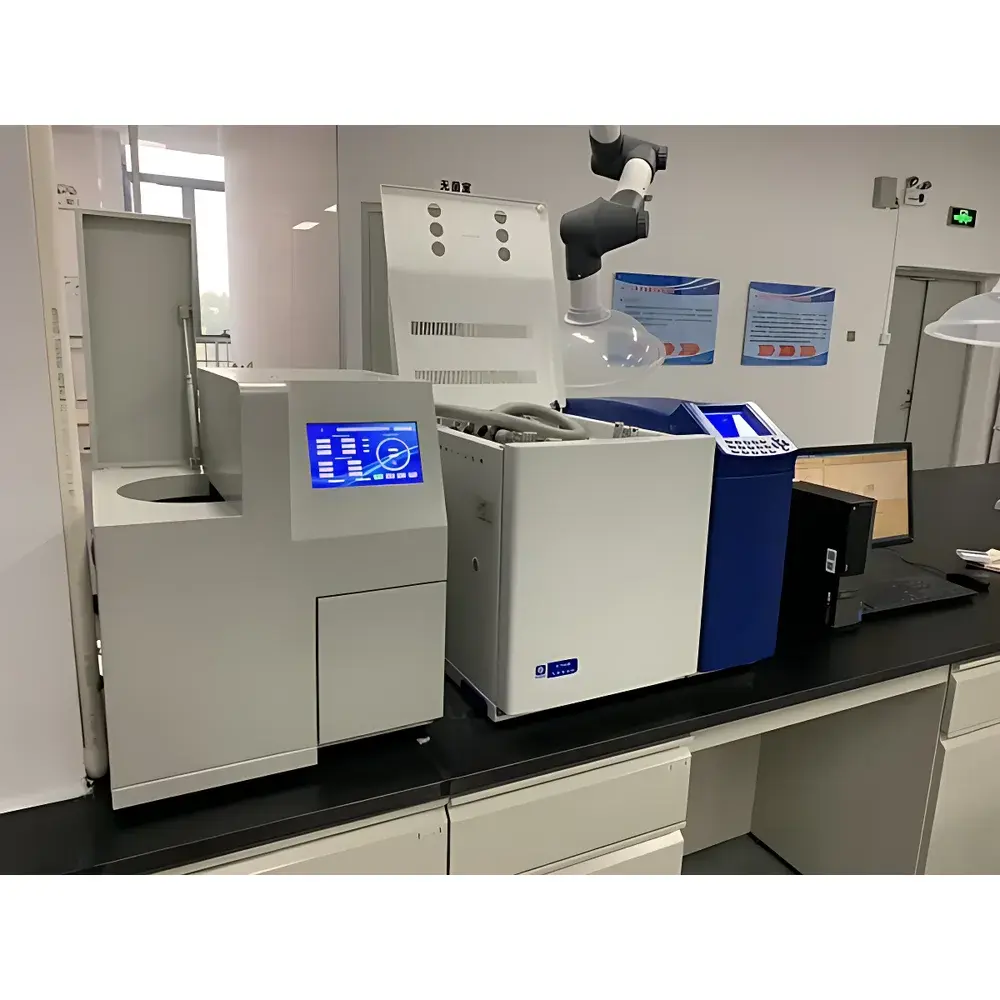
Beifen Sanpu AHS-20A-1 Fully Automated Static Headspace Sampler
| Brand | Beifen Sanpu |
|---|---|
| Origin | Beijing, China |
| Manufacturer Type | Direct Manufacturer |
| Instrument Type | Static Headspace Sampler |
| Automation Level | Fully Automatic |
| Sample Vial Heating Range | 40–220 °C |
| Valve Heating Range | 40–220 °C |
| Temperature Control Accuracy | ±0.5% of setpoint |
| Quantitative Loop Volume | 1 mL (customizable: 0.5, 2, 5 mL) |
| Vial Capacity | 20 positions |
| Compatible Vial Sizes | 10 mL or 20 mL (customizable: 50 mL, 100 mL) |
| RSD | <1.0% (for 100 ppm ethanol in water) |
| Pressure Control Range | 0–0.25 MPa (continuously adjustable) |
| Sampling Time | 0–30 min |
| Injection Time | 0–999 s |
| Purge/Flush Time | 0–30 min |
| Minimum Time Resolution | 1 ms |
| Carrier Gas Flow Control | Optional EPC (Electronic Pressure Control) |
| Interface | USB, GC synchronization trigger, external event input/output |
Overview
The Beifen Sanpu AHS-20A-1 is a fully automated static headspace sampler engineered for precision, reproducibility, and seamless integration into regulated analytical laboratories performing gas chromatography (GC) and GC–MS analyses. It operates on the fundamental principle of static headspace analysis: equilibration of volatile analytes between a solid or liquid sample matrix and its overlying vapor phase at controlled temperature and pressure, followed by quantitative transfer of the equilibrium vapor into the GC injection port. Designed for high-throughput routine analysis, the AHS-20A-1 supports unattended operation of up to 20 samples per batch, with independent thermal control of the sample vial oven, six-port valve block, and transfer lines—all maintained within a single insulated heating chamber to eliminate cold spots and ensure analyte integrity during transport. Its modular architecture, inert flow path (using de-activated fused-silica and stainless-steel tubing), and positive-pressure sampling mechanism minimize carryover, adsorption, and baseline drift—critical requirements for trace-level VOC quantification in environmental, pharmaceutical, food safety, and forensic applications.
Key Features
- Fully automated workflow: auto-balancing, pressurization, sampling, injection, and post-injection purge—no manual intervention required.
- 20-position carousel with precise motor-driven positioning and built-in vial detection; automatically skips empty or misaligned positions to prevent mechanical collision.
- Triple-zone independent temperature control: sample vial oven (40–220 °C), six-port valve block (40–220 °C), and transfer line (40–220 °C), all with stability better than ±0.5 °C and accuracy of ±0.5% of setpoint.
- High-inertness fluidic path: quantitative loop (standard 1 mL, optional 0.5/2/5 mL), six-port valve, and heated transfer lines constructed from silanized stainless steel and fused silica to suppress active site interactions and cross-contamination.
- Positive-pressure headspace sampling: eliminates vacuum-induced fractionation effects and ensures consistent injection volume across diverse matrices (liquids, soils, polymers, pharmaceuticals).
- Real-time system diagnostics: comprehensive self-check at power-on; automatic fault detection for vial misplacement, motor stall, heater failure, or communication loss—with audible/visual alerts and safe shutdown protocol.
- Flexible timing resolution: programmable intervals down to 1 ms for pressurization, equilibration, sampling, injection, and purge phases—enabling method optimization for thermally labile or highly volatile compounds.
- USB interface and GC synchronization capability: accepts TTL triggers from external GC systems or data stations; supports bidirectional communication for method upload, status monitoring, and audit-ready event logging.
Sample Compatibility & Compliance
The AHS-20A-1 accommodates standard 10 mL and 20 mL crimp-top headspace vials, with customization available for 50 mL and 100 mL formats to support heterogeneous sample types—including aqueous solutions, sludges, soils, powdered solids, and packaged consumer goods. Its design aligns with widely adopted regulatory frameworks governing volatile organic compound (VOC) analysis: EPA Methods 502.2, 524.4, and 8260; ISO 15681-2 (water analysis); ASTM D7622 (petroleum distillates); USP & Ph. Eur. chapters and 2.4.24 (residual solvents); and Chinese national standards including GB 5749-2022 (drinking water), HJ 642–643–736–810 (soil, sediment, solid waste, and water), and ChP 2020 Vol. IV (pharmaceutical excipients). All thermal and pressure parameters are logged with timestamped metadata, supporting GLP/GMP-compliant data integrity under 21 CFR Part 11 when paired with validated chromatography data systems.
Software & Data Management
Instrument control and method development are performed via intuitive PC-based software accessible through USB 2.0 connection. The interface supports full parameter configuration—including temperature ramps, pressure profiles, timing sequences, and GC synchronization logic—without requiring firmware updates. All operational events (vial loading, equilibration start, valve actuation, injection pulse, purge completion) are time-stamped and stored locally in non-volatile memory. Exportable CSV logs include method name, operator ID, sample ID, vial position, actual vs. set temperatures, pressure readings, and RSD validation results. Audit trail functionality records user login/logout, parameter changes, and error events—enabling traceability for internal QA reviews and regulatory inspections. Optional EPC module provides closed-loop carrier gas flow regulation, enhancing retention time stability and method robustness across instrument platforms.
Applications
The AHS-20A-1 delivers reliable performance across regulated and research-driven workflows. In environmental labs, it quantifies BTEX, chlorinated hydrocarbons, and halogenated solvents in groundwater (per HJ 810), soil (HJ 736), and landfill leachate. In pharmaceutical QC, it meets ICH Q2(R2) validation requirements for residual solvents in APIs and finished dosage forms per USP . Food and packaging laboratories apply it to assess migration of solvents (e.g., toluene, ethyl acetate) from printed films into simulants (SN/T 4068), while tobacco testing labs comply with YC/T 207 for paper coating volatiles. Forensic toxicology labs use it for blood alcohol (ethanol) and volatile drug screening (e.g., acetone, isopropanol) per GA/T 842–2009. Its low RSD (<1.0% at 100 ppm ethanol) and minimal carryover make it suitable for high-sensitivity clinical and industrial hygiene monitoring.
FAQ
What sample matrices can the AHS-20A-1 handle?
It is validated for liquids (aqueous, organic), semi-solids (slurries, creams), and solids (soils, powders, polymers) using standard 10 mL or 20 mL headspace vials.
Is the instrument compatible with third-party GC systems?
Yes—it features universal TTL trigger inputs/outputs and USB communication, enabling synchronization with Agilent, Thermo Fisher, Shimadzu, PerkinElmer, and国产 GC platforms.
Can temperature ranges be extended beyond 220 °C?
Optional high-temp configurations support up to 300 °C for both vial oven and valve zones, subject to material certification and validation.
How is data integrity ensured for regulated environments?
All method parameters, run logs, and system events are time-stamped and exportable; when integrated with compliant CDS software, it satisfies 21 CFR Part 11 electronic record requirements.
What maintenance is required for long-term reliability?
Routine tasks include periodic inspection of septa, cleaning of the needle seat and valve rotor seal, and verification of vial carousel alignment—no consumables beyond standard GC-grade vials and caps.




