
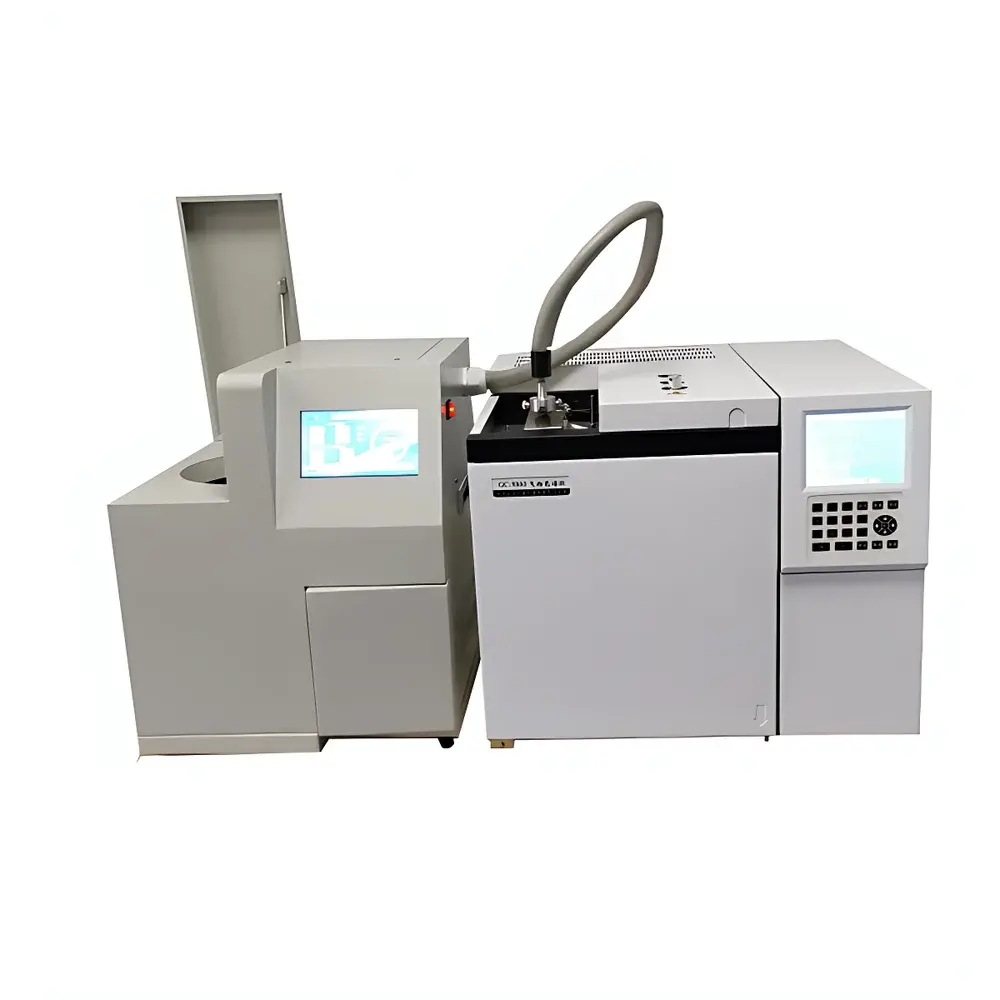
Beifen Sanpu AHS-20A Plus Fully Automated Static Headspace Sampler for Blood Ethanol Analysis
| [Brand | Beifen Sanpu |
|---|---|
| Origin | Beijing, China |
| Manufacturer Type | Manufacturer |
| Instrument Type | Static Headspace Sampler |
| Automation Level | Fully Automatic |
| Sample Vial Heating Range | Ambient to 200 °C (1 °C increment) |
| Valve & Transfer Line Temperature Control Range | 40–220 °C (±1 °C accuracy) |
| Quantitative Loop Volume | 1 mL |
| Sample Position Capacity | 20 positions |
| Compatible Vial Sizes | 10 mL or 20 mL] |
Overview
The Beifen Sanpu AHS-20A Plus Fully Automated Static Headspace Sampler is engineered for precise, high-throughput quantitative analysis of volatile organic compounds—particularly ethanol—in biological matrices such as whole blood and urine. Designed specifically to meet the stringent requirements of forensic toxicology laboratories, this system operates on the principle of static headspace gas-phase equilibrium: a sealed vial containing a liquid or solid sample is heated to a controlled temperature, allowing volatile analytes—including ethanol, methanol, propanol, acetaldehyde, acetone, isopropanol, butanol, and amyl alcohol—to partition into the headspace above the sample. A precisely metered volume of this equilibrated vapor phase is then introduced into a gas chromatograph (GC) via a thermostatted six-port valve and inert transfer line. When coupled with a GC equipped with a flame ionization detector (FID) and a dedicated capillary column (e.g., 30 m ethanol-specific phase), the complete system delivers robust, reproducible quantification using internal standard calibration (e.g., tert-butanol). The methodology complies fully with GA/T 842–2019—the current People’s Republic of China Public Security Industry Standard for ethanol determination in blood—replacing the prior GA/T 842–2009 edition.
Key Features
- Fully automated 20-position carousel accommodates either 10 mL or 20 mL crimp-top headspace vials, enabling unattended batch processing without manual intervention.
- Independent thermal control of sample vial block (ambient to 200 °C), injection valve (40–220 °C), and transfer line (40–220 °C), all with ±1 °C precision and <±0.5 °C stability, ensuring consistent phase equilibrium and minimal analyte condensation.
- 1 mL fixed-volume quantitative loop ensures high volumetric repeatability; optional loop sizes (0.5/2/5 mL) available upon request.
- Positive-pressure sampling mechanism eliminates baseline drift and enables reliable analysis of both liquid and solid specimens under ambient pressure conditions.
- All fluidic pathways—including the six-port valve, quantitative loop, and transfer tubing—are constructed from high-inertness, de-activated fused-silica or SilcoNert®-treated stainless steel to prevent adsorption, carryover, or cross-contamination.
- Integrated USB interface allows full parameter configuration and real-time status monitoring via PC; front-panel operation remains available for standalone use.
- Comprehensive self-diagnostic functions include automatic vial position detection, mechanical fault recognition, electrical continuity verification, and error-triggered emergency stop protocols to safeguard hardware integrity.
Sample Compatibility & Compliance
The AHS-20A Plus supports direct analysis of anticoagulated whole blood (e.g., K2EDTA tubes), serum, plasma, and urine without derivatization or solvent extraction. Its design adheres to core forensic quality assurance principles: it facilitates method validation per ISO/IEC 17025 requirements and supports audit-ready workflows compatible with GLP and GMP environments. While not certified to FDA 21 CFR Part 11 out-of-the-box, the system’s deterministic timing control (1 ms resolution), electronic parameter logging, and synchronization capability with GC data systems enable implementation of compliant electronic record and signature practices when integrated with validated chromatography data systems (CDS). All operational parameters—including heating time, pressurization duration, sampling interval, and purge cycles—are programmable and stored with timestamping for full traceability.
Software & Data Management
The sampler interfaces seamlessly with third-party GC data acquisition software (e.g., BF-2002 Chromatography Workstation or OpenLAB CDS) via TTL-level event triggering and USB command protocol. All method parameters—including vial temperature ramp profiles, valve actuation sequences, loop fill/flush timing, and inter-sample purge durations—are defined and archived digitally. The onboard 7-inch graphical LCD display presents animated workflow guidance, real-time temperature feedback, and elapsed run timers. Method files can be exported/imported via USB drive for laboratory-wide standardization. For forensic applications requiring chain-of-custody documentation, integration with LIMS platforms is supported through ASCII-based output logs containing sample ID, acquisition timestamp, instrument state flags, and QC pass/fail indicators.
Applications
- Quantitative determination of ethanol in human blood for DUI/DWI forensic investigations per GA/T 842–2019.
- Simultaneous screening and quantification of toxic alcohols (methanol, isopropanol, n-propanol) and metabolites (acetaldehyde, acetone) in clinical toxicology.
- Residual solvent analysis in pharmaceutical manufacturing (ICH Q3C compliance support).
- Volatile impurity profiling in food safety testing (e.g., fermentation byproducts, spoilage markers).
- Environmental monitoring of VOCs in water and soil extracts using EPA Method 502.2 or 8260D-compatible workflows.
FAQ
What regulatory standards does this system support for forensic blood alcohol testing?
It is explicitly configured to comply with GA/T 842–2019, the mandatory Chinese public security industry standard for blood ethanol analysis. Its performance characteristics—including RSD <1.0% at 100 ppm ethanol in aqueous matrix—meet minimum precision requirements outlined in the standard.
Can the AHS-20A Plus be used with non-Beifen Sanpu gas chromatographs?
Yes. It features universal TTL trigger I/O and RS-232/USB communication protocols, enabling compatibility with Agilent, Shimadzu, Thermo Fisher, and other major GC platforms.
Is internal standard addition automated?
No—internal standard (e.g., tert-butanol) must be added manually to each vial prior to capping, following validated SOPs. The sampler handles only headspace vapor introduction.
What maintenance intervals are recommended for routine forensic operation?
Valve seal replacement every 10,000 injections; quantitative loop cleaning after every 500 samples; annual calibration verification of all temperature zones using NIST-traceable thermometers.
Does the system support dynamic headspace or purge-and-trap modes?
No—it is a static headspace sampler only. Dynamic extraction requires separate purge-and-trap instrumentation.
Related Products





