
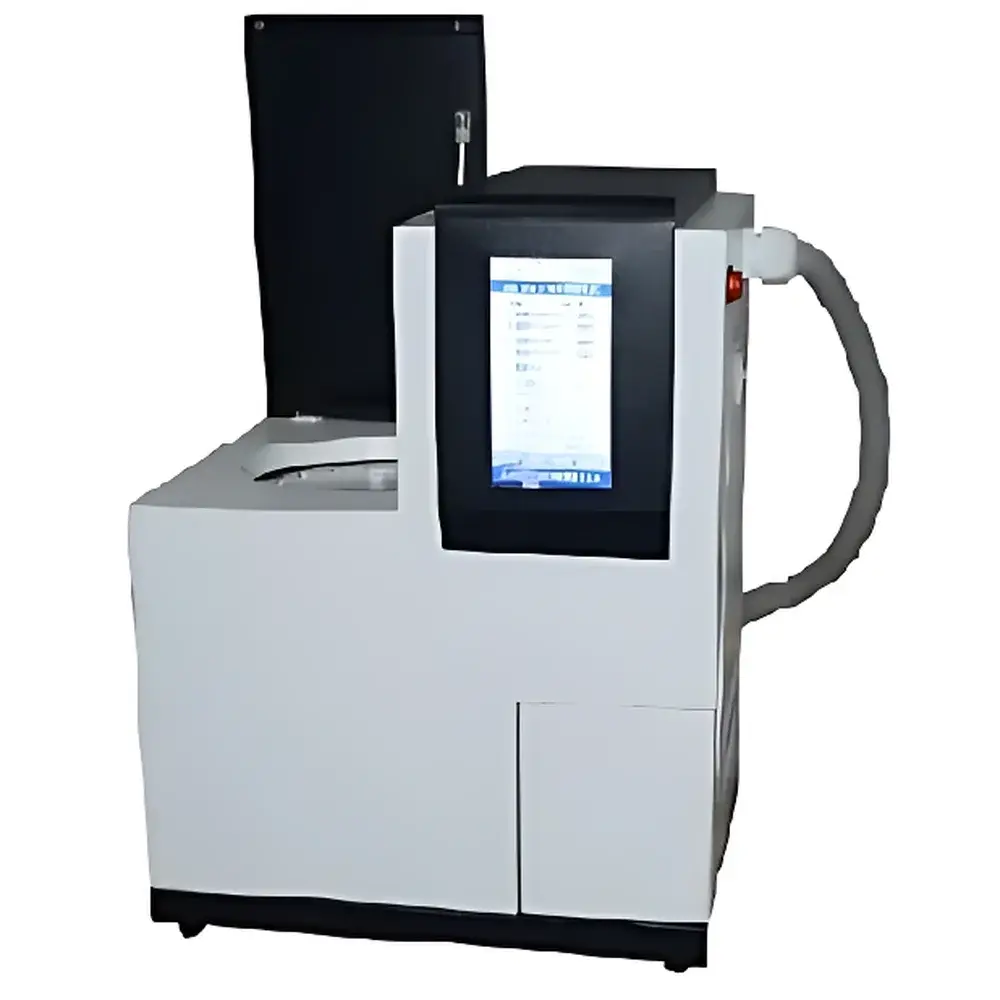
Beifen Sanpu ATDS-20A Fully Automated Two-Stage Thermal Desorber
| Brand | Beifen Sanpu |
|---|---|
| Origin | Beijing, China |
| Manufacturer Type | Direct Manufacturer |
| Instrument Type | Two-Stage Thermal Desorber |
| Primary Desorption Temperature Range | Ambient to 450 °C |
| Secondary Desorption (Flash) Temperature Range | 100–450 °C |
| Cryo-Focusing Trap Temperature Range | −35 °C to Ambient |
| Desorption Recovery Rate | >99% (compound-dependent) |
| Sample Capacity | 20 positions |
| Cold Trap Cooling Method | Electronic Peltier Cooling |
| Temperature Control Accuracy | ±0.5 °C |
| RSD | ≤2.5% (for 0.05 μg benzene in methanol) |
| Sample Tube Specification | 1/4″ OD × 3.5″ (ASTM D6196-compliant) |
| Valve Actuation | Motor-driven 6-port switching valve |
| GC Synchronization | TTL-level trigger output for GC start and data system |
| Power Supply | AC 220 V ±10%, 50 Hz |
| Dimensions (W×D×H) | 350 × 450 × 510 mm |
| Weight | ~40 kg |
Overview
The Beifen Sanpu ATDS-20A Fully Automated Two-Stage Thermal Desorber is an engineered solution for quantitative pre-concentration and introduction of volatile and semi-volatile organic compounds (VOCs and SVOCs) into gas chromatography (GC) or GC–MS systems. It operates on the principle of thermal desorption—first-stage desorption from sorbent tubes under controlled carrier gas flow, followed by cryogenic focusing in a thermoelectrically cooled trap, and rapid second-stage flash desorption directly into the GC inlet. This two-stage architecture eliminates solvent use, minimizes analyte degradation, and delivers high sensitivity (sub-ppt detection capability), narrow peak widths, and superior reproducibility across complex matrices—including humid air, water extracts, soil headspace, and polymer off-gas samples.
Key Features
- Fully automated 20-position sample carousel with motor-driven indexing and auto-calibration via built-in optical positioning sensors;
- Independent, PID-controlled temperature zones: primary desorption furnace (ambient–450 °C), secondary flash heater (100–450 °C), valve oven (ambient–300 °C), transfer line (ambient–300 °C), and Peltier-cooled cryo-trap (−35 °C to ambient);
- Motor-driven 6-port rotary valve with zero-dead-volume heated interface; all critical gas pathways housed within temperature-stabilized enclosures to prevent cold spots;
- High-inertness sample pathway: de-activated fused silica or quartz-lined transfer lines standard; optional quartz capillary tubing available for highly reactive analytes (e.g., aldehydes, sulfur compounds);
- Integrated electronic refrigeration system enabling precise, stable, and maintenance-free cryo-focusing without liquid nitrogen or mechanical compressors;
- Onboard method programming with customizable time segments: purge, primary desorption, trap focusing, flash desorption, GC injection, and post-run bake-out;
- Real-time status monitoring via 7-inch 64K-color TFT-LCD touchscreen (800 × 480 resolution) with intuitive Chinese/English bilingual UI;
- Self-diagnostic firmware with automatic fault logging, valve position verification, and heater resistance validation;
- GC synchronization via TTL trigger output; compatible with all major GC platforms (Agilent, Thermo Fisher, Shimadzu, PerkinElmer, etc.) and chromatography data systems (CDS) supporting external start signals;
- No external drive gas required—fully electric actuation ensures operational safety and simplifies lab infrastructure requirements.
Sample Compatibility & Compliance
The ATDS-20A supports standardized sorbent tubes compliant with ASTM D6196, ISO 16017-1, and EN 14662. It accommodates common tube configurations including single-bed (Tenax TA, Carbopack™ B/C) and multi-bed (Carbotrap™/Carboxen™/Carbograph™) media. The system is validated for analysis of C3–C16 hydrocarbons, halogenated VOCs (e.g., chloroform, TCE, PCE), aromatic compounds (benzene, toluene, xylenes), oxygenates (alcohols, ketones, esters), and polar species (acetaldehyde, formaldehyde when paired with derivatization-compatible traps). Its performance meets or exceeds regulatory requirements outlined in:
- HJ 644–2013 (China EPA: VOC analysis in ambient air via TD-GC–MS);
- HJ 583–2010 and HJ 734–2014 (solid sorbent TD for benzene-series and industrial source emissions);
- GB/T 18883–2002 and GB 50325–2020 (indoor air TVOC and benzene testing);
- HJ/T 400–2007 (in-vehicle VOC and carbonyl compound profiling);
- US EPA TO-17 (determination of VOCs in air using sorbent tubes and thermal desorption).
All temperature ramps, dwell times, and flow parameters are fully auditable and exportable—supporting GLP/GMP workflows and 21 CFR Part 11 compliance when integrated with validated CDS environments.
Software & Data Management
The ATDS-20A operates autonomously via embedded firmware; no PC dependency is required for routine operation. All methods—including temperature profiles, timing sequences, valve states, and GC trigger logic—are stored internally with timestamped version control. Method files can be exported/imported via USB 2.0 port for backup or cross-instrument replication. The system logs full operational history (startup/shutdown cycles, temperature deviations, valve actuation counts, error codes) with retention configurable up to 12 months. For laboratory information management system (LIMS) integration, ASCII-formatted log exports support automated ingestion into ELN or QC tracking platforms. Optional remote monitoring is achievable via Ethernet-enabled PLC modules (not included) when deployed in centralized analytical facilities.
Applications
- Ambient, indoor, and workplace air monitoring for regulatory VOC compliance (e.g., OSHA PELs, EU REACH screening);
- Environmental forensics and emergency response—rapid identification of unknown airborne contaminants following chemical incidents;
- Food and flavor analysis: headspace profiling of roasted coffee, spices, dairy products, and packaging migration studies;
- Pharmaceutical quality control: residual solvent quantification in APIs and excipients per ICH Q3C guidelines;
- Forensic toxicology: detection of volatile metabolites in breath or blood headspace;
- Polymer and coating R&D: off-gassing characterization under accelerated aging conditions;
- Medical diagnostics research: exhaled breath condensate (EBC) analysis for disease biomarkers;
- Industrial hygiene assessments: real-time exposure evaluation in semiconductor cleanrooms, paint booths, and printing facilities.
FAQ
What sorbent tube formats are supported?
The ATDS-20A accepts standard 1/4″ OD × 3.5″ stainless steel or glass tubes per ASTM D6196, including single- and multi-bed configurations. Custom tube adapters are available upon request.
Is liquid nitrogen required for cryo-focusing?
No. The system uses solid-state Peltier cooling capable of reaching −35 °C continuously without consumables or vacuum maintenance.
Can the instrument perform tube conditioning (baking) in situ?
Yes—integrated tube activation protocols allow programmable high-temperature purging (up to 450 °C) with adjustable flow and duration, eliminating the need for a separate aging station.
How is data integrity ensured during unattended runs?
All temperature setpoints, actual readings, valve transitions, and GC trigger events are logged with millisecond timestamps. Internal non-volatile memory retains logs even after power loss.
What maintenance intervals are recommended?
Valve seals and septa should be inspected every 500 cycles; transfer lines require annual passivation. No routine calibration is needed—the system maintains ±0.5 °C thermal accuracy via factory-trimmed RTD sensors and digital PID tuning.
Does the ATDS-20A comply with 21 CFR Part 11?
The hardware and firmware support audit trail generation and electronic signature readiness. Full Part 11 compliance requires configuration within a validated chromatography data system (e.g., OpenLab CDS, Chromeleon) and documented SOPs for user access control and method change management.





