
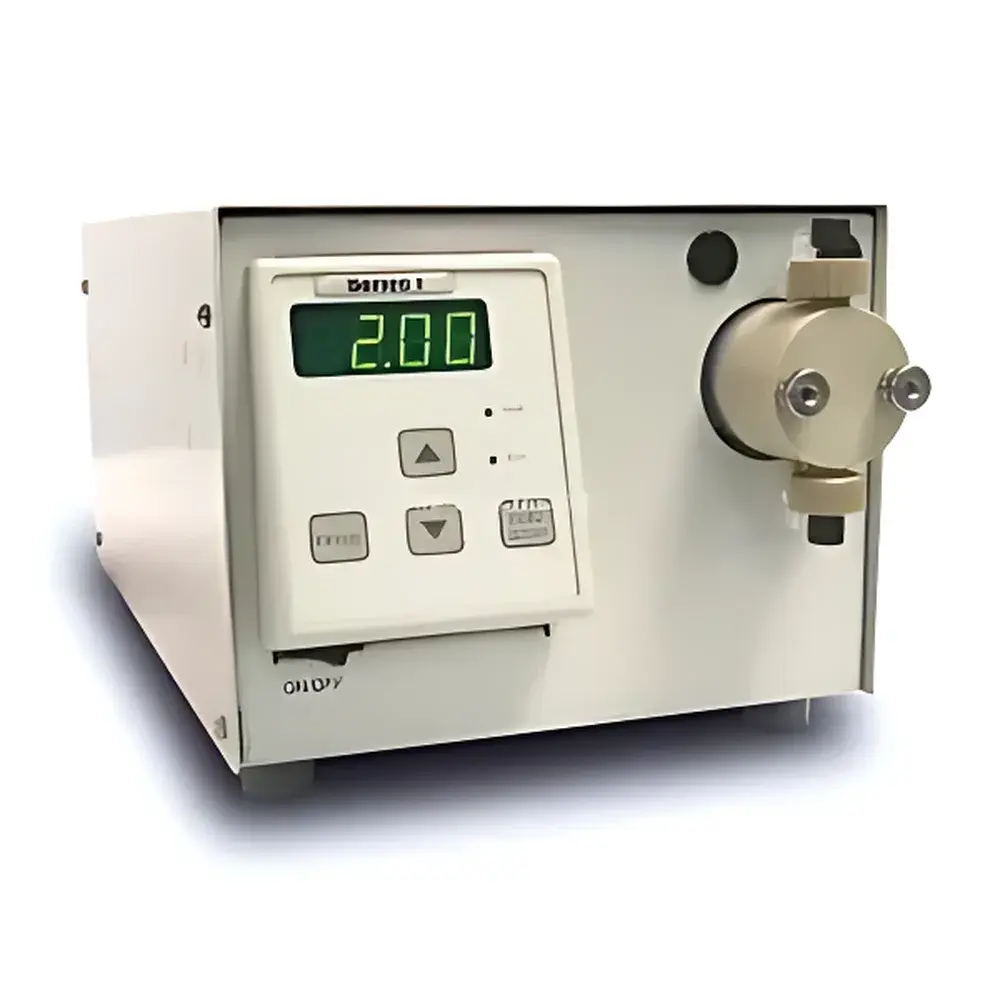
Laballiance Series I Constant Flow Pump
| Brand | Laballiance |
|---|---|
| Origin | USA |
| Model | Series I |
| Flow Range (10 mL head) | 0.01–10 mL/min |
| Flow Range (40 mL head) | 0.1–40 mL/min |
| Maximum Pressure (10 mL head) | 2500 psi |
| Maximum Pressure (40 mL head) | 650 psi |
| Flow Accuracy | ±2% (10 mL), ±5% (40 mL) |
| Flow Precision | ≤0.5% RSD |
| Control Interface | RS-232, Start/Stop TTL |
| Dimensions | 6.5" H × 6.5" W × 13" D |
| Materials | PEEK, Ceramic, Inert Polymers |
| Power Supply | 120/232 V, 50/60 Hz |
Overview
The Laballiance Series I Constant Flow Pump is an engineered solution for precise, continuous liquid delivery in analytical, preparative, and process-scale laboratory applications. Based on positive displacement reciprocating piston technology, it delivers stable, pulse-dampened flow across a wide operational range—without reliance on flexible tubing or elastomeric components that degrade under chemical or pressure stress. Unlike peristaltic pumps, the Series I eliminates flow pulsation-induced baseline noise and long-term drift, making it suitable for applications demanding high reproducibility—including post-column derivatization in HPLC, catalyst injection in microreactors, and reagent dosing in catalytic distillation systems. Its compact footprint (6.5″ × 6.5″ × 13″) supports integration into space-constrained instrument racks or modular reactor platforms, while its dual-head configuration (10 mL and 40 mL variants) enables flexibility across low-flow analytical and higher-volume process requirements.
Key Features
- Two interchangeable pump heads: 10 mL head (0.01–10 mL/min, up to 2500 psi) and 40 mL head (0.1–40 mL/min, up to 650 psi), selected based on pressure and flow requirements.
- Patented online seal self-cleaning mechanism actively flushes crystalline salt deposits from sealing surfaces during operation—reducing maintenance frequency and extending seal service life by up to 3× compared to conventional piston pumps.
- Chemically inert wetted-path construction using PEEK, ceramic, and other high-performance polymers ensures compatibility with aggressive solvents (e.g., THF, DMF, concentrated acids/bases) and biological samples requiring non-leaching, non-adsorptive surfaces.
- Modular, field-replaceable pump head assembly allows full mechanical interchangeability—no recalibration required when swapping heads or seals between units of the same model series.
- RS-232 serial interface with ASCII command protocol enables seamless integration into automated workflows via third-party software (e.g., LabVIEW, Python-based control scripts) or legacy lab data systems.
Sample Compatibility & Compliance
The Series I pump meets material compatibility requirements defined in ASTM F2081 (biocompatibility of polymeric materials) and ISO 10993-5 (cytotoxicity testing). Its inert fluid path supports GLP-compliant applications involving pharmaceutical intermediates, enzyme-containing buffers, and organometallic catalysts. While not certified to FDA 21 CFR Part 11 out-of-the-box, audit-ready operation is achievable through validated control software implementing electronic signatures, user access logs, and change history tracking. The pump’s pressure and flow specifications align with common HPLC system design envelopes per USP and ASTM D3370 (standard test method for flow rate calibration).
Software & Data Management
The Series I operates via simple ASCII commands over RS-232 (e.g., “FLOW=5.2”, “START”, “STOP”), enabling direct scripting without proprietary drivers. Laballiance provides a basic terminal utility for manual operation and verification; however, most users implement custom control logic within existing LIMS or SCADA environments. For regulated environments, integration with compliant software platforms (e.g., Thermo Fisher SampleManager, Waters Empower) requires validation of command execution latency, flow setpoint tracking, and error response consistency—documentation templates for IQ/OQ/PQ are available upon request.
Applications
- HPLC auxiliary functions: post-column derivatization reagent delivery, mobile phase blending, and sample loop filling in preparative systems.
- Catalyst and co-reagent metering in bench-scale continuous-flow reactors, microreactors, and catalytic distillation columns—particularly where precise stoichiometric control and solvent resistance are critical.
- Controlled infusion in corrosion studies, electrochemical cell feeding, and polymerization initiation systems requiring stable monomer addition rates.
- Calibration standard delivery in gravimetric or volumetric flow verification setups per ISO/IEC 17025-accredited laboratories.
- Long-duration infusion in environmental simulation chambers (e.g., soil column leaching, aquatic toxicity assays) where uninterrupted operation over 72+ hours is required.
FAQ
What pump head should I select for my application?
Use the 10 mL head for high-pressure, low-flow applications (e.g., analytical HPLC auxiliary lines, microfluidic interfacing); choose the 40 mL head for lower-pressure, higher-volume delivery (e.g., catalyst feed to 10–50 mL batch reactors, solvent makeup in synthesis modules).
Is the pump compatible with acetonitrile, DMSO, or hydrochloric acid solutions?
Yes—when configured with PEEK or ceramic components, the Series I maintains integrity with common organic solvents, polar aprotic media, and aqueous acids/bases at concentrations and temperatures within standard lab operating ranges (up to 60°C, pH 1–14).
Can the pump be operated unattended for extended periods?
Yes—its self-cleaning seal design and robust thermal management support continuous operation for >120 hours under nominal load, provided ambient temperature remains below 35°C and inlet fluid is particle-free (<0.5 µm filtration recommended).
Does Laballiance provide validation documentation for GMP use?
Factory test reports (flow accuracy, pressure hold, leak integrity) are included with each unit. Full IQ/OQ documentation packages—including installation checklists, operational protocols, and performance qualification templates—are available as optional add-ons subject to site-specific risk assessment.
How is flow accuracy verified during routine use?
Users may perform periodic gravimetric verification per ASTM D3370 using certified analytical balances and timed collection intervals. Laballiance recommends quarterly verification for critical applications and after any head or seal replacement.



