
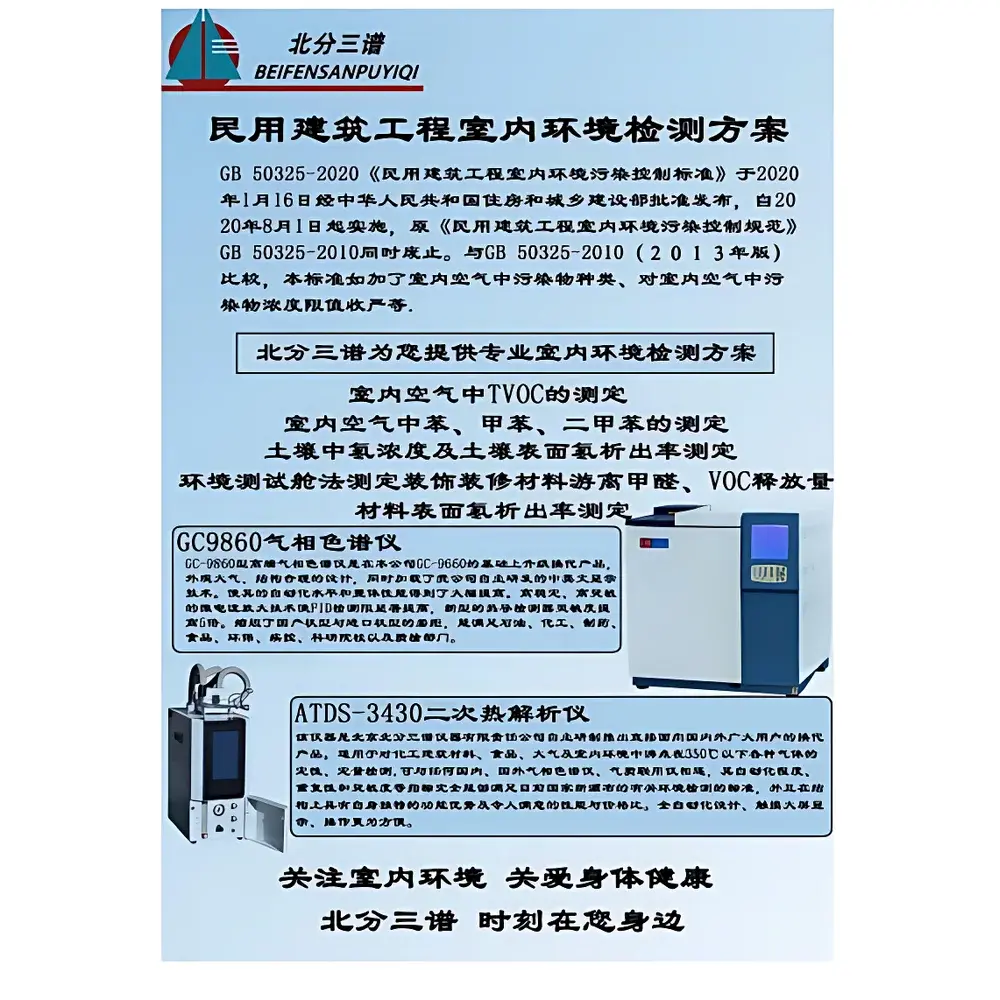
Beifen Sanpu ATDS-3430 Dual-Stage Thermal Desorber for GB 50325-2020 Indoor Air Quality Compliance
| Brand | Beifen Sanpu |
|---|---|
| Origin | Beijing, China |
| Manufacturer Type | Manufacturer |
| Product Category | Domestic |
| Model | ATDS-3430 |
| Instrument Type | Dual-stage thermal desorber (cold trap enabled) |
| Automation Level | Semi-automatic |
| Desorption Temperature Range | Ambient to 450 °C |
| Valve Injection Zone Temperature Range | Ambient to 200 °C |
| Transfer Line Temperature Range | Ambient to 200 °C |
| Cold Trap Temperature Range | Down to –35 °C |
| Temperature Control Accuracy | < ±0.1 °C |
| Analyte Recovery Rate | >99% (compound-dependent) |
| Sample Position Capacity | 1 tube |
Overview
The Beifen Sanpu ATDS-3430 is a semi-automatic dual-stage thermal desorber engineered for precise, reproducible analysis of volatile organic compounds (VOCs) and aromatic hydrocarbons—including benzene, toluene, ethylbenzene, xylenes (BTEX), and total VOCs (TVOC)—in indoor air samples, as mandated by the People’s Republic of China’s mandatory standard GB 50325-2020, *Standard for Indoor Environmental Pollution Control of Civil Building Engineering*. This instrument implements a two-step thermal desorption process: first-stage desorption from the sorbent tube at elevated temperature under carrier gas flow, followed by cryo-focusing in a thermoelectrically cooled cold trap (–35 °C minimum), and second-stage rapid flash desorption directly into the GC inlet. Its architecture ensures minimal analyte loss, high transfer efficiency, and compatibility with capillary gas chromatography systems—particularly those equipped with flame ionization detection (FID) or mass spectrometry (MS). Designed specifically for regulatory compliance workflows, the ATDS-3430 supports the full analytical sequence outlined in GB 50325-2020 Annex D, including sampling using T-C composite adsorbent tubes (2,6-diphenylphenol–graphitized carbon black–X polymer), thermal desorption, and subsequent GC quantification.
Key Features
- Dual-stage desorption with integrated cryogenic cold trap (–35 °C) for enhanced sensitivity and peak sharpness
- Independent, PID-controlled temperature zones: desorption oven, valve box, transfer line, and cold trap—each with accuracy better than ±0.1 °C
- Optimized for T-C composite sorbent tubes per GB 50325-2020 requirements, ensuring quantitative recovery of polar and non-polar VOCs
- Semi-automatic operation with programmable method storage, enabling repeatable run sequences across multiple sample batches
- Robust stainless-steel gas path design with inert surface treatment to minimize catalytic degradation and memory effects
- Integrated leak-tight valve system with low-dead-volume connections for reliable, low-background carrier gas delivery
Sample Compatibility & Compliance
The ATDS-3430 is validated for use with 6 mm OD stainless steel or quartz T-C composite adsorption tubes (e.g., 2,6-diphenylphenol / graphitized carbon black / X polymer), as specified in GB 50325-2020 Section D.3. It accommodates single-tube loading and supports direct coupling to common GC platforms via standard 1/8″ or 1/4″ Swagelok fittings. The system meets the performance criteria defined in GB 50325-2020 Annex D.4, including analyte recovery (>99% for BTEX and selected aldehydes under optimized conditions), precision (RSD < 5% for replicate analyses), and blank integrity (demonstrated < 0.5% of method detection limit for all target compounds). While GB 50325-2020 is a national construction standard, the ATDS-3430’s operational parameters align with internationally recognized thermal desorption validation principles described in ISO 16000-6 and ASTM D6196, facilitating cross-referenced method development for laboratories operating under GLP or ISO/IEC 17025 frameworks.
Software & Data Management
The ATDS-3430 operates via front-panel keypad interface with embedded firmware supporting up to 10 user-defined methods. Each method stores complete thermal program parameters (ramp rates, hold times, temperatures), carrier gas flow settings, and cold trap conditioning cycles. All run logs—including date/time stamp, method ID, tube ID (manually entered), and status flags—are stored internally and exportable via USB to CSV format for audit trail generation. While the instrument does not include proprietary PC software, its timing and temperature profiles are fully compatible with third-party chromatography data systems (CDS) such as Agilent OpenLab, Thermo Chromeleon, or Shimadzu LabSolutions, enabling synchronized GC start triggers and automated result reporting. For laboratories subject to regulatory audits, manual logbook entries supplemented by exported run records satisfy traceability requirements under GB/T 27025-2019 (equivalent to ISO/IEC 17025) and support internal quality control documentation.
Applications
- Quantitative determination of benzene, toluene, ethylbenzene, xylenes (o-, m-, p-), and TVOC in indoor air per GB 50325-2020 Sections 6.0.12–6.0.13
- Analysis of VOC emissions from building materials using environmental test chambers (e.g., 1 m³ chamber effluent air)
- Soil gas radon progeny screening when coupled with activated charcoal trapping and subsequent desorption–GC analysis
- Verification of adsorbent tube breakthrough volumes and desorption efficiency during method validation
- Supporting compliance testing for Class I civil buildings (e.g., kindergartens, schools, elderly care facilities), where mandatory sampling coverage is ≥50% of rooms (minimum 20 rooms)
FAQ
Does the ATDS-3430 comply with GB 50325-2020’s requirement for T-C composite tube analysis?
Yes—the instrument’s temperature programming, cold trap capability, and flow control parameters are configured to meet the desorption conditions specified in GB 50325-2020 Annex D for T-C tubes.
Can the ATDS-3430 be upgraded to full automation?
No—it is designed as a semi-automatic platform with single-tube handling; robotic autosamplers are not supported.
What GC detectors are recommended for use with this thermal desorber?
Flame ionization detector (FID) is specified in GB 50325-2020 for TVOC and BTEX; mass spectrometric detection (MS or MS/MS) is suitable for confirmatory analysis and expanded compound screening.
Is cold trap cooling achieved via liquid nitrogen or thermoelectric modules?
Thermoelectric (Peltier) cooling is used, enabling stable operation down to –35 °C without consumables or external cryogens.
How is system performance verified between analyses?
Users perform daily system suitability checks using certified VOC standards on T-C tubes; recovery, retention time stability, and peak shape are monitored against acceptance criteria defined in internal SOPs aligned with GB 50325-2020 verification clauses.
Related Products





