
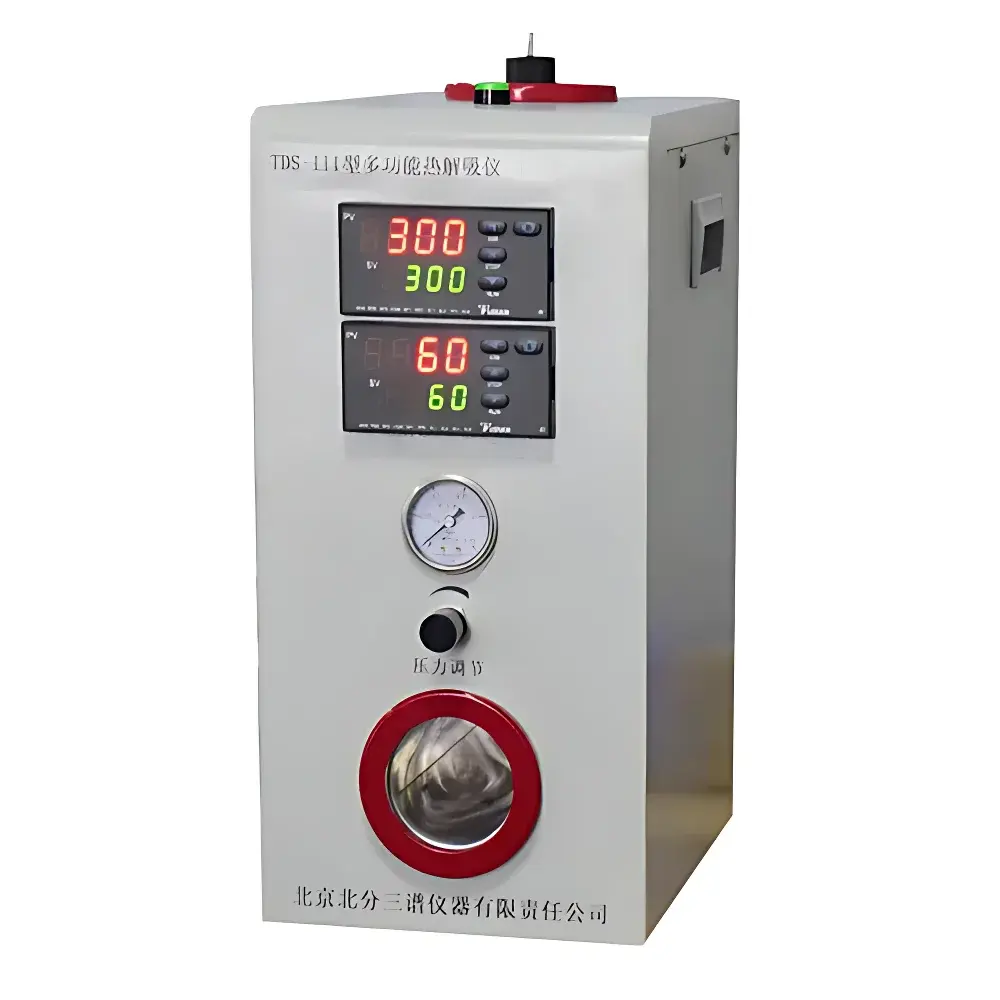
Beifen Sanpu BTDS-III Thermal Desorption Unit for Butyraldehyde Analysis by Gas Chromatography with FID Detection
| [Brand | Beifen Sanpu |
|---|---|
| Model | BTDS-III |
| Origin | Beijing, China |
| Manufacturer Type | OEM Manufacturer |
| Key Features | Dual-zone temperature control (desorption furnace up to 400 °C & syringe heater up to 100 °C), 1 °C programmable resolution, ±0.5 °C temperature stability, accommodates 6 mm OD or 1/4″ OD thermal desorption tubes, supports 10–200 mL/min sampling flow, compatible with 100 mL gas-tight syringes, >85% analyte recovery (butyraldehyde-dependent), compact footprint (390 × 170 × 360 mm), 500 W power consumption, 9 kg net weight] |
Overview
The Beifen Sanpu BTDS-III Thermal Desorption Unit is a dedicated sample introduction system engineered for quantitative determination of volatile aldehydes—including butyraldehyde—in workplace air matrices using gas chromatography with flame ionization detection (GC-FID). It implements a two-stage thermal desorption principle: adsorbed analytes on silica gel sorbent tubes are thermally released under controlled inert carrier gas flow (typically nitrogen), transferred quantitatively into a pre-heated 100 mL gas-tight syringe, and manually injected into the GC inlet. This methodology aligns with established occupational health standards including GBZ/T 300.62–2017 (Determination of Butyraldehyde in Workplace Air) and supports compliance-driven workflows in industrial hygiene laboratories performing routine monitoring per Chinese national occupational exposure limits.
Key Features
- Dual independent temperature zones: a high-temperature desorption furnace (room temperature to 400 °C, 1 °C adjustable, ±0.5 °C stability) and a syringe heating chamber (room temperature to 100 °C, ±0.5 °C stability), enabling precise thermal management for both tube desorption and vapor-phase transfer.
- Optimized tube interface design eliminates dead volume—critical for minimizing analyte loss and carryover during desorption of low-boiling compounds such as butyraldehyde (BP: 75 °C).
- Supports standard 6 mm OD (or 1/4″) thermal desorption tubes of variable length, including silica gel-packed tubes specified in GBZ/T 300.62–2017 for aldehyde collection.
- Integrated flow regulation capability (10–200 mL/min, <0.1% stability) ensures reproducible sampling and desorption kinetics across batch analyses.
- Robust mechanical architecture facilitates repeat injections from the same desorbed sample—enabling technical replicate analysis without re-sampling, thereby improving measurement confidence and reducing consumable usage.
- Designed for compatibility with common GC systems equipped with split/splitless inlets and FID detectors, including Shimadzu GC-2010-class instruments referenced in method validation protocols.
Sample Compatibility & Compliance
The BTDS-III is validated for use with silica gel sorbent tubes (200 mg bed mass) per GBZ/T 300.62–2017 requirements for butyraldehyde sampling at flow rates between 10–200 mL/min. It also accommodates alternative sorbents (e.g., activated carbon) for broader VOC applications such as TVOC analysis per GB 50325–2006. The unit supports manual injection workflows compliant with GLP-aligned laboratory practices where electronic audit trails are not mandated; however, when integrated into validated analytical procedures, it contributes to data integrity through consistent thermal profiles and calibrated syringe handling. While the BTDS-III itself does not incorporate 21 CFR Part 11-compliant software, its operational parameters (temperature setpoints, flow rates, desorption duration) are fully documentable within laboratory notebooks and method SOPs required for regulatory audits.
Software & Data Management
The BTDS-III operates via front-panel digital controllers with dual LED displays—one for furnace temperature and one for syringe heater temperature—eliminating dependency on proprietary PC software. All critical operating parameters (setpoint temperatures, dwell times, carrier gas flow) are manually recorded and traceable per analyst log entries. For laboratories implementing LIMS or electronic lab notebooks (ELN), these values are entered directly into structured analytical records alongside GC integration parameters (e.g., injection volume, column type: FFAP, 30 m × 0.32 mm × 0.5 μm; detector settings). Quantitative results—derived from peak area or height response against a linear calibration curve (r ≥ 0.999)—are generated externally via GC data systems (e.g., GCsolution, Chromeleon), ensuring full separation of instrument control from data evaluation responsibilities.
Applications
- Quantitative determination of butyraldehyde in workplace air per GBZ/T 300.62–2017, including ambient monitoring near coating, resin synthesis, and plasticizer production facilities.
- Supporting indoor air quality assessments for aldehydes and total volatile organic compounds (TVOC) in residential and commercial buildings, aligned with GB 50325–2006.
- Method development and validation studies for thermal desorption–GC methods targeting C2–C5 carbonyls and saturated aldehydes in occupational hygiene laboratories.
- Training platform for new analysts due to intuitive manual injection workflow, visual temperature feedback, and minimal consumable complexity compared to automated thermal desorption systems.
- Cost-effective alternative for laboratories requiring reliable, low-maintenance desorption capability without full automation—particularly where sample throughput remains moderate (<20 samples/day).
FAQ
What is the primary application of the BTDS-III in butyraldehyde analysis?
It serves as a thermal desorption interface for silica gel tube-based air sampling, enabling quantitative GC-FID analysis of butyraldehyde in accordance with GBZ/T 300.62–2017.
Can the BTDS-III be used with other sorbent tubes besides silica gel?
Yes—it accepts standard 6 mm OD or 1/4″ OD tubes, including activated carbon and multi-sorbent configurations suitable for TVOC or benzene analysis per GB 50325–2006.
Does the BTDS-III support automated injection into the GC?
No—it delivers desorbed analytes into a 100 mL gas-tight syringe for manual injection, providing operator control over timing and volume consistency.
What is the typical analyte recovery for butyraldehyde using this system?
Recovery exceeds 85% under optimized conditions (300 °C desorption, 50 mL/min N₂ flow, 100 mL collection volume), consistent with performance expectations for low-molecular-weight aldehydes on silica gel.
Is the BTDS-III compliant with international standards such as ISO 16017 or ASTM D6196?
While designed to meet Chinese national standards (GBZ/T, GB), its thermal desorption mechanics and operational parameters are technically compatible with principles outlined in ISO 16017-1 for VOC analysis; method adaptation requires local validation per ISO/IEC 17025 requirements.




