
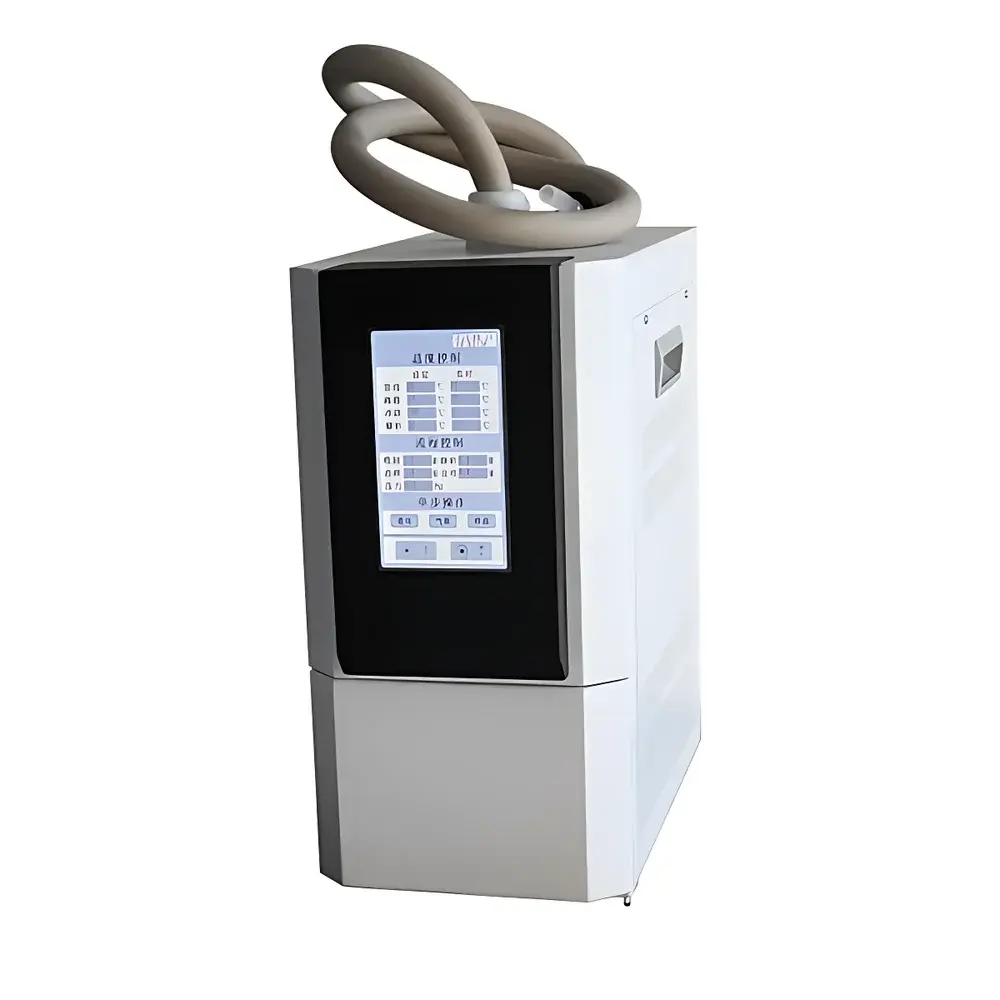
Beifen Sanpu HP-6900N Atmospheric Pre-concentrator
| Brand | Beifen Sanpu |
|---|---|
| Origin | Beijing, China |
| Manufacturer Type | Direct Manufacturer |
| Model | HP-6900N |
| Instrument Type | Dual-stage Thermal Desorber |
| Cryo-trap Temperature Range | −35 °C to ambient, 1 °C increments |
| Desorption Temperature Range | Ambient to 350 °C, 1 °C increments |
| Valve & Transfer Line Temp Range | Ambient to 220 °C, 1 °C increments |
| Temperature Control Accuracy | < ±0.5 °C |
| Adsorption Flow Rate | 0–300 mL/min (adjustable) |
| Desorption Recovery Rate | >90% |
| Sample Position Count | 1 |
| Dimensions | 400 × 220 × 420 mm |
| Power Consumption | ~300 W |
| Weight | ~20 kg |
Overview
The Beifen Sanpu HP-6900N Atmospheric Pre-concentrator is a dual-stage thermal desorption system engineered for trace-level volatile organic compound (VOC) and sulfur-containing compound analysis in ambient air matrices. It operates on the principle of cryogenic pre-concentration followed by rapid thermal desorption—enabling quantitative transfer of analytes from large-volume air samples onto capillary gas chromatography (GC) or GC–mass spectrometry (GC–MS) systems. Designed specifically to meet the requirements of GB/T 14678–1993 for the determination of hydrogen sulfide, methanethiol, dimethyl sulfide, and dimethyl disulfide in ambient air, the HP-6900N integrates semiconductor-based cooling with precisely programmable temperature gradients across four independently controlled zones: adsorption trap, desorption oven, valve manifold, and transfer line. Its architecture supports full automation—including timed adsorption, cryofocusing, flash desorption, backflush cleaning, and synchronized GC trigger—ensuring high reproducibility, minimal carryover, and compliance-ready operation in regulated environmental testing laboratories.
Key Features
- Four-zone independent temperature control: cryo-trap (−35 °C to ambient), desorption zone (ambient to 350 °C), valve manifold (ambient to 220 °C), and transfer line (ambient to 220 °C), all adjustable in 1 °C increments with accuracy better than ±0.5 °C.
- Semiconductor refrigeration system eliminates reliance on liquid nitrogen or mechanical compressors—reducing operational complexity, maintenance burden, and safety hazards associated with cryogens.
- Integrated flow sensor enables real-time volumetric sampling calculation; users define target concentration thresholds and the system automatically calculates required sampling duration (0.01–999 min) at flow rates up to 300 mL/min.
- Dual-purge capability: automated backflush of both sample transfer lines and valve pathways (0.01–999 min, 0–160 mL/min) prevents cross-contamination between sequential analyses.
- Full inert surface treatment throughout gas pathways—including stainless-steel tubing, Swagelok fittings, and internal linings—minimizes analyte adsorption, especially critical for reactive sulfur species and polar VOCs.
- 7-inch capacitive touchscreen interface with Chinese/English language toggle; supports complete method programming, runtime monitoring, timestamped event logging, and calendar-based scheduling.
- Hardware-level GC synchronization: TTL-triggered start of GC oven ramp and data acquisition via dedicated I/O port; compatible with Agilent, Thermo Fisher, Shimadzu, PerkinElmer, and domestic GC/GC–MS platforms through configurable analog/digital interfaces.
Sample Compatibility & Compliance
The HP-6900N accepts standard 1/4″ OD stainless-steel or fused-silica sorbent tubes (e.g., Tenax TA, Carbopack B/C, Carboxen 1000) and supports single-tube operation optimized for regulatory methods requiring discrete atmospheric sampling. Its performance aligns with key international standards including EPA TO-17 (determination of VOCs in ambient air), ISO 16017-1 (indoor air—sampling and analysis of VOCs), and ASTM D6196 (selection of sorbents for VOC monitoring). The instrument’s deterministic timing, calibrated flow control, and documented thermal profiles support auditability under GLP and ISO/IEC 17025 frameworks. All temperature and flow parameters are logged with timestamps and user IDs, satisfying traceability requirements for FDA 21 CFR Part 11–compliant environments when paired with validated LIMS or chromatography data systems.
Software & Data Management
Local configuration and method development occur via the embedded touchscreen UI, which stores up to 100 user-defined methods with version-stamped metadata. For centralized deployment, PC-based configuration software (Windows-compatible, USB or Ethernet-connected) provides advanced scripting capabilities—including multi-step thermal ramps, conditional triggers, and interlock logic with external devices. All operational logs—including temperature setpoints, actual readings, flow rates, event timestamps, and error codes—are exportable in CSV format. Audit trails record operator logins, parameter changes, and method executions—supporting review workflows during internal QA audits or regulatory inspections. No cloud connectivity or proprietary binary formats are used; raw data remains fully accessible and human-readable without vendor-specific viewers.
Applications
- Regulatory ambient air monitoring per GB/T 14678–1993 and EPA Method TO-17 for odorant sulfur compounds (H2S, CH3SH, (CH3)2S, (CH3)2SS).
- Indoor air quality (IAQ) assessment targeting formaldehyde, benzene, toluene, xylenes (BTX), and other C2–C12 VOCs at sub-pptr levels.
- Workplace exposure evaluation in petrochemical, pharmaceutical, and wastewater treatment facilities where low-concentration reactive volatiles require pre-concentration prior to GC separation.
- Method development and validation studies requiring precise control over adsorption kinetics, cold trap focusing efficiency, and thermal desorption fidelity.
- Calibration traceability using liquid standard injection mode—enabling direct comparison between gaseous and liquid-phase calibration approaches.
FAQ
Is the HP-6900N compatible with non-Chinese GC systems?
Yes. It features universal analog and digital I/O ports, along with mechanical adapters and protocol documentation for seamless integration with Agilent 7890/8890, Thermo ISQ/Trace 1300, Shimadzu GC-2030, and PerkinElmer Clarus series instruments.
Does the system support multi-tube autosampling?
No. The HP-6900N is configured for single-tube operation. For high-throughput applications requiring unattended multi-sample analysis, Beifen Sanpu offers the HP-6900A series with 20-position autosamplers.
What is the typical desorption recovery rate for polar compounds like aldehydes?
Recovery exceeds 90% for most VOCs including formaldehyde, acetaldehyde, and acetone when using appropriate sorbent combinations (e.g., Carbopack X + Carbopack B) and optimized cryo-focusing conditions.
Can the cold trap reach temperatures below −35 °C?
No. The semiconductor cooling module is rated for a minimum of −35 °C, sufficient for trapping C2–C12 VOCs at recommended sampling flow rates. Lower temperatures would require LN2-based systems not supported by this model.
Is firmware update capability available remotely?
Firmware updates are performed locally via USB drive only. No remote access, telemetry, or network connectivity is implemented—ensuring data security and compliance with air-gapped laboratory IT policies.





