
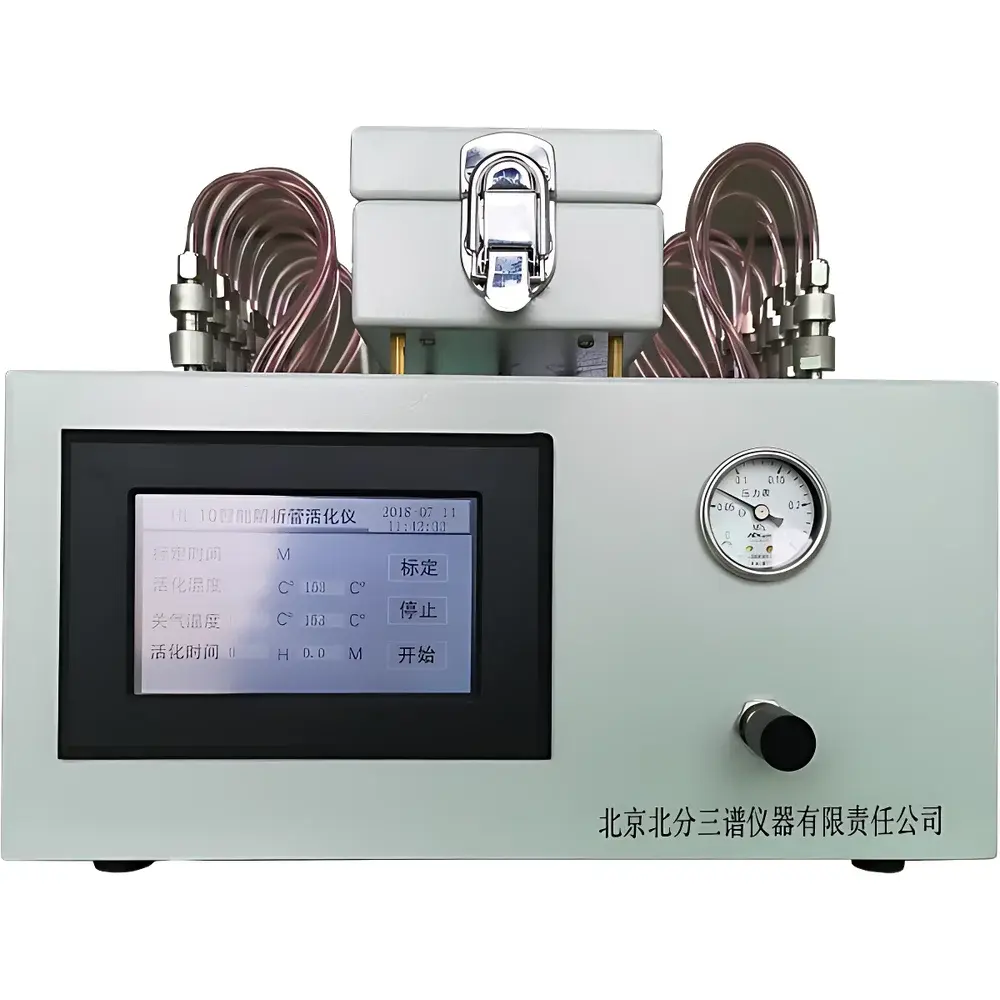
Beifen Sanpu LH-10 Adsorption Tube Aging Instrument
| Brand | Beifen Sanpu |
|---|---|
| Origin | Beijing, China |
| Manufacturer Type | Direct Manufacturer |
| Model | LH-10 |
| Temperature Control Range | Ambient to 450 °C |
| Gas Flow Rate | 0–200 mL/min |
| Tube Capacity | 10 tubes |
| Power Supply | 220 VAC, 50 Hz |
| Power Consumption | <200 VA |
| Temperature Accuracy | ±1 °C |
| Maximum Aging Duration | >999 h |
| Simulated Sampling Time | 0–99 min |
| Flow Adjustment Range | 0–1000 mL/min |
| Tube Dimensions (Standard) | Ø6 mm × ≥110 mm |
| Dimensions (H×W×D) | 225 × 265 × 345 mm |
| Net Weight | ~10.5 kg |
Overview
The Beifen Sanpu LH-10 Adsorption Tube Aging Instrument is a precision-engineered thermal conditioning system designed for the controlled thermal desorption (CTD) workflow in volatile organic compound (VOC) and semi-volatile organic compound (SVOC) analysis. It operates on the principle of programmed thermal aging—applying precise, uniform heat under regulated inert gas flow to remove residual contaminants, moisture, and memory effects from sorbent-packed adsorption tubes prior to sampling or analytical use. This process ensures baseline stability, minimizes carryover, and enhances method reproducibility in accordance with ISO 16000-6, ASTM D6196, and EPA TO-17 protocols. The LH-10 is not a standalone analytical instrument but a critical pre-analytical preparation tool integrated into GC–MS, GC–FID, and thermal desorption–gas chromatography (TD–GC) laboratories serving environmental monitoring, occupational hygiene, building material emissions testing, and regulatory compliance workflows.
Key Features
- Intelligent 5-inch capacitive touch interface with real-time display of temperature, flow rate, elapsed time, and remaining cycle duration—enabling intuitive parameter configuration and status monitoring.
- Independent dual-zone heating architecture: one zone for tube bed temperature control (ambient to 450 °C), another for inlet gas line pre-heating—eliminating condensation and ensuring consistent thermal delivery to all 10 tube positions.
- Simultaneous aging of up to 10 standard adsorption tubes (Ø6 mm × ≥110 mm), supporting common formats including Tenax TA, Carbopack B/C, Carboxen, and multi-bed sorbent configurations.
- Integrated safety logic: automatic power cutoff when temperature exceeds user-defined safety threshold (configurable up to 450 °C); redundant overtemperature protection via independent mechanical thermostat.
- Automated cooldown sequence: upon aging completion, the system initiates forced-air cooling to user-specified endpoint temperature (e.g., 50 °C), followed by automatic gas shutoff—reducing argon/nitrogen consumption and minimizing operator intervention.
- Optional simulated sampling module enables quantitative spiking of certified reference standards directly onto aged tubes, facilitating recovery calibration and method validation per ISO/IEC 17025 requirements.
Sample Compatibility & Compliance
The LH-10 accommodates industry-standard stainless steel or quartz-lined adsorption tubes with outer diameters of 6 mm and minimum lengths of 110 mm. Its uniform axial heating profile and laminar gas distribution manifold ensure equivalent thermal exposure across all 10 positions—critical for inter-tube consistency in accredited laboratories. The instrument supports traceable calibration using NIST-traceable thermocouples and mass flow controllers. Its operational parameters align with QA/QC requirements outlined in US EPA Method TO-17 (Section 8.2.1), ISO 16000-6 Annex B, and EN 16516 Annex C. Full audit trail capability—including timestamped start/stop events, temperature logs, and gas flow records—is available when paired with optional data logging software compliant with FDA 21 CFR Part 11 and GLP/GMP documentation standards.
Software & Data Management
The LH-10 operates autonomously via its embedded firmware; no external PC is required for routine operation. All method parameters—including target temperature, ramp rate, dwell time, cooldown setpoint, and gas flow—are stored as named methods (up to 99 user-defined protocols). Each run generates an internal log file containing date/time stamp, actual temperature profile (recorded at 10-second intervals), flow verification points, and fault codes (if triggered). Optional USB export enables transfer of CSV-formatted logs for integration into LIMS or statistical process control (SPC) platforms. For laboratories requiring electronic records management, a validated software add-on provides electronic signature support, role-based access control, and change history tracking—fully aligned with ALCOA+ data integrity principles.
Applications
- Pre-conditioning of sorbent tubes prior to active or passive air sampling in indoor air quality (IAQ) and ambient air monitoring programs.
- Method validation and recovery testing in VOC emission studies from construction materials, furniture, and automotive interior components (per ISO 16000-9, ISO 12219-4).
- Quality assurance for certified reference material (CRM) preparation in metrology institutes and national measurement laboratories.
- Routine maintenance of thermal desorption systems in third-party environmental testing labs accredited to ISO/IEC 17025:2017.
- Research applications involving novel sorbent evaluation, breakthrough capacity assessment, and aging kinetics modeling under controlled thermal–atmospheric conditions.
FAQ
What tube specifications are supported by the LH-10?
The instrument is optimized for 6 mm OD adsorption tubes with a minimum length of 110 mm. Tubes must be compatible with temperatures up to 450 °C and inert gas flow (N₂ or Ar). Custom fixtures are available for alternative diameters upon request.
Does the LH-10 meet regulatory requirements for accredited testing?
Yes—its temperature accuracy (±1 °C), traceable calibration options, automated logging, and configurable safety limits support compliance with ISO/IEC 17025, EPA TO-17, and ISO 16000 series standards when operated within documented SOPs.
Can aging parameters be exported for audit purposes?
All run data—including timestamps, setpoints, actual profiles, and event flags—are stored internally and exportable via USB as time-stamped CSV files suitable for regulatory review.
Is remote monitoring or network connectivity supported?
The base model operates stand-alone; however, RS-232 or Ethernet-enabled variants are available for integration into centralized lab automation systems (subject to custom configuration and validation).
What maintenance is required for long-term reliability?
Routine inspection of O-rings, gas fittings, and heating element terminals is recommended every 6 months. No scheduled recalibration is required unless physical damage or performance deviation is observed—verified via annual verification using calibrated reference thermometers and flow meters.
Related Products






