
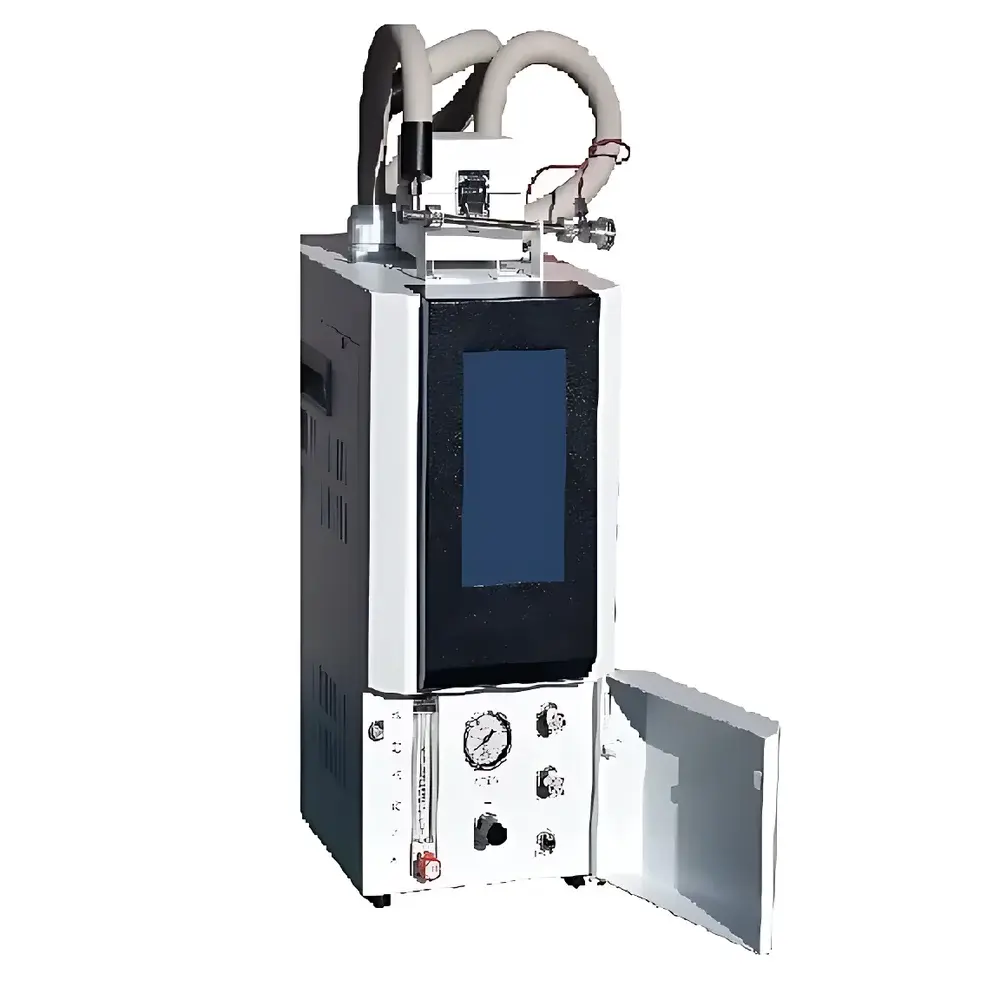
Beifen Sanpu TADS-3430 Dual-Stage Thermal Desorber for GC/GC-MS
| Brand | Beifen Sanpu |
|---|---|
| Origin | Beijing, China |
| Manufacturer Type | Direct Manufacturer |
| Instrument Type | Dual-stage Thermal Desorber |
| Desorption Temperature Range | Ambient to 450 °C |
| Cold Trap Temperature Range | −35 °C to Ambient |
| Desorption Recovery Rate | >99% (compound-dependent) |
| Sample Position Capacity | 1 tube |
Overview
The Beifen Sanpu TADS-3430 is a fully automated, dual-stage thermal desorber engineered for high-fidelity sample introduction into gas chromatography (GC) and gas chromatography–mass spectrometry (GC-MS) systems. It operates on the principle of thermally driven analyte release from sorbent tubes—first-stage desorption transfers volatiles to a cryogenically focused cold trap; second-stage rapid thermal desorption (≥3000 °C/min) injects a narrow, highly concentrated analyte band into the GC column. This two-step process significantly enhances sensitivity, peak shape integrity (peak width <3 s), and quantitative reproducibility—critical for trace-level volatile organic compound (VOC) analysis in environmental, occupational health, and building material testing applications. Designed to meet stringent regulatory requirements, the TADS-3430 supports method-compliant workflows aligned with U.S. EPA TO-17, ISO 16017-1, and multiple Chinese national standards including HJ 644–2013, HJ 583–2010, and GB 50325–2020.
Key Features
- Integrated Peltier-based cooling system enables precise cold trap temperature control from −35 °C to ambient, eliminating reliance on liquid nitrogen or mechanical chillers and reducing operational cost and complexity.
- Four independently programmable heating zones: primary desorption oven, secondary desorption chamber, six-port valve assembly, and transfer line—all heated up to 450 °C (valve up to 240 °C) with ±0.5 °C stability.
- High-inertness, de-activated fused-silica transfer lines minimize adsorption and carryover; automated back-flush functionality prevents cross-contamination between samples.
- Motor-driven high-temperature six-port valve (240 °C max) ensures precise timing and robust actuation under repeated thermal cycling.
- 7-inch full-color LCD touchscreen interface with intuitive Chinese/English bilingual navigation; all parameters—including desorption time, trap focusing duration, and purge flow—are fully programmable via time-segmented method templates.
- Onboard calibration simulation mode allows direct generation of standard curves using certified reference gases or liquid spiking, streamlining method validation and QC checks.
- Universal GC interface compatibility: includes dedicated hardware adapters for Agilent, Thermo Fisher, Shimadzu, PerkinElmer, and domestic GC platforms; 24 V low-voltage power supply for transfer line ensures intrinsic safety and EMI resilience.
Sample Compatibility & Compliance
The TADS-3430 accepts standard 1/4″ OD stainless steel or glass sorbent tubes (≤6.5 mm diameter, ≥150 mm length), compatible with common multi-bed sorbents (e.g., Tenax TA, Carbopack B/C, Carboxen 1000). It supports both ambient and refrigerated sampling protocols per ISO 16017-1 and HJ 644–2013. All thermal zones comply with GLP documentation requirements: audit-trail-capable method storage, real-time status logging, and timestamped run records facilitate FDA 21 CFR Part 11–aligned data governance when paired with compliant chromatography data systems (CDS). The instrument’s RSD ≤2.5% (measured at 0.05 μg benzene on Tenax TA) meets precision thresholds defined in USP , EP 2.2.46, and GB/T 32466–2015 for VOC quantification.
Software & Data Management
Control firmware supports seamless synchronization with external GC start signals or CDS software triggers (e.g., OpenLab CDS, Chromeleon, GCsolution). Method files store complete thermal profiles, flow settings (purge: 0–100 mL/min; sampling: 0–160 mL/min), and timing sequences—each editable via USB or touchscreen. Internal memory retains ≥100 method templates and 500 run logs with date/time stamps, operator ID fields, and error flags. Exportable CSV reports include desorption temperature ramps, cold trap equilibration times, and valve actuation events—enabling traceability during regulatory audits. No proprietary software installation is required; configuration remains accessible via embedded web interface (optional Ethernet module).
Applications
- Environmental monitoring: ambient air, indoor air, and stack emissions analysis per HJ 734–2014, HJ/T 400–2007, and GB/T 18883–2002.
- Building material emission testing: formaldehyde, benzene, toluene, xylene, and C2–C12 aliphatics from carpets, adhesives, and composite wood products (GB 50325–2020).
- Workplace exposure assessment: OSHA Method 52, NIOSH 1501, and ISO 16017-1 compliant sampling of industrial solvents and monomers.
- Food packaging migration studies: residual monomers and printing ink volatiles in PET, PE, and multilayer laminates.
- Forensic and failure analysis: off-gassing characterization of polymers, sealants, and electronic encapsulants.
FAQ
Does the TADS-3430 support single-stage desorption mode?
Yes—it can be configured via software to operate as a conventional single-stage thermal desorber by bypassing cold trap focusing.
What sorbent tube specifications are supported?
Tubes must be ≤6.5 mm OD and ≥150 mm long; compatibility verified with Markes, Supelco, and custom-packed tubes using Tenax TA, Carbopack series, or graphitized carbon black media.
Is remote operation possible?
Standard RS-232 and optional Ethernet interfaces enable integration into centralized lab automation networks; no cloud connectivity or vendor lock-in is implemented.
How is calibration verified?
The built-in simulation mode allows dynamic spiking of certified gas standards directly into the sampling path; recovery tests across 0.01–10 μg ranges satisfy ISO/IEC 17025 method validation criteria.
What maintenance intervals are recommended?
Valve actuator lubrication every 12 months; cold trap cleaning every 200 runs; transfer line bake-out at 300 °C for 30 minutes after high-boiling sample batches.
Related Products





