
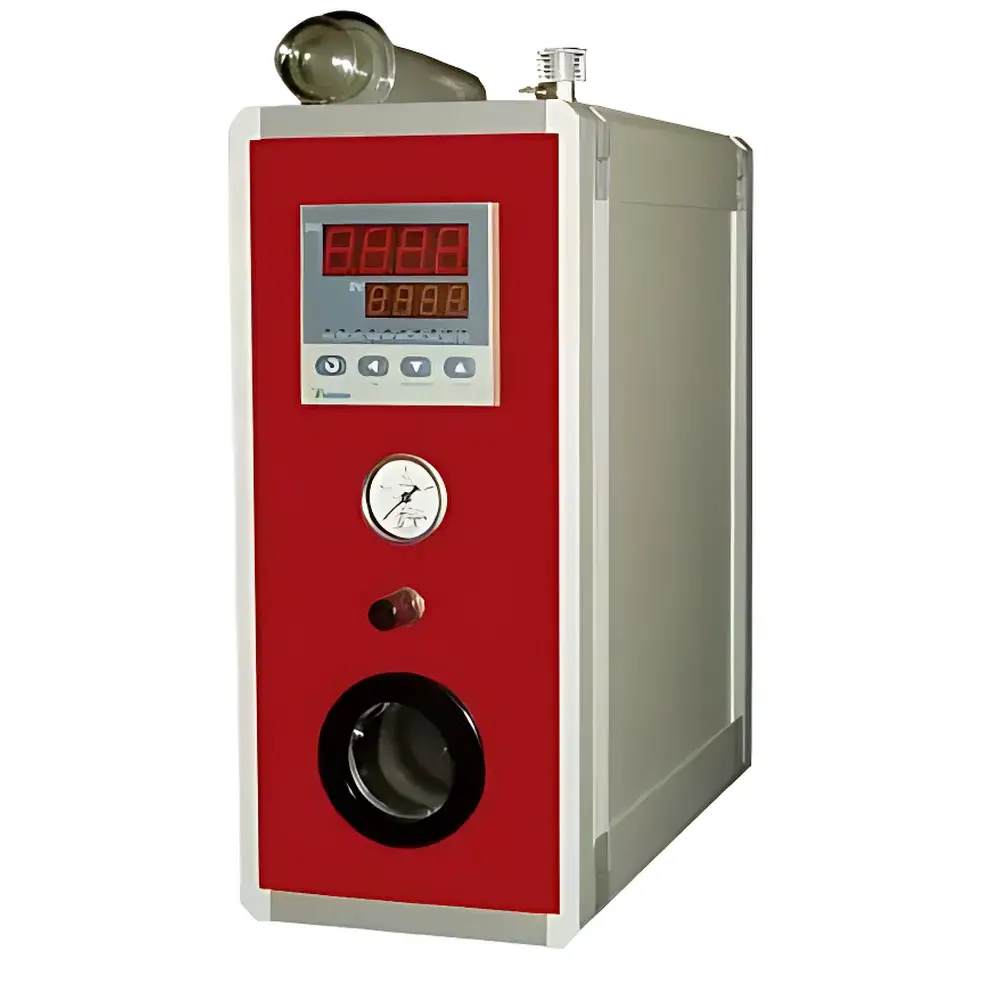
Beifen Sanpu TDS-3430 Dual-Stage Thermal Desorber
| Brand | Beifen Sanpu |
|---|---|
| Origin | Beijing, China |
| Manufacturer Type | Direct Manufacturer |
| Instrument Type | Dual-Stage Thermal Desorber / Thermal Desorption Unit |
| Desorption Temperature Range | 150–380 °C |
| Cold Trap Temperature | −30 °C |
| Desorption Recovery Rate | ≥85% (compound-dependent) |
| Sample Positions | 10 |
| Activation & Desorption Furnace Temp Range | Ambient to 400 °C (1 °C increments) |
| Syringe Heater Temp Range | Ambient to 100 °C (1 °C increments) |
| Syringe Capacity | Up to 100 mL |
| Tube OD Compatibility | 6 mm or 1/4″ |
| Flow Control Range | 10–200 mL/min (stability <0.1%) |
| Dimensions | 390 × 170 × 360 mm |
Overview
The Beifen Sanpu TDS-3430 Dual-Stage Thermal Desorber is a benchtop sample introduction system engineered for offline thermal desorption prior to gas chromatographic analysis. It operates on the principle of controlled thermal volatilization—where analytes adsorbed onto solid-phase sorbent tubes (e.g., Tenax TA, Carbopack B/C, activated carbon) are thermally released under inert carrier gas flow, concentrated in a cryogenically cooled trap (−30 °C), and subsequently re-desorbed as a narrow, focused band into the GC inlet. This two-stage process—comprising primary desorption from the sampling tube and secondary focusing/remobilization from the cold trap—significantly enhances sensitivity, peak shape, and quantitative reproducibility for trace-level volatile organic compounds (VOCs) and semi-volatile organic compounds (SVOCs). Designed explicitly to support compliance with GB 50325–2006 (China’s Standard for Indoor Air Pollution Control in Civil Construction Projects), the TDS-3430 enables robust execution of benzene and total volatile organic compound (TVOC) determinations in indoor air matrices without requiring full automation or integration with autosamplers.
Key Features
- Integrated dual-function architecture: Combines a programmable desorption furnace (ambient to 400 °C) and a precision syringe heater (ambient to 100 °C) in a single compact chassis—eliminating external heating modules and minimizing thermal lag.
- Manual syringe-based injection pathway: Accommodates standard glass or stainless-steel 100 mL gas-tight syringes; enables direct transfer of desorbed vapor into split/splitless GC inlets without valving complexity.
- Zero-dead-volume tube interface: Uses standardized 6 mm OD (or 1/4″) sorbent tubes with optimized sealing geometry—reducing analyte loss, carryover, and breakthrough during high-flow desorption (10–200 mL/min).
- Repeat-injection capability: Allows multiple manual injections from the same desorbed syringe, supporting method validation, replicate analysis, and troubleshooting without re-desorbing the original tube.
- User-centric design: Intuitive dual digital temperature controllers, tactile manual actuation, and minimal setup steps reduce operator training time—particularly advantageous in QC labs with mixed-experience personnel.
- Cost-effective consumables compatibility: Fully supports low-cost activated carbon tubes for TVOC screening per GB 50325–2006 Annex E, while maintaining quantitative recovery ≥85% across C6–C16 hydrocarbons and oxygenates.
Sample Compatibility & Compliance
The TDS-3430 accommodates industry-standard sorbent tubes—including single-bed (e.g., Tenax TA) and multi-bed configurations (e.g., Carbopack B + Carbopack C + Carbosieve SIII)—with no modification required. Its flow stability (<0.1%) and precise temperature ramping (±0.5 °C accuracy) ensure adherence to critical parameters outlined in GB 50325–2006 Sections 6.2.12 (benzene) and 6.2.13 (TVOC), as well as aligned methodologies in ISO 16000-6 and ASTM D6196. While not inherently 21 CFR Part 11 compliant due to its manual operation and lack of electronic audit trail, the instrument supports GLP-aligned workflows when paired with documented SOPs, calibrated syringes, and validated tube lots. All thermal zones meet IEC 61010-1 safety requirements for laboratory electrical equipment.
Software & Data Management
The TDS-3430 operates via standalone hardware controls—no proprietary software, drivers, or PC connectivity are required. Temperature setpoints, ramp rates, and hold times are configured directly on dual independent PID controllers with LED displays. This design prioritizes operational reliability, eliminates software licensing dependencies, and ensures uninterrupted use in environments where IT policy restricts third-party installations. Raw data (e.g., desorption time, syringe volume, GC integration results) are recorded manually or imported into LIMS via standard CSV export from chromatography data systems (CDS) such as Agilent OpenLab, Thermo Chromeleon, or Shimadzu LabSolutions. Traceability is maintained through lab notebook entries referencing tube lot numbers, calibration certificates for syringes and flow meters, and temperature verification logs per ISO/IEC 17025 Clause 6.4.3.
Applications
- Indoor air quality (IAQ) monitoring per GB 50325–2006, including benzene, toluene, ethylbenzene, xylenes (BTEX), and C9–C16 aliphatics/aromatics.
- Workplace exposure assessment for VOCs in occupational hygiene laboratories using NIOSH/OSHA-compatible sampling protocols.
- Material emission testing (e.g., carpets, adhesives, particleboard) following ISO 16000-9 and ASTM D5116.
- Environmental forensics and source identification where manual injection allows flexible fraction collection or selective reinjection.
- Educational laboratories requiring a pedagogically transparent, maintenance-light platform for teaching thermal desorption fundamentals and GC coupling principles.
FAQ
Is the TDS-3430 compatible with all common sorbent tube formats?
Yes—it accepts standard 6 mm OD (¼″) stainless steel or glass tubes up to 150 mm in length, including single- and multi-bed configurations. No adapters or custom fixtures are needed.
Can it be used for EPA Method TO-17 analysis?
While the TDS-3430 meets key thermal and flow specifications referenced in TO-17 (e.g., desorption at 250–320 °C, cold trap at −30 °C), it does not provide automated sequential tube processing or electronic method scheduling. It is suitable for TO-17-compliant *manual* workflows when paired with validated tube lots and documented SOPs.
What is the typical lifetime of the cold trap assembly?
The −30 °C Peltier-cooled trap has no consumable refrigerants and requires only periodic cleaning with methanol to remove non-volatile residues. Under normal use (≤10 samples/day), mechanical longevity exceeds 5 years with proper desiccant maintenance.
Does the instrument include flow calibration verification tools?
No built-in calibrator is supplied, but the unit features a calibrated rotameter and supports external bubble flowmeter verification per ISO 5725. Users are advised to perform quarterly flow checks using NIST-traceable standards.
Is service and spare parts support available outside China?
Beifen Sanpu provides technical documentation, controller firmware updates, and OEM replacement components (furnace elements, Peltier modules, temperature sensors) globally via authorized distributors—with lead times typically 4–6 weeks for non-stock items.
Related Products





