
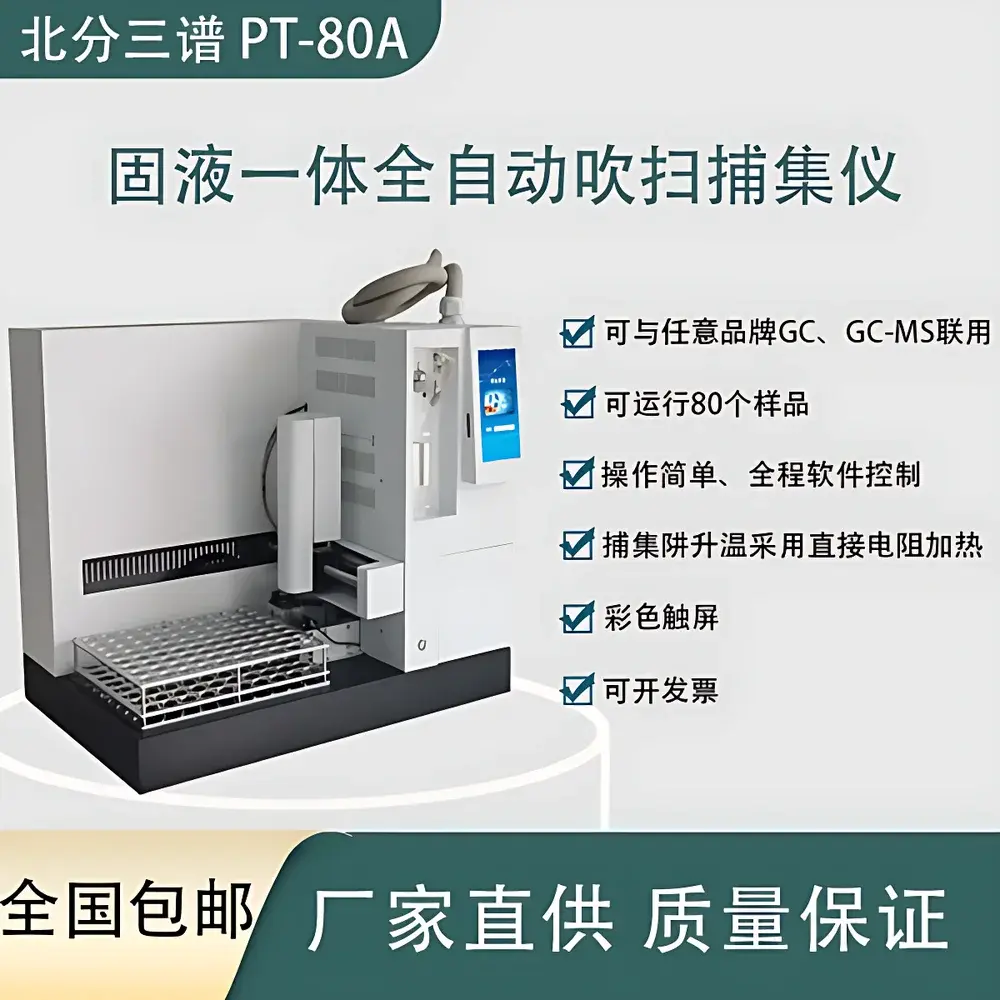
Beifen Sanpu TP-80A Fully Automated Purge and Trap Concentrator for Water and Soil Matrices
| Brand | Beifen Sanpu |
|---|---|
| Origin | Beijing, China |
| Manufacturer Type | Direct Manufacturer |
| Country of Origin | China |
| Model | TP-80A |
| Instrument Category | Water-and-Soil Integrated Purge and Trap System |
| Sample Tray Capacity | 80 positions (40 mL VOA vials) |
| Injection Precision | RSD ≤ 3% |
| Trap Temperature Range | Ambient to 380 °C |
| Cooling | 250 °C → 35 °C in ≤ 90 s |
| Purge Tube Heating | Ambient to 95 °C |
| Sample Chilling | Ambient (no active cooling) |
Overview
The Beifen Sanpu TP-80A is a fully automated, water-and-soil integrated purge and trap concentrator engineered for high-throughput, trace-level analysis of volatile organic compounds (VOCs) in environmental, regulatory, and food safety laboratories. It operates on the principle of dynamic headspace extraction: inert gas purging volatilizes target analytes from aqueous or solid-phase samples into a carrier stream, which transports them onto a cryogenically cooled or electronically refrigerated trap. Following desorption, analytes are transferred quantitatively—via heated transfer lines—to a coupled gas chromatograph (GC) or GC–mass spectrometer (GC–MS) for separation and detection. Designed to meet the rigorous demands of U.S. EPA Method 524.2, 502.2, 624, and 8260-compliant workflows—as well as Chinese standard methods HJ 605–2011, HJ 639–2012, and HJ 686–2014—the TP-80A delivers robust performance across heterogeneous sample matrices without manual intervention.
Key Features
- Fully automated 80-position sample carousel accommodating standard 40 mL VOA vials, supporting unattended operation for up to three shifts;
- Electronic Peltier-based cold trap capable of reaching –40 °C (at ambient 20 °C), eliminating dependency on liquid nitrogen while maintaining reproducible low-temperature trapping efficiency;
- Direct-resistance-heated quartz trap (Φ4 mm × 80 mm × 1 mm) with ultra-rapid thermal response: heating rate > 2000 °C/min and controlled cool-down from 250 °C to 35 °C within 90 seconds;
- Integrated foam sensor in the purge tube assembly to detect foaming events during aqueous sample purging, preventing carryover and safeguarding downstream instrumentation;
- Independent purge gas and back-flush gas pathways ensure zero cross-contamination between samples; trapped analytes are never routed back through the purge tube during desorption;
- Dual-stage water management: a dedicated heated water removal trap (up to 400 °C) positioned at the purge gas inlet removes bulk moisture prior to trapping, minimizing water-induced GC column degradation and MS source contamination;
- All fluidic paths—including transfer lines, six-port valves, and purge tubes—feature PEEK and silanized stainless-steel construction with zone-specific heating (ambient to 220 °C) to eliminate cold spots and prevent analyte condensation or adsorption;
- Solid-sample module enables direct addition of 5 mL distilled water, programmable heating (ambient to 100 °C), and mechanical shaking for homogeneous slurry formation prior to purge;
- Two TTL-synchronized digital outputs (1–2 s pulse width) allow precise triggering of GC oven start, valve switching, and data acquisition systems in accordance with 21 CFR Part 11–compliant audit trail requirements.
Sample Compatibility & Compliance
The TP-80A supports both liquid (e.g., drinking water, wastewater, leachates) and solid (e.g., soil, sediment, sludge) matrices without hardware modification. Its design aligns with internationally recognized analytical standards including ASTM D5016, ISO 15681-2, and EN ISO 17943. For regulatory compliance, the system is validated for use in laboratories operating under GLP and GMP frameworks. All temperature zones, timing sequences, and method parameters are logged with timestamped audit trails, satisfying FDA 21 CFR Part 11 data integrity requirements when paired with compliant chromatography data systems (CDS). The instrument’s modular architecture permits integration into existing LIMS environments via RS-232 or Ethernet interfaces.
Software & Data Management
Control is executed via a Windows-based PC application featuring intuitive graphical workflow configuration, real-time monitoring of all thermal zones and pneumatic states, and remote instrument supervision. Method files store complete parameter sets—including purge time (0.1 s–100 min), flow rate (0–150 mL/min), trap desorption profile, and rinse cycles—and support version-controlled archiving. The software enforces user role-based access control (RBAC), electronic signatures, and automatic backup of raw logs to network drives. All operational events—including power-on, method load, sample injection, error alerts, and maintenance reminders—are recorded in an immutable event log compatible with third-party validation packages.
Applications
- Regulatory monitoring of VOCs in drinking water per Standard Methods 524.2 and GB/T 5750.8–2023;
- Analysis of chlorinated solvents, BTEX, and haloethers in soil and sediment per HJ 605–2011 and EPA SW-846 Method 5035A;
- Screening of volatile contaminants in food packaging materials and agricultural commodities;
- Environmental forensics involving petroleum hydrocarbon fingerprinting in groundwater plumes;
- Method development and validation studies requiring high inter-day precision (RSD ≤ 3% for replicate injections) and minimal carryover (< 0.1% for high-concentration standards).
FAQ
Can the TP-80A be interfaced with third-party GC or GC–MS systems?
Yes—its universal pneumatic and electrical interfaces support seamless integration with Agilent, Thermo Fisher, Shimadzu, PerkinElmer, and other major GC platforms via analog/digital synchronization signals.
Does the system require liquid nitrogen for cold trapping?
No—the Peltier-cooled trap achieves –40 °C without cryogens, reducing operational cost and safety hazards associated with LN₂ handling.
How is carryover mitigated during high-concentration sample analysis?
The system employs programmable needle and purge tube rinses with hot water (up to 90 °C), combined with independent back-flush gas routing and heated transfer lines to minimize residual adsorption.
Is method validation documentation available?
Yes—Beifen Sanpu provides IQ/OQ documentation templates, temperature mapping reports, and RSD verification protocols aligned with ISO/IEC 17025 and CNAS requirements.
What maintenance intervals are recommended for routine operation?
Daily: visual inspection of purge tube and trap integrity; quarterly: replacement of O-rings, calibration of flow sensors, and verification of cold trap performance at –40 °C.




