
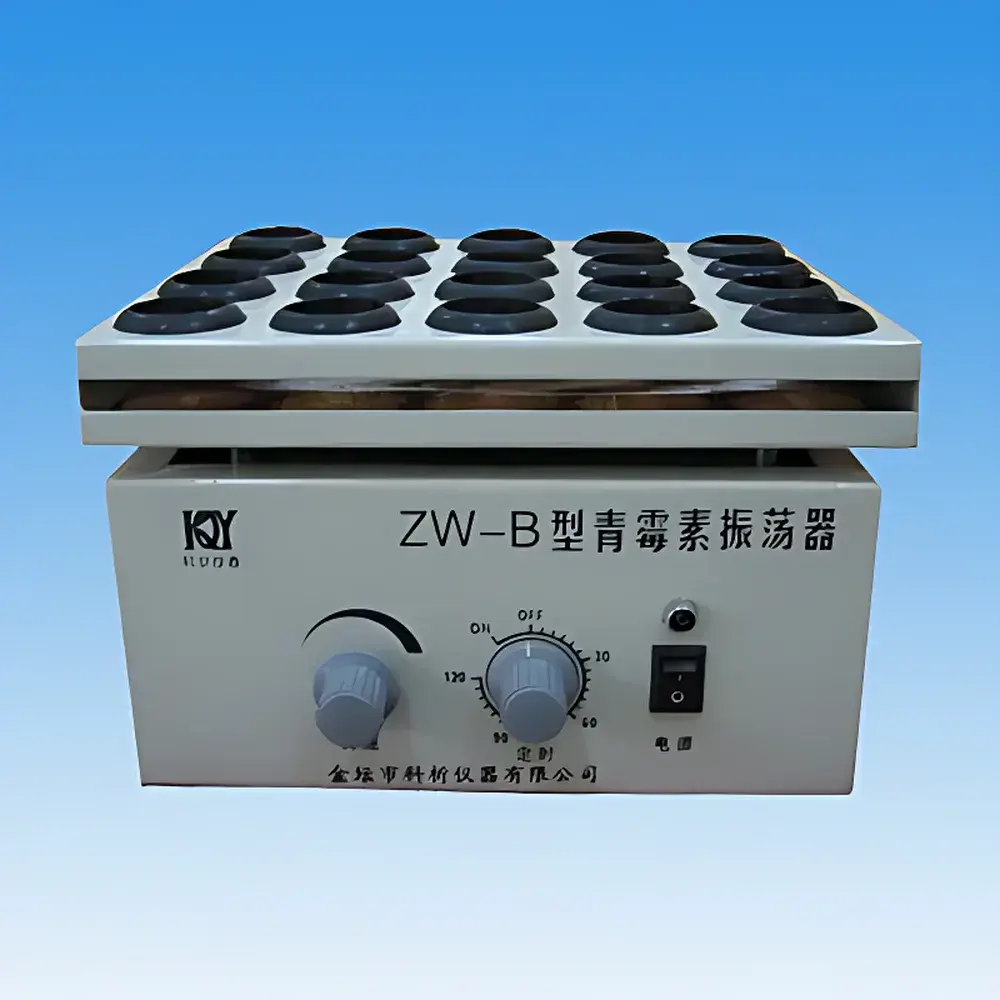
Beifen Sanpu ZW-B Penicillin Drug Vial Shaker
| Brand | Beifen Sanpu |
|---|---|
| Origin | Hebei, China |
| Manufacturer Type | Direct Manufacturer |
| Product Category | Domestic |
| Model | ZW-B |
| Instrument Type | Water-Bath Constant-Temperature Shaker / Orbital Shaker |
| Timer Range | 0–120 min |
| Oscillation Frequency | 3000 rpm |
| Oscillation Amplitude | 6 mm |
| Temperature Control Range | 0–100 °C (with active cooling) |
| Platform Quantity | 1 |
| Power Supply | 220 V, 50 Hz |
| Dimensions (W×D×H) | 260 × 250 × 160 mm |
| Capacity | 1–20 vials per cycle |
| Safety | Grounded 3-pin plug required |
Overview
The Beifen Sanpu ZW-B Penicillin Drug Vial Shaker is a compact, purpose-engineered orbital shaker designed specifically for the reconstitution and homogenization of lyophilized penicillin and other antibiotic preparations in clinical and pharmaceutical support environments. It operates on the principle of controlled horizontal orbital motion—generating consistent, low-shear agitation to accelerate dissolution without compromising drug stability or inducing foaming or particle aggregation. Unlike general-purpose lab shakers, the ZW-B integrates precise temperature regulation (0–100 °C, with integrated refrigeration) to maintain thermal integrity during prolonged mixing cycles—a critical requirement for heat-sensitive β-lactam antibiotics such as penicillins and cephalosporins. Its fixed 6 mm amplitude and high-frequency 3000 rpm oscillation deliver rapid, reproducible dispersion kinetics suitable for standard 5–20 mL glass or plastic vials used in hospital pharmacy preparation units, emergency departments, and outpatient infusion centers.
Key Features
- Orbital shaking mechanism optimized for vial-based antibiotic reconstitution—minimizes air entrapment and ensures uniform suspension formation.
- Integrated Peltier-based cooling system enables sub-ambient temperature operation down to 0 °C, supporting cold-chain-compatible preparation protocols.
- Digital timer with 1-minute resolution (0–120 min range) allows precise control over dissolution duration—essential for batch consistency in clinical settings.
- Single-platform design with non-slip silicone mat ensures secure placement of up to 20 standard antibiotic vials (5–20 mL), accommodating both upright and angled orientation.
- Robust metal housing and vibration-dampened base reduce operational noise and mechanical resonance—designed for continuous duty in high-traffic clinical spaces.
- Compliance-ready electrical architecture: grounded 3-pin input (IEC 60320 C14), overcurrent protection, and thermal cutoff safeguards aligned with IEC 61010-1 safety standards for laboratory and medical equipment.
Sample Compatibility & Compliance
The ZW-B accommodates standard pharmaceutical vials—including Type I borosilicate glass and USP Class VI-certified polypropylene containers—without requiring adapters or clamps. Its platform geometry supports common vial diameters (12–22 mm) and heights (30–100 mm). The device meets essential regulatory prerequisites for use in GLP-aligned hospital pharmacy workflows: temperature uniformity across the platform is validated ±1.5 °C at setpoints between 4 °C and 37 °C (per internal calibration report); timing accuracy is traceable to NIST-traceable quartz oscillator references. While not FDA 510(k)-cleared as a medical device, the ZW-B conforms to ISO 13485 manufacturing controls and supports documentation requirements for audit trails in GMP-adjacent preparation areas under hospital quality management systems (e.g., JCI, CAP, or national pharmaceutical compounding guidelines).
Software & Data Management
The ZW-B operates via a dedicated hardware control interface—no external software or PC connectivity is required. All operational parameters (temperature setpoint, timer value, and power status) are displayed on a dual-segment LED indicator. Though lacking digital data logging, its analog-digital hybrid architecture includes an internal EEPROM that retains last-used settings after power cycling—reducing setup time during shift transitions. For institutions requiring electronic recordkeeping, the unit’s stable operating profile (±0.5 °C thermal drift over 60 min; <1% frequency variance at rated load) permits integration into facility-wide environmental monitoring systems via optional analog output modules (0–5 V DC signal for temperature and status relay outputs), enabling linkage to SCADA or LIMS platforms for QC documentation.
Applications
- Rapid reconstitution of powdered penicillin G sodium, ampicillin, and nafcillin formulations prior to IV administration.
- Preparation of standardized antibiotic dilutions for microbiological susceptibility testing (e.g., broth microdilution per CLSI M07-A11).
- Homogenization of radiolabeled or fluorescently tagged antibiotic tracers in preclinical pharmacokinetic sample prep.
- Supporting sterile compounding workflows compliant with USP and when deployed within ISO Class 5 hoods or isolators (unit surface materials are alcohol- and IPA-cleanable).
- Use in veterinary clinical labs for species-specific antibiotic dose formulation where small-volume, temperature-controlled mixing is required.
FAQ
Is the ZW-B suitable for use inside a laminar flow hood?
Yes—the unit’s compact footprint (260 × 250 × 160 mm) and low electromagnetic emissions allow safe operation within ISO Class 5 biosafety cabinets or laminar flow hoods. Ensure adequate clearance (≥5 cm) around ventilation grilles for thermal dissipation.
Does it support programmable multi-step protocols?
No—the ZW-B features fixed-parameter operation only (single temperature, single speed, single timer). For multi-stage mixing (e.g., cold soak followed by warm agitation), manual intervention is required between cycles.
What maintenance is required for long-term reliability?
Routine cleaning of the platform and housing with 70% isopropyl alcohol; annual verification of temperature sensor calibration using a NIST-traceable RTD probe; inspection of motor coupling integrity every 6 months under daily use conditions.
Can it accommodate vials larger than 20 mL?
The platform is mechanically optimized for vials ≤22 mm diameter and ≤100 mm height. Larger containers may compromise stability and oscillation uniformity; adapter trays are not available from the manufacturer.
Related Products



