
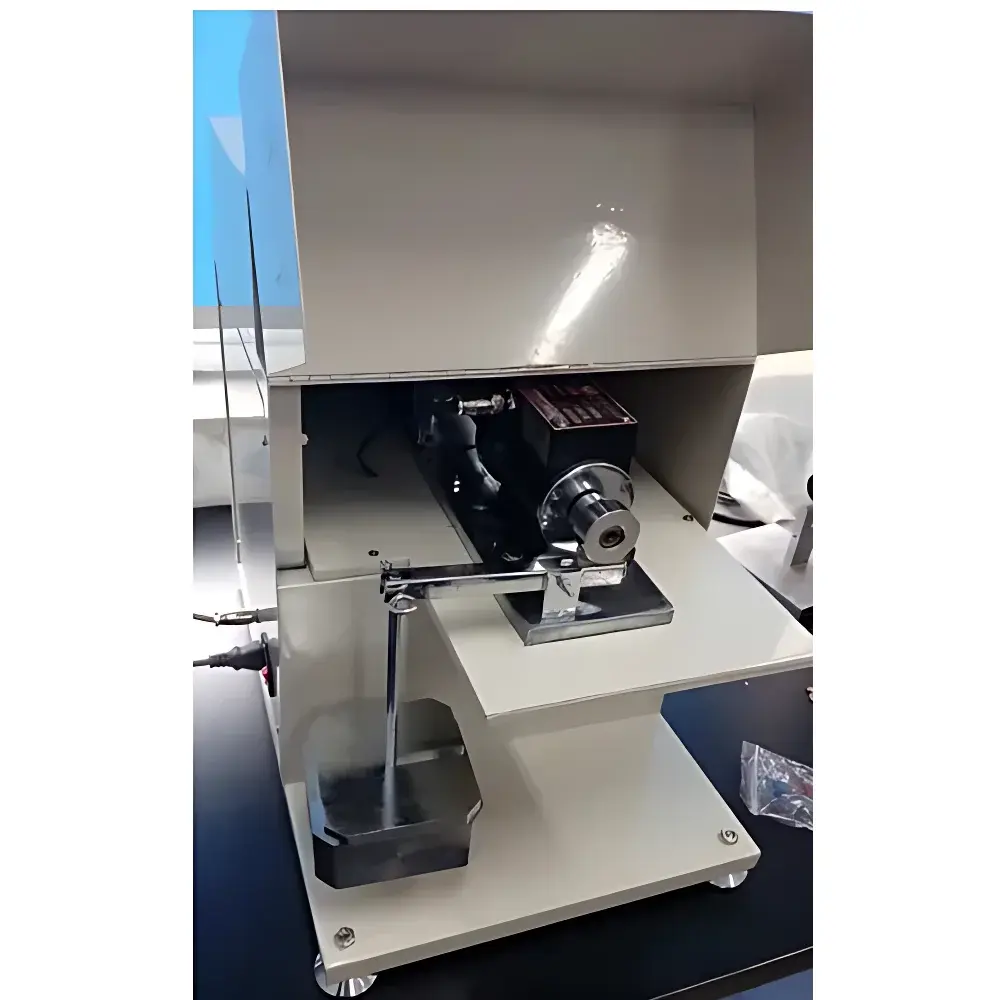
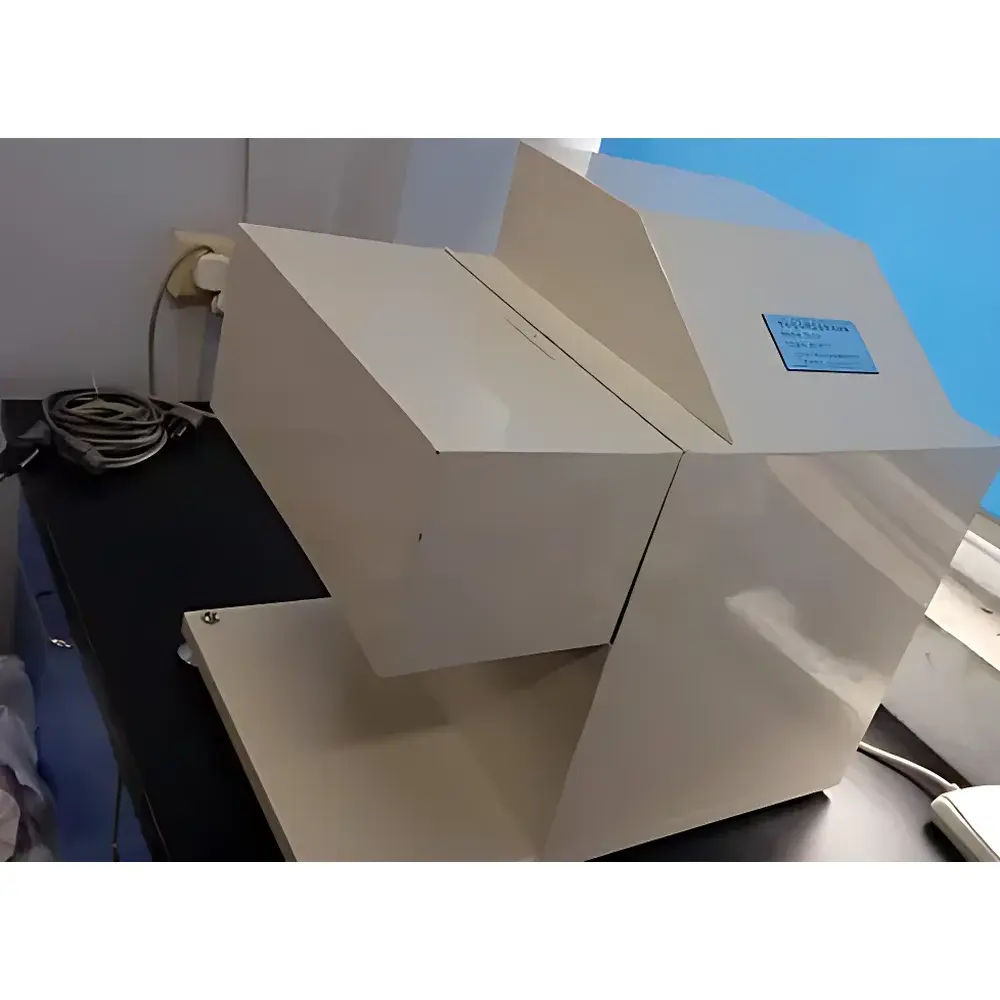
Beiguang Jingyi M-200* Plastic and Rubber Tribological Tester
| Brand | Beiguang Jingyi / All Precision Instrument |
|---|---|
| Origin | Beijing, China |
| Manufacturer Type | Direct Manufacturer |
| Product Category | Domestic |
| Model | M-200* |
| Instrument Type | Sliding Friction and Wear Tester |
| Maximum Friction Force | 1 N |
| Friction Force Resolution | 1 N |
| Maximum Operating Temperature | 1 °C |
| Specimen Dimensions | 30 mm × 7 mm × 6 mm ± 0.1 mm |
| Rotational Speed Range | 0–500 rpm (continuously adjustable) |
| Applied Load | 196 N ± 0.2% (expandable to 392 N) |
| Friction Ring Dimensions | Ø40 mm × 10 mm, 0.5 × 45° chamfer, concentricity < 0.01 mm |
| Friction Torque Range | 0–4 N·m ± 0.5% |
| Timer Range | 0–9999 h |
| Weight Calibration Set | One 4 kg mass + four 1 kg masses |
| Speed Accuracy | ±1% |
| Load Accuracy | ±0.5% |
| Torque Accuracy | ±1% |
| Timer Accuracy | ±1 s |
| Sensor Full-Scale Accuracy | ±1% FS |
| Compliance | GB/T 3960–1983, GB/T 9141.8–1999 |
Overview
The Beiguang Jingyi M-200* Plastic and Rubber Tribological Tester is a precision-engineered sliding friction and wear testing system designed for quantitative evaluation of tribological behavior in polymeric and elastomeric materials under controlled load, speed, and geometry conditions. It operates on the principle of counter-rotating or fixed/sliding specimen configurations—enabling precise control of sliding velocity, slip ratio (typically 10% by default), and contact pressure—thereby replicating real-world service conditions such as bearing interfaces, seal dynamics, and polymer-on-metal sliding contacts. The instrument employs a dual-axis mechanical drive architecture with left-hand and right-hand threaded sample holders to prevent loosening during high-torque operation, and integrates high-fidelity torque sensing via a calibrated solid-state sensor (±1% FS accuracy) coupled with real-time displacement transduction. Its modular design supports both ASTM- and ISO-aligned test protocols, making it suitable for R&D labs, quality control departments, and academic tribology research groups requiring reproducible, traceable wear data.
Key Features
- Automated test sequence execution: pre-programmed start/stop logic with automatic shutdown upon completion or fault detection
- Dual-speed motor-driven configuration enabling independent control of upper and lower specimen rotation (e.g., 180/200 rpm or 360/400 rpm) to generate defined slip ratios
- Adjustable normal load via calibrated spring-compression mechanism (196 N standard, expandable to 392 N) with digital force feedback and real-time display
- High-resolution torque measurement (0–4 N·m, ±0.5%) using a precision strain-gauge-based torque sensor mounted on the lower shaft assembly
- Integrated color thermal printer producing compliant test reports containing time-torque curves, tabulated friction coefficient values, wear volume estimates, and institutional header information
- Real-time diagnostic monitoring with dual-alert system—hardware-level fault signaling and software-based error logging—to prevent mechanical overloading or sensor saturation
- Comprehensive weight calibration kit (1 × 4 kg + 4 × 1 kg masses) supporting incremental load application and verification per GB/T 3960 requirements
Sample Compatibility & Compliance
The M-200* accommodates standardized rectangular specimens measuring 30 mm × 7 mm × 6 mm ± 0.1 mm, conforming to the dimensional specifications outlined in GB/T 3960–1983. It accepts both rigid thermoplastics (e.g., POM, PA6, PTFE), thermoset composites, and elastomers (e.g., NR, SBR, EPDM) with surface roughness ≤ Ra 0.8 µm. The Ø40 mm × 10 mm hardened steel friction ring features strict geometric tolerances—including concentricity deviation < 0.01 mm and a precision 0.5 × 45° chamfer—to ensure uniform contact stress distribution. The system complies fully with Chinese national standards GB/T 3960–1983 (Plastic Sliding Friction and Wear Test Method) and GB/T 9141.8–1999 (Sliding Friction Coefficient Test for Flexible Graphite Sheets). While not certified to ISO 15143 or ASTM D3702, its mechanical architecture and measurement traceability align with foundational principles required for cross-standard correlation studies.
Software & Data Management
The embedded Windows 7-based control software provides synchronized acquisition of torque, rotational speed, elapsed time, and applied load at configurable sampling intervals (default: 100 ms). It enables user-defined test profiles—including stepwise load ramping, timed dwell segments, and cycle-count termination—and displays live torque–time plots alongside derived metrics: dynamic friction coefficient (µ = T / r·Fn), cumulative wear volume (calculated from mass loss or dimensional change inputs), and statistical deviation across replicate runs. All raw data are stored in CSV format with timestamped metadata, supporting post-processing in MATLAB, Python (Pandas), or Excel. Audit trails record operator ID, calibration timestamps, parameter changes, and system alerts—meeting basic GLP documentation requirements. Software does not support FDA 21 CFR Part 11 electronic signature functionality but permits manual export of PDF reports with digital watermarking and revision history.
Applications
This tester serves critical roles in polymer formulation development, where comparative wear resistance screening informs material selection for automotive bushings, conveyor components, and medical device housings. It supports QC validation of incoming elastomer batches against internal friction/wear thresholds, particularly for seals exposed to reciprocating motion. Academic users apply it to study temperature-dependent tribological transitions in filled polymers, lubricant migration effects in rubber compounds, and third-body wear mechanisms induced by abrasive contaminants. Its capacity for extended-duration tests (up to 9999 hours) makes it suitable for accelerated aging assessments under constant-load sliding conditions. When paired with post-test profilometry or SEM analysis, it contributes directly to failure mode analysis (FMA) workflows in root cause investigations.
FAQ
What standards does the M-200* comply with?
It conforms to GB/T 3960–1983 and GB/T 9141.8–1999. Users requiring ISO or ASTM alignment should validate protocol equivalence through interlaboratory comparison.
Can the instrument operate beyond 196 N load?
Yes—the mechanical frame and torque sensor support up to 392 N via optional calibration and hardware verification; contact technical support prior to high-load operation.
Is the friction ring replaceable and standardized?
Yes—standard Ø40 mm × 10 mm rings are supplied; custom geometries (e.g., grooved, textured) can be machined to specification upon request.
Does the system support ambient temperature variation during testing?
No built-in environmental chamber; however, external temperature-controlled enclosures may be integrated with appropriate cabling and safety interlocks.
How is wear quantified in this system?
Direct torque-derived friction work is recorded; volumetric wear must be calculated externally using pre- and post-test mass/dimensional measurements per ASTM G133 guidelines.



