
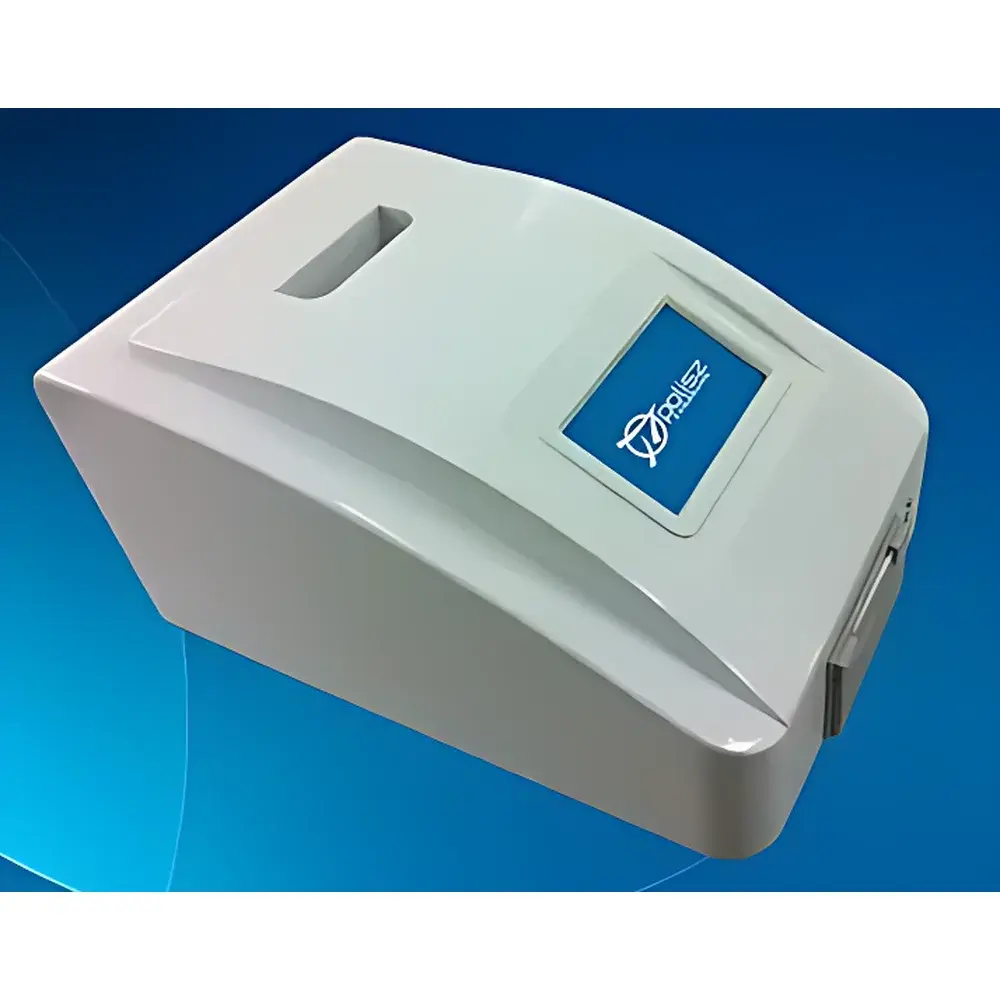
Beiguang Jingyi BC-40A Upgraded Portable Total Organic Carbon (TOC) Analyzer for Pharmaceutical Water
| Brand | Beiguang Jingyi / All Precision Instrument |
|---|---|
| Origin | Beijing, China |
| Manufacturer Type | Direct Manufacturer |
| Instrument Type | Portable TOC Analyzer |
| Detection Principle | Direct Conductivity Method |
| Oxidation Method | UV/Persulfate Oxidation |
| Measurement Range | 0–50,000 ppb (0–50 mg/L) as C |
| Detection Limit | 1 ppb (0.001 mg/L) as C |
| Accuracy | ±5% of reading |
| Resolution | 0.1 ppb |
| Repeatability | ≤3% RSD |
| Analysis Time | ≤4 min per sample |
| Response Time | ≤15 min |
| Sample Temperature Range | 1–95 °C |
| Ambient Temperature Range | 10–40 °C (±5 °C/day max) |
| Internal Flow Rate | 0.5 mL/min |
| Power Supply | 220 V ±22 V, 50 Hz ±1 Hz, 100 W |
| Dimensions | 44 × 18 × 26 cm |
| Data Storage | 6 months of historical records |
| Interface | RS232 |
| Compliance | Chinese Pharmacopoeia 2010 Edition, Appendix VIII R |
Overview
The Beiguang Jingyi BC-40A Upgraded Portable Total Organic Carbon (TOC) Analyzer is a dedicated analytical instrument engineered for precise, regulatory-compliant quantification of organic carbon in pharmaceutical water systems. It operates on the fundamental principle of differential conductivity measurement following oxidative conversion of organic carbon to carbon dioxide. In this method, sample water undergoes dual-path analysis: one stream is subjected to UV/persulfate oxidation to convert all organic carbon (OC) to CO₂, while the other bypasses oxidation to measure total inorganic carbon (TIC) only. The difference between total carbon (TC) and TIC yields the total organic carbon (TOC) concentration—i.e., TOC = TC − TIC. This stoichiometric approach ensures trace-level sensitivity and high reproducibility, making it suitable for monitoring purified water (PW), water for injection (WFI), and ultra-pure water (UPW) in GMP-regulated environments. The analyzer’s compact footprint, integrated touchscreen interface, and field-deployable design support both offline laboratory verification and point-of-use validation—critical for routine system suitability testing and continuous quality assurance in pharmaceutical manufacturing.
Key Features
- UV/persulfate oxidation module with stable 185/254 nm dual-wavelength UV lamp—designed for complete mineralization of refractory organics without catalyst contamination.
- Direct conductivity detection cell with temperature-compensated electrodes, eliminating need for carrier gas or NDIR sensors—reducing maintenance and operational complexity.
- Touchscreen HMI (640 × 480 true-color LCD) with intuitive navigation, one-touch analysis initiation, and automated system self-check prior to each run.
- Tool-free modular design: UV lamp and peristaltic pump tubing are accessible from the front panel—no chassis disassembly required for routine replacement.
- Programmable detection upper limit with audible/visual alarm; configurable auto-flush sequence (four cycles pre-analysis) to minimize carryover and baseline drift.
- Embedded data management: stores ≥6 months of timestamped results locally; supports export via RS232 to LIMS or Excel-compatible formats.
- Compliance-ready operation: built-in system suitability test (SST) protocol aligned with Chinese Pharmacopoeia 2010 Appendix VIII R requirements.
Sample Compatibility & Compliance
The BC-40A is validated for use with low-conductivity aqueous matrices typical of pharmaceutical water systems—including purified water (PW), water for injection (WFI), and ultra-pure water (UPW)—with conductivity <5.1 µS/cm at 25 °C. It meets the detection sensitivity requirement of ≤0.001 mg/L (1 ppb) specified in the Chinese Pharmacopoeia for TOC instrumentation. While not certified to ISO 17025 or FDA 21 CFR Part 11 out-of-the-box, its audit trail functionality (including user ID, timestamp, method version, and raw conductivity values) supports GLP/GMP documentation practices when deployed within controlled IT environments. The instrument satisfies core elements of ASTM D5903–22 (Standard Test Method for Total Organic Carbon in Water by High-Temperature Catalytic Oxidation and Direct Conductivity Detection) and aligns with ICH Q5C guidance on water quality monitoring for biopharmaceutical process streams.
Software & Data Management
Firmware includes embedded operating logic for automatic calibration verification, SST execution (using sucrose and 1,4-benzoquinone standards), and real-time drift compensation. All measurements are tagged with operator ID, sample ID, date/time stamp, and method configuration parameters. Data files adhere to CSV format for seamless integration into enterprise quality management systems (QMS). Optional PC-based software (sold separately) enables trend analysis, report generation (PDF/Excel), and electronic signature capture—facilitating alignment with ALCOA+ data integrity principles. Audit trail logs record all critical events: method edits, calibration updates, result deletions, and user logins—retained for minimum 6 months per internal storage policy.
Applications
- Routine QC testing of PW, WFI, and UPW distribution loops per pharmacopeial monographs.
- Validation of purification systems (e.g., RO, EDI, distillation) during commissioning and periodic requalification.
- Investigation of microbial excursion events—correlating TOC spikes with bioburden trends.
- Supporting environmental monitoring programs where organic carbon serves as an indirect indicator of cleaning agent residue or leachables.
- Field-based troubleshooting of pharmaceutical water systems—leveraging portability for on-site sampling and immediate analysis.
FAQ
Does the BC-40A comply with USP or EP 2.2.44?
It is designed to meet the functional requirements of those chapters (e.g., TOC = TC − TIC, SST, ≤1 ppb detection limit), though formal compliance certification requires site-specific IQ/OQ/PQ and method validation per local regulatory expectations.
Can the instrument be used for wastewater or high-salinity samples?
No—it is optimized exclusively for low-conductivity pharmaceutical waters; saline or wastewater matrices require dilution or alternate oxidation/detection methods (e.g., NDIR) to avoid conductivity saturation and chloride interference.
Is the UV lamp lifetime monitored internally?
Yes—the firmware tracks cumulative UV exposure hours and triggers a service alert at 1,000 hours, consistent with lamp manufacturer specifications.
How is zero drift corrected during extended operation?
The system performs automatic zero-point verification every 24 hours using deionized water blanks; manual zero adjustment is also available via service menu.
What is the recommended calibration frequency?
Daily system suitability testing is required; full calibration with certified TOC standards (e.g., potassium hydrogen phthalate) is recommended weekly or after maintenance.
Related Products







