
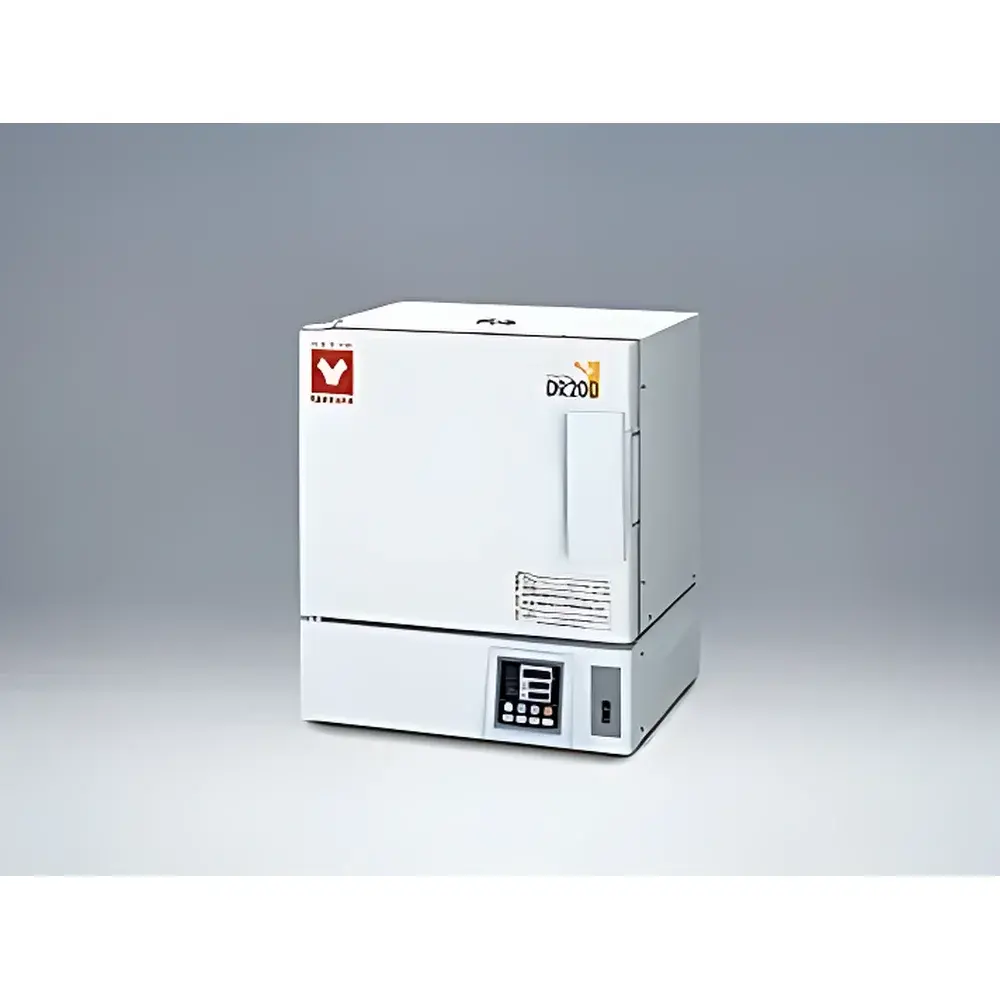
YAMATO DR210C Triple-Function High-Temperature Drying Oven / Muffle Furnace / Constant-Temperature Chamber
| Brand | YAMATO |
|---|---|
| Origin | Japan |
| Model | DR210C |
| Heating Method | Natural Convection |
| Temperature Range | 300–700 °C |
| Temp. Control Accuracy | ±5 °C (at 700 °C) |
| Temp. Uniformity | ±25 °C (at 700 °C) |
| Internal Dimensions (W×D×H) | 250×250×220 mm |
| Net Volume | 13.75 L |
| Max. Load per Shelf | 15 kg |
| Shelf Capacity | 3 shelves (33 mm spacing) |
| Heater | 1.3 kW Fe-Cr-Al Alloy Wire |
| Controller | 3-Stage PID with Dual 4-Digit LED Display (Green for PV, Red for SV) |
| Programmable Ramp-Soak | 3 segments × 30 steps |
| Timer Range | 1 min–99 h 59 min & 100–999 h 50 min (with standby delay) |
| Safety Systems | Dual independent overtemperature protection (main controller + dedicated overheat preventer), self-diagnostic circuit (thermocouple fault, heater open, SSR short, auto overtemp cutoff), earth-leakage circuit breaker, key lock, power-loss recovery |
| Power Supply | AC 220 V, 7 A, 50/60 Hz |
| Weight | ~36 kg |
| Standard Accessories | 2 stainless steel wire mesh shelves (integrated shelf supports) |
Overview
The YAMATO DR210C is a rigorously engineered triple-function high-temperature chamber designed for laboratories requiring precise thermal processing across multiple operational modes: as a muffle furnace for ashing and heat treatment, as a constant-temperature chamber for thermal stability testing, and as a drying oven for moisture removal from heat-resistant samples. Its architecture integrates natural convection airflow with a robust ceramic fiber insulation system and high-purity Fe-Cr-Al heating elements—optimized to deliver stable, repeatable thermal environments up to 700 °C. Unlike forced-air ovens, the DR210C’s natural convection design minimizes sample disturbance while maintaining adequate temperature homogeneity for non-critical uniformity applications. The unit complies with fundamental safety and electromagnetic compatibility requirements under JIS B 7751 and conforms to IEC 61010-1 for laboratory electrical equipment. Its dual-sensor architecture—employing independent K-type thermocouples for both primary temperature control and redundant overtemperature prevention—ensures fail-safe operation in unattended or long-duration runs.
Key Features
- Triple-mode operational flexibility: seamless switching between constant-temperature holding, programmable ramp-soak thermal profiles, and timed high-temperature drying/furnace cycles.
- Intuitive 3-segment, 30-step programmable controller with digital keypad navigation; supports nested configurations (e.g., 30 steps × 1 segment, 15 × 2, or 10 × 3) for complex thermal protocols.
- Dual 4-digit LED display: green for measured process value (PV), red for setpoint value (SV); enables real-time visual verification of thermal status without menu diving.
- Comprehensive self-diagnostic circuitry continuously monitors thermocouple integrity, heater continuity, SSR output state, and automatic overtemperature response—logging fault codes accessible via auxiliary menu.
- Power-loss compensation function retains program position and resumes operation upon power restoration, critical for multi-hour thermal treatments.
- Mechanical key lock prevents unauthorized parameter changes; configurable via auxiliary menu to restrict access to temperature setting, timer, or program editing functions.
- Integrated shelf support structure with fixed 33 mm pitch and load-rated stainless steel wire mesh shelves (2 supplied, max 15 kg per shelf).
Sample Compatibility & Compliance
The DR210C accommodates standard crucibles, ceramic boats, quartz tubes, and metal sample holders within its 13.75 L chamber. Its stainless steel interior and chemical-resistant exterior coating resist corrosion from residual halides, sulfates, and basic ash residues common in ASTM D3174 (ash content) or ISO 1171 (determination of ash) procedures. While not certified for Class I Div 1 hazardous locations, the unit meets UL/CSA recognition criteria for general-purpose laboratory use. It supports GLP-compliant workflows through traceable temperature logging when paired with optional external recording devices (e.g., chart recorders or data acquisition systems via 4–20 mA analog output). The RS485 communication interface (optional) enables integration into centralized lab monitoring systems adhering to IEEE 11073 or Modbus RTU protocols.
Software & Data Management
The DR210C operates autonomously without proprietary software; all configuration and execution occur via front-panel controls. However, its analog and digital I/O interfaces facilitate third-party data capture: the 4–20 mA temperature output provides linear signal scaling for connection to PLCs or SCADA systems; the time-arrival and alarm output terminals support hardware-triggered events (e.g., initiating gas purge sequences or activating cooling fans). Optional external chart recorders (e.g., YAMATO REX-200 series) provide permanent thermal history documentation required for audit trails under FDA 21 CFR Part 11 when used with appropriate validation protocols. No embedded firmware updates or cloud connectivity are provided—ensuring deterministic behavior and eliminating cybersecurity attack surfaces common in networked instruments.
Applications
- Gravimetric analysis: ashing of organic matrices (food, feed, pharmaceutical excipients) per AOAC 923.03 or USP <281>.
- Thermogravimetric pre-conditioning: pre-drying polymer pellets prior to TGA or melt flow index testing.
- Heat treatment of metallurgical specimens: stress-relief annealing of aluminum alloys or sintering aids in ceramic R&D.
- Calibration lab support: thermal soak of reference standards (e.g., PTFE blocks, glass thermometers) at fixed points between 300 °C and 700 °C.
- Materials stability testing: accelerated aging of battery cathode materials or catalyst supports under inert or air atmospheres.
- Residue quantification: moisture and volatile loss determination in inorganic salts, clays, and construction materials per ASTM C114 or EN 196-2.
FAQ
What is the maximum continuous operating temperature of the DR210C?
The DR210C is rated for continuous operation at 700 °C. Exceeding this limit may compromise heater lifespan and thermal insulation integrity.
Does the DR210C support inert atmosphere operation?
The base model is configured for ambient air operation. Optional gas inlet/outlet ports (not included) can be retrofitted to enable nitrogen or argon purging—subject to user validation of seal integrity and thermal mass effects.
Can the DR210C be validated for GMP environments?
Yes—when equipped with calibrated NIST-traceable thermocouples and connected to a compliant data logger, the system supports IQ/OQ/PQ protocols aligned with EU Annex 15 and WHO TRS 986 requirements.
Is the 30-step program memory retained after power cycling?
Program data persists in non-volatile memory; however, active run state is lost unless power-loss compensation is enabled and mains interruption duration remains within capacitor hold-up limits (~200 ms).
What maintenance is required for long-term reliability?
Annual inspection of heater terminals, thermocouple junction integrity, and ceramic fiber insulation compression is recommended. Avoid thermal shock by limiting ramp rates to ≤10 °C/min during repeated cycling.



