
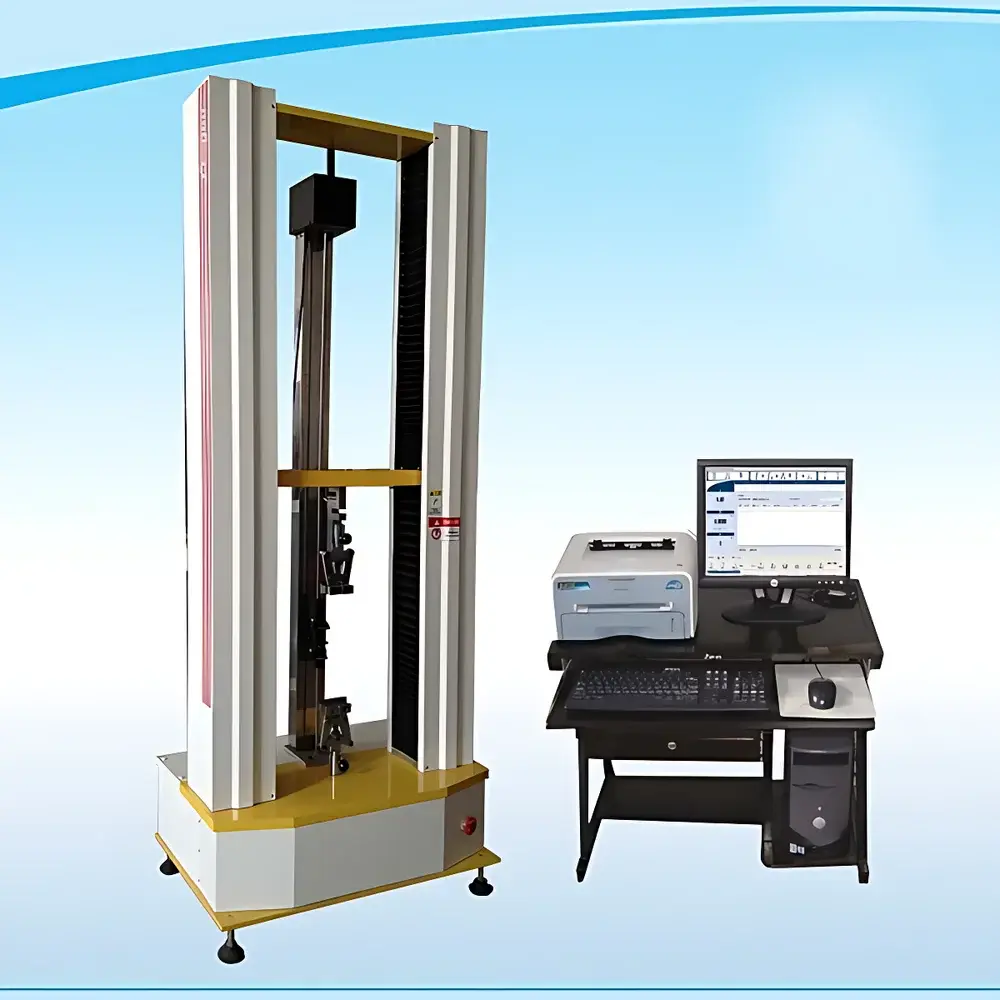
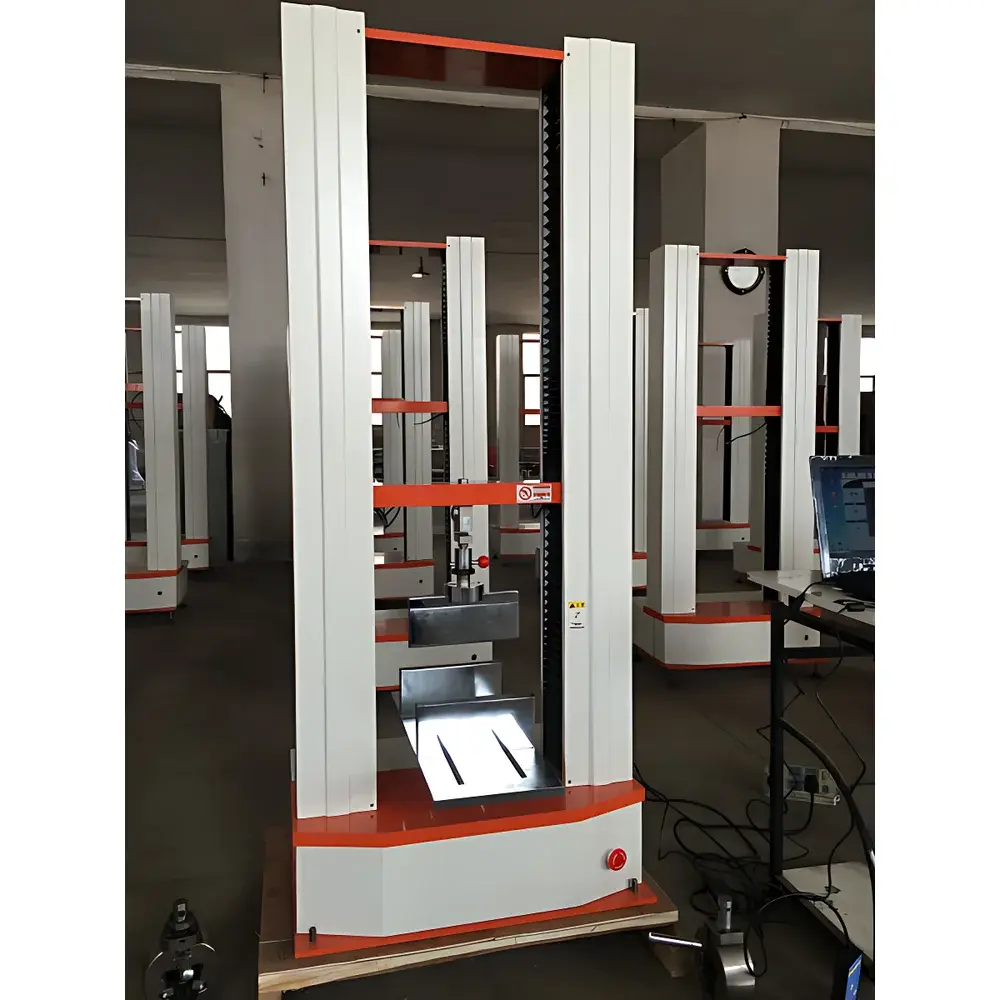
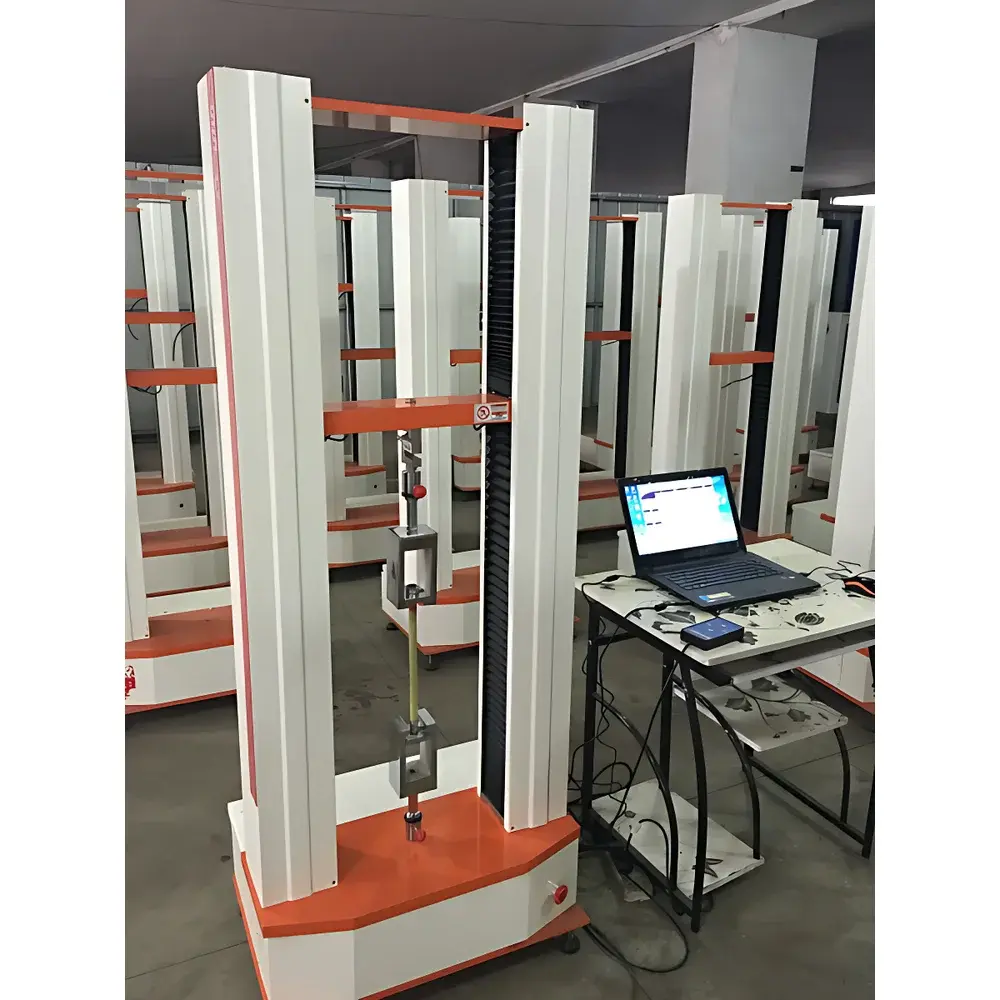
Beiguang Jingyi BG-200KN PE Pipe Ring Stiffness Testing Machine
| Brand | Beiguang Jingyi / All Precision Instrument |
|---|---|
| Origin | Beijing, China |
| Manufacturer Type | OEM Manufacturer |
| Product Category | Domestic |
| Model | BG-200KN |
| Max Test Load | 0–200 kN |
| Force Measurement Range | 2%–100% of Full Scale (FS) |
| Force Accuracy | Better than ±0.5% of reading |
| Crosshead Speed Range | 0.05–500 mm/min (infinitely variable) |
| Displacement Resolution | 0.01 mm |
| Displacement Accuracy | Better than ±0.5% of reading |
| Stroke | 0–1000 mm (excluding fixtures) |
| Control System | Full-digital servo motor + precision ball screw + arc-synchronous reduction gearbox |
| Software Platform | Windows XP–compatible test software with GLP-compliant data audit trail |
| Compliance | ASTM D2412, ISO 9969, GB/T 9647, EN 13476, CJJ 101 |
Overview
The Beiguang Jingyi BG-200KN PE Pipe Ring Stiffness Testing Machine is a high-precision electromechanical universal testing system engineered specifically for the quantitative evaluation of ring stiffness (SN) in thermoplastic pipes—particularly polyethylene (PE) pressure and non-pressure drainage pipes. It operates on the principle of controlled radial compression under standardized loading conditions defined in ASTM D2412 (Standard Test Method for Determining Ring Stiffness of Plastic Pipe), ISO 9969 (Plastics Pipes — Determination of Ring Stiffness), and China’s national standard GB/T 9647. The machine applies axial compressive force to a pipe segment supported on two parallel steel rollers, measuring the resulting deformation (deflection) at specified load increments to calculate ring stiffness (kN/m²) as per SN = (0.0186 × E × t³) / D³, where E is flexural modulus, t is wall thickness, and D is mean diameter. Its rigid frame, high-resolution displacement feedback, and closed-loop digital control architecture ensure reproducible, traceable, and metrologically sound results required for quality assurance, third-party certification, and regulatory submission.
Key Features
- Full-scale load capacity of 200 kN with force resolution maintained across entire range—no manual range switching required
- Dual-closed-loop control: independent real-time regulation of both load and crosshead displacement for precise compliance with ASTM/ISO ramp-and-hold protocols
- High-accuracy load measurement via calibrated S-type load cell (±0.5% accuracy, traceable to NIM or equivalent national metrology institute)
- Precision ball screw transmission system coupled with arc-synchronous gear reduction ensures smooth, low-backlash motion and long-term mechanical stability
- Optical encoder-based displacement sensing with 0.01 mm resolution and ±0.5% linearity over full stroke (1000 mm)
- Programmable speed control from 0.05 to 500 mm/min, enabling both slow creep tests and rapid failure characterization
- Integrated dual-limit protection: mechanical end-stop switches plus software-enforced travel boundaries prevent over-travel damage
- Automatic overload shutdown triggered at 3–5% above set limit, safeguarding both specimen and actuator integrity
Sample Compatibility & Compliance
The BG-200KN accommodates PE pipe specimens with nominal diameters ranging from DN110 to DN1600 mm (standard configurations), using interchangeable roller supports and adjustable support spacing compliant with ISO 9969 Annex A. It supports both single-ring and multi-ring test configurations per EN 13476-2 for structured-wall pipes. All mechanical components—including rollers, base plates, and load platens—are manufactured from hardened stainless steel to minimize wear and maintain dimensional fidelity across thousands of test cycles. The system meets essential requirements of ISO/IEC 17025 for testing laboratories, including documented calibration intervals, uncertainty budgets for force and displacement channels, and hardware-level traceability. It is routinely deployed in CNAS-accredited labs for certification against CJJ 101 (Urban Water Supply and Drainage Pipeline Engineering Code) and GB/T 19472 (Buried Polyethylene Pipes for Sewerage Systems).
Software & Data Management
The included Windows XP–compatible test software provides full GLP/GMP-aligned functionality: user-level access control, electronic signatures, automated audit trails (per FDA 21 CFR Part 11 principles), and timestamped raw data export in CSV, Excel, and PDF formats. Test methods are pre-configured to match ASTM D2412 Procedure A (constant-rate compression) and ISO 9969 Mode 1 (load-controlled ramp). Users may define custom test sequences—including hold periods at specific loads, multi-step cyclic loading, and conditional stop logic based on strain thresholds. All curves (load vs. deflection, stiffness vs. time) are stored with metadata (operator ID, calibration certificate number, environmental conditions). Report templates comply with ISO 14689 and can be exported directly to Word or Excel for inclusion in technical dossiers submitted to municipal authorities or certification bodies such as CE-Marking Notified Bodies.
Applications
This system serves as the primary mechanical verification tool for PE pipe manufacturers, municipal infrastructure QA/QC labs, and independent testing institutes performing type approval and batch release testing. Typical use cases include: validation of ring stiffness claims for HDPE solid-wall pipes used in gravity sewer networks; comparative assessment of corrugated PE pipes under combined soil-load and traffic-load simulation; R&D evaluation of novel PE resin formulations for enhanced structural performance; and forensic analysis of field-failed pipe sections to determine root cause (e.g., insufficient wall thickness, thermal degradation, or improper installation-induced deformation). Its versatility extends to related polymer pipe materials—including PP-R, PVC-U, and PERT—provided appropriate fixture sets and method adaptations are applied per material-specific standards.
FAQ
What standards does this machine fully support out-of-the-box?
ASTM D2412, ISO 9969, GB/T 9647, EN 13476-2, and CJJ 101—all test procedures are pre-loaded in software with automatic calculation of ring stiffness (SN), deformation ratio, and compressive strength.
Is the system compatible with modern Windows OS (e.g., Windows 10/11)?
Yes—while the original software was developed for Windows XP, Beiguang Jingyi provides a certified virtualized runtime environment (via Windows 10 Hyper-V) with validated driver compatibility and full audit-trail continuity for regulated environments.
Can the machine perform other mechanical tests beyond ring stiffness?
Yes—equipped with optional tensile grips, compression platens, and peel fixtures, it functions as a full-featured universal testing machine compliant with ASTM E4, ISO 7500-1, and GB/T 228.1 for tensile, compression, flexure, and shear testing of plastics, metals, and composites.
How often must the load cell and encoder be recalibrated?
Per ISO/IEC 17025, annual calibration is recommended; however, internal verification using certified reference load standards (Class M1) and displacement gauge blocks should be performed daily or per-shift in production QA settings.
Does the system include documentation for regulatory audits?
Yes—the delivery package includes Factory Calibration Certificate, Installation Qualification (IQ) checklist, Operational Qualification (OQ) protocol, and a complete set of traceable uncertainty statements for all critical measurement channels.



