
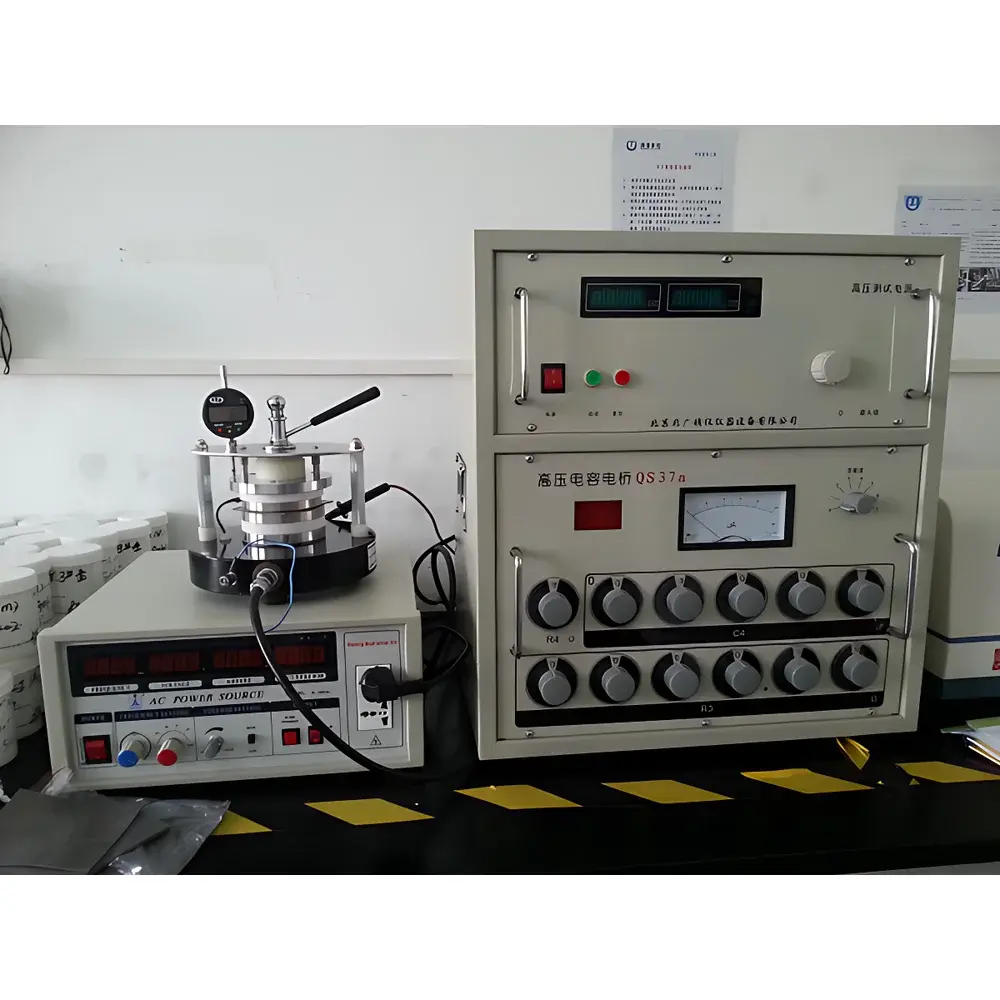
Beiguang Jingyi BQS-37A High-Voltage Schering Bridge for Power-Frequency Dielectric Constant and Dissipation Factor Measurement
| Brand | Beiguang Jingyi / All Precision Instrument |
|---|---|
| Origin | Beijing, China |
| Manufacturer Type | Direct Manufacturer |
| Country of Origin | China |
| Model | BQS-37A |
| Price | USD 1,700 (approx.) |
Overview
The Beiguang Jingyi BQS-37A High-Voltage Schering Bridge is a precision AC impedance measurement system engineered for standardized determination of dielectric constant (εr) and dissipation factor (tan δ) of solid insulating materials at power frequency (50 Hz). It implements the classical Schering bridge topology—a four-arm AC null-balance configuration—optimized for high-voltage dielectric characterization under industrial and laboratory test conditions. The instrument operates on the principle of phase-sensitive null detection: when the bridge achieves electrical balance, the voltage across the null detector (a high-sensitivity galvanometer) approaches zero, enabling direct calculation of Cx and tan δ via fundamental bridge equations. Its design conforms to internationally recognized test standards including GB/T 1409, GB/T 5654, GB/T 1693, and ASTM D150–1998 (2004), ensuring metrological traceability and regulatory acceptability in quality control, R&D, and certification workflows involving polymers, ceramics, transformer oils, and high-voltage insulation systems.
Key Features
- Integrated 0–2500 V digitally displayed high-voltage AC source with ±3% output accuracy, calibrated for stable 50 Hz sinusoidal excitation.
- Onboard 100 pF reference capacitor with ultra-low inherent loss (tan δ < 5×10⁻⁵), thermally aged for long-term stability and minimal drift.
- Dual-shielded bridge architecture: outer electrostatic shield + inner active guard driven by an auto-tracking potentiostat, suppressing stray capacitance and electromagnetic interference (EMI).
- High-reliability decade resistance (10×(1 kΩ + 100 Ω + 10 Ω + 1 Ω + 0.1 Ω)) and capacitance (10×(0.1 µF + 0.01 µF + 0.001 µF + 0.0001 µF)) arms with low-contact-resistance rotary switches rated for >100,000 operations.
- Null detector with voltage sensitivity ≥1×10⁻⁶ V/div and current sensitivity ≥2×10⁻⁹ A/div at 50 Hz; harmonic rejection >25 dB (2nd) and >50 dB (3rd) for robust noise immunity.
- Fixed R4 resistor network (3183.2 Ω or 318.3 Ω) pre-configured to enable direct tan δ readout without manual conversion.
Sample Compatibility & Compliance
The BQS-37A supports dielectric testing of rigid and semi-rigid solid insulators—including epoxy resins, polyethylene, porcelain, glass, and laminated composites—as well as liquid dielectrics (e.g., mineral oil, silicone fluid) when used with standardized electrode cells (e.g., ASTM D924-type). Sample geometry must comply with IEC 60250 and GB/T 1409 electrode configurations (e.g., parallel-plate, guarded-electrode). Measurement validity requires ambient conditions within 20±5°C and 30–80% RH. The system meets functional safety requirements per GB/T 4793.1 (equivalent to IEC 61010-1) for laboratory electrical equipment. All test procedures align with ISO/IEC 17025 documentation practices, supporting GLP-compliant reporting and audit-ready data integrity when paired with external logging tools.
Software & Data Management
While the BQS-37A is a manually operated analog bridge, its measurement outputs are fully compatible with digital data acquisition workflows. Users may interface the null detector output (analog voltage signal) or R3/C4 dial positions with external DAQ systems (e.g., National Instruments USB-6211) for automated balancing and real-time parameter calculation. Raw measurements satisfy FDA 21 CFR Part 11 requirements when recorded in validated electronic lab notebooks (ELNs) with user authentication, audit trails, and electronic signatures. Calibration certificates for the internal standard capacitor and HV source are provided with NIST-traceable uncertainty statements. Firmware-free operation ensures deterministic behavior and eliminates cybersecurity vulnerabilities associated with embedded software.
Applications
- Quality assurance of polymer-based insulating components in power transformers, bushings, and cable terminations.
- Material screening during formulation development of high-dielectric-strength encapsulants and potting compounds.
- Acceptance testing of ceramic substrates and printed circuit board (PCB) laminates per IPC-TM-650 2.5.1.
- Research into aging mechanisms of solid dielectrics under thermal/electrical stress, where tan δ serves as an early indicator of degradation.
- Verification of moisture ingress in cellulose-based insulation (e.g., transformer paper) via elevated tan δ at 50 Hz.
- Calibration reference for lower-cost handheld LCR meters operating at power frequency.
FAQ
What is the maximum recommended test voltage for routine operation?
The bridge is rated for continuous operation up to 2500 V RMS at 50 Hz. However, the A–B terminals must not exceed 11 V relative to ground (V point); all high-voltage connections must be made exclusively via the designated HV terminal block.
Can the BQS-37A measure samples at frequencies other than 50 Hz?
It is optimized for 50 Hz power-frequency testing. Measurements at non-standard frequencies require correction using the formula tan δactual = (f′/f) × tan δmeasured, where f = 50 Hz. For broadband dielectric spectroscopy, a dedicated impedance analyzer is recommended.
Is external calibration required annually?
Yes. Annual verification of the internal 100 pF standard capacitor and HV source against accredited standards is advised. Certificate of calibration includes uncertainty budget per ISO/IEC 17025.
How does the auto-tracking guard shield improve measurement accuracy?
By maintaining equipotential between the inner shield (S) and bridge node B, it eliminates capacitive leakage paths and minimizes errors from parasitic coupling—especially critical when measuring low-loss materials (tan δ < 0.001).
What safety certifications does the instrument carry?
It complies with GB/T 4793.1–2008 (IEC 61010-1:2010), including dielectric strength, creepage/clearance, and protective earth continuity requirements. CE marking is not applicable as it is designed for domestic Chinese market compliance only.



