
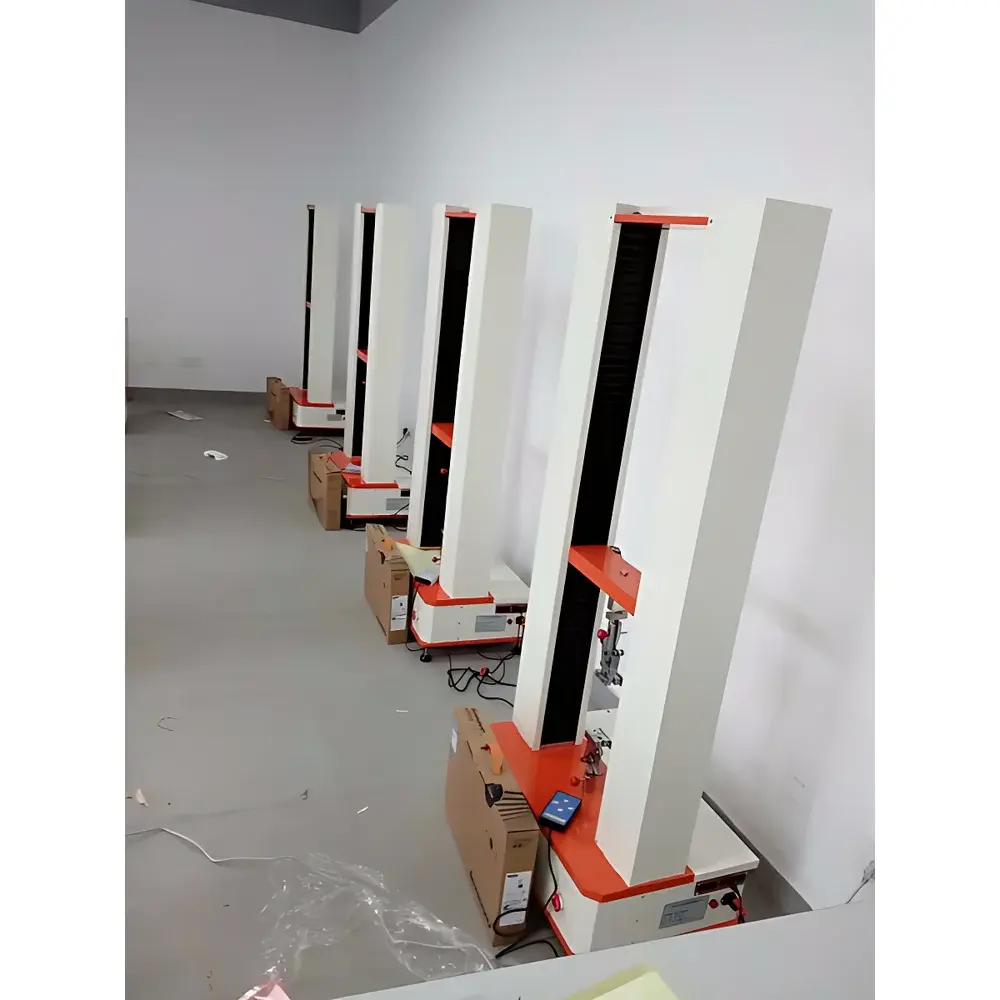
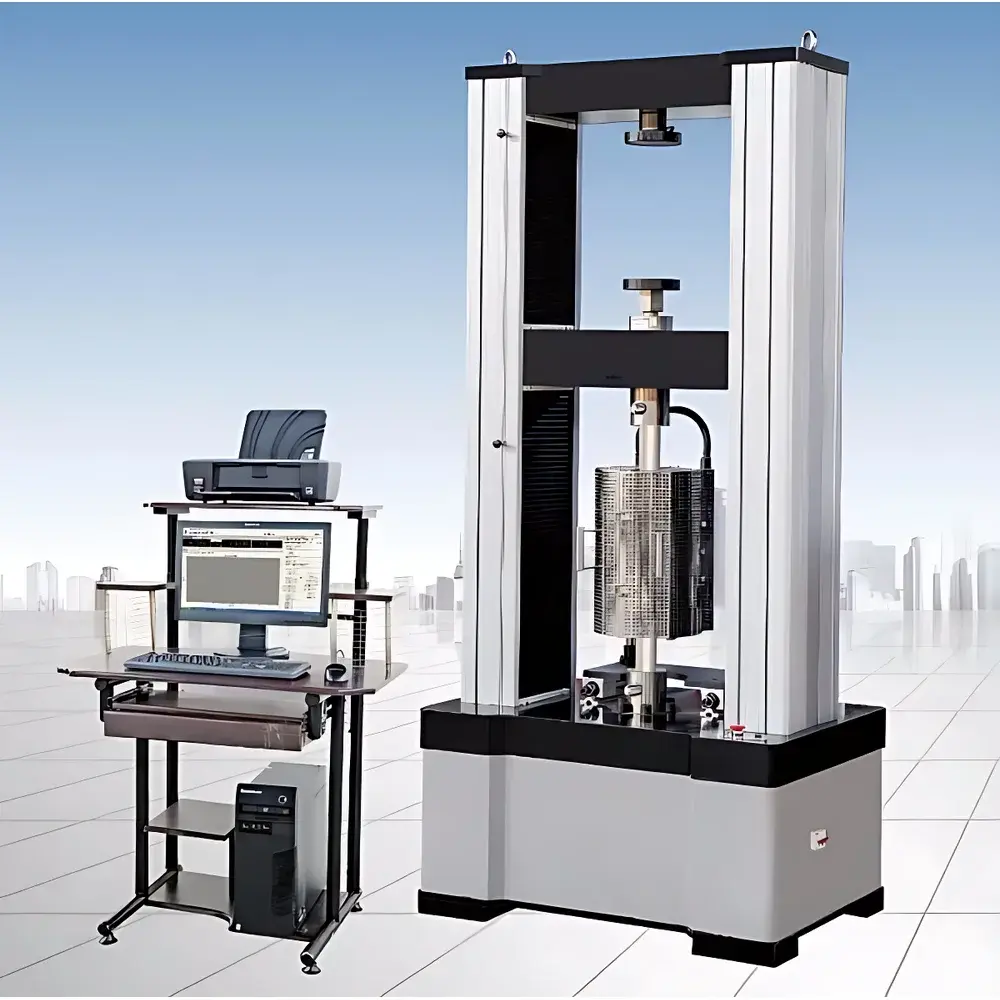
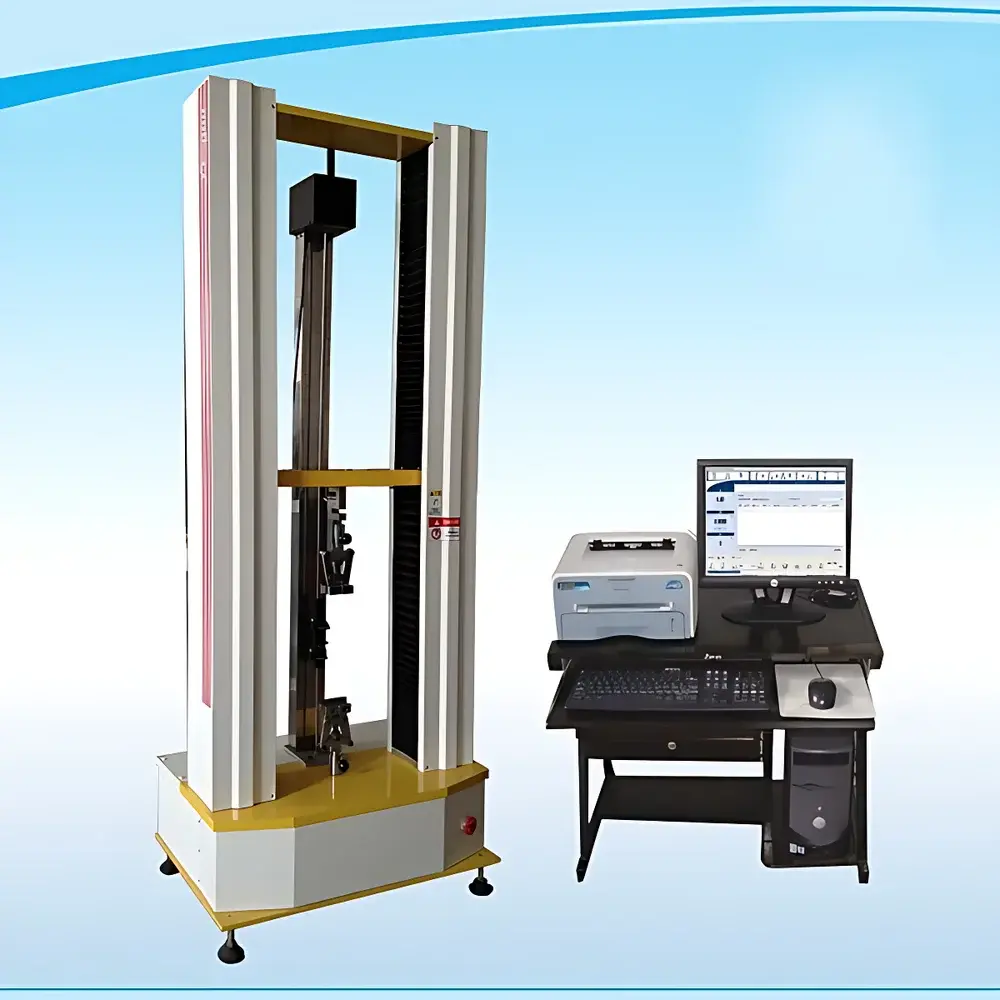
Beiguang Jingyi BW-10KN Electronic Universal Testing Machine for Seat Belt Tensile Strength Testing
| Brand | Beiguang Jingyi / All Precision Instrument |
|---|---|
| Origin | Beijing, China |
| Manufacturer Type | Direct Manufacturer |
| Instrument Type | Electronic Universal Testing Machine |
| Model | BW-10KN |
| Max Test Force | 0–10 kN |
| Force Measurement Accuracy | ±1% of reading |
| Force Resolution | Constant across full scale |
| Effective Force Range | 2–100% of full scale |
| Crosshead Speed Range | 0.05–500 mm/min (infinitely variable) |
| Speed Control Accuracy | ±0.5% |
| Displacement Resolution | 0.01 mm |
| Displacement Accuracy | ±0.5% |
| Maximum Tensile Stroke | 1000 mm (excluding fixtures) |
| Test Width | ~350 mm |
| Effective Vertical Travel | 950 mm (excluding fixtures) |
| Power Supply | 220 V, 50 Hz, 0.5 kW |
| Compliance Standards | GB/T 16491, GB/T 1040, ASTM D412, ASTM D3574, ISO 37, ISO 1798, EN ISO 1421, EN ISO 1798 |
Overview
The Beiguang Jingyi BW-10KN Electronic Universal Testing Machine is a precision-engineered force measurement system designed specifically for tensile strength evaluation of automotive safety restraints—including seat belts, webbing, anchorage hardware, and related passive safety components. It operates on the principle of controlled uniaxial loading under servo-controlled electromechanical actuation, enabling accurate determination of mechanical properties such as ultimate tensile strength, yield strength, elongation at break, modulus of elasticity, and load–displacement behavior. The machine conforms to internationally recognized test protocols for restraint systems, including those specified in FMVSS 209, ECE R16, ISO 6487, and SAE J1531. Its robust dual-column frame, high-fidelity load cell (±0.8% accuracy), and real-time closed-loop displacement control ensure repeatability and traceability required for quality assurance in Tier-1 supplier labs and OEM validation centers.
Key Features
- High-precision 10 kN load cell with 16-bit A/D conversion and auto-ranging across four internal force segments (0.25×, 0.5×, 0.75×, 1× full scale) for optimal resolution at low and high loads.
- Electromechanical drive system featuring a precision ball screw assembly and digital AC servo motor, delivering ultra-low noise operation and speed stability within ±0.5% across the full 0.05–500 mm/min range.
- Dual-mode positioning: coarse adjustment for rapid crosshead movement and fine micro-adjustment for precise specimen alignment—critical for maintaining axial loading integrity per ISO 527-1 and ASTM D638.
- Integrated dual-limit protection architecture: programmable software limits plus mechanical hard stops prevent over-travel and protect both operator and instrumentation.
- Overload safety shutdown activated at 3–5% above rated capacity, complemented by emergency stop circuitry compliant with IEC 60204-1.
- Automatic post-fracture return and data retention—ensuring uninterrupted workflow during batch testing of serial production samples.
- Modular fixture interface supporting standardized tensile grips (pneumatic, wedge, roller), peel fixtures, and custom-designed clamping solutions for non-planar webbing geometries.
Sample Compatibility & Compliance
The BW-10KN accommodates flat, woven, braided, and coated textile specimens up to 350 mm wide and 1000 mm gauge length, making it suitable for testing seat belt webbing (polyester, nylon), pretensioner cables, anchor plates, and stitching interfaces. It meets mechanical and procedural requirements of multiple regulatory frameworks: GB/T 3923.1 (Chinese textile tensile standard), ISO 20810 (seat belt static strength), UN Regulation No. 16 (ECE R16 Annex 4), and FMVSS 209 Appendix B. All force and displacement measurements are traceable to national metrological standards, and system calibration certificates comply with ISO/IEC 17025 guidelines. Optional audit-ready configuration supports 21 CFR Part 11-compliant electronic signatures and ALCOA+ data integrity principles when paired with validated software modules.
Software & Data Management
The Windows-based control software provides full GLP/GMP-aligned test execution and documentation. It features pre-configured templates for common safety restraint test methods—including constant-rate-of-extension (CRE), stress-relaxation, and cyclic loading sequences. Real-time plotting includes synchronized load–displacement, stress–strain, and extension–time curves with dynamic auto-scaling and multi-curve overlay capability. Data export supports native .csv, Excel (.xlsx), and Word (.docx) formats; all reports include metadata such as operator ID, timestamp, environmental conditions (optional sensor input), calibration status, and instrument identification. Built-in statistical analysis calculates mean, SD, CV%, and confidence intervals per ISO 5725. Audit trails record all user actions—including method edits, parameter changes, and data deletions—with immutable timestamps and user authentication logs.
Applications
This system is routinely deployed in automotive component QA/QC laboratories, third-party certification bodies (e.g., TÜV, SGS, Intertek), and R&D departments developing next-generation restraint systems. Typical use cases include: verification of webbing tensile performance after UV exposure or humidity conditioning (per ISO 188); evaluation of stitching seam strength in lap-belt assemblies; fatigue life assessment of retractor mechanisms via repeated loading cycles; validation of pretensioner cable pull-out resistance; and comparative analysis of recycled vs. virgin polymer webbing. It also supports ancillary tests per ASTM D1445 (yarn tensile), ASTM D5035 (grab test), and EN 12995 (webbing abrasion resistance pre-test conditioning).
FAQ
What safety standards does this machine support for seat belt testing?
It complies with ISO 20810, ECE R16 Annex 4, FMVSS 209, and GB/T 3923.1—covering static tensile, dynamic impact simulation preparation, and elongation limit verification.
Can the system be integrated into an existing LIMS or MES environment?
Yes—via configurable OPC UA or TCP/IP API endpoints, enabling bidirectional data exchange with laboratory information management systems while preserving raw waveform integrity.
Is the software 21 CFR Part 11 compliant out of the box?
The base software includes electronic signature, audit trail, and role-based access controls; full Part 11 compliance requires installation of optional validation package and documented IQ/OQ/PQ protocols.
What is the recommended recalibration interval?
Annual calibration is advised per ISO 7500-1 Class 1 requirements; however, intermediate verification using certified reference load cells is recommended before each test shift in regulated environments.
Does the machine support high-speed video synchronization for strain field analysis?
Yes—via TTL trigger output and GenICam-compatible camera interface, enabling DIC (Digital Image Correlation) integration for full-field deformation mapping during tensile events.



