
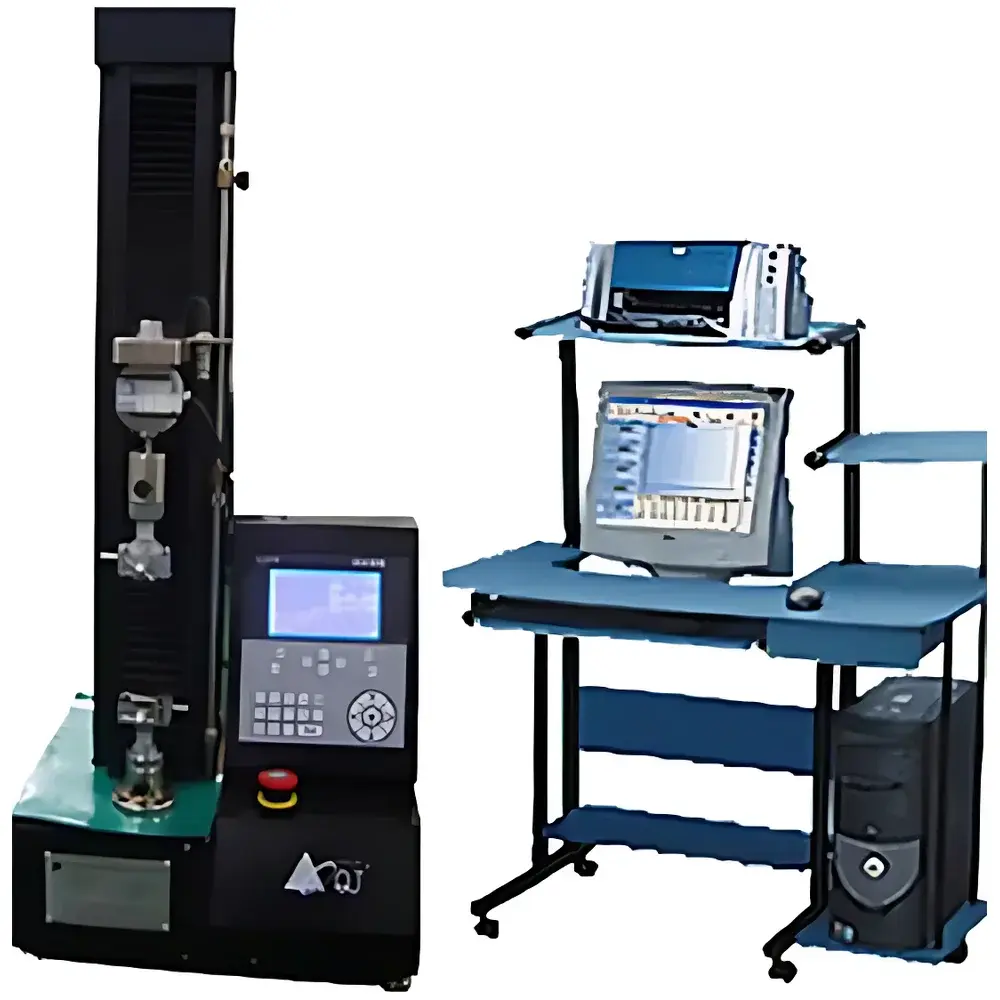
Beiguang Precision HMLS-1000 Universal Tensile Tester for Flexible Polyurethane Foam
| Brand | Beiguang Precision Instrument |
|---|---|
| Origin | Beijing, China |
| Manufacturer Type | OEM Manufacturer |
| Model | HMLS-1000 |
| Price | USD 1,950 (FOB Beijing) |
| Load Capacity | 1000 N |
| Force Accuracy | ±1% of reading (optional ±0.5%) |
| Force Resolution | 1/30,000 full scale |
| Test Speed Range | 0.05–500 mm/min |
| Speed Accuracy | ±1% of set value (optional ±0.5%) |
| Effective Stroke | ≥850 mm |
| Effective Width | 400–550 mm (customizable) |
| Compliance Standards | GB/T 6344-2008, GB/T 10808-2006, ISO 1798:1997 |
| Protection | Dual-limit (mechanical + programmable), overload cutoff at 110% FS |
Overview
The Beiguang Precision HMLS-1000 Universal Tensile Tester is an engineered solution for mechanical property characterization of flexible polymeric foams—primarily soft polyurethane (PU) and viscoelastic open-cell foams used in automotive seating, bedding, packaging, and medical cushioning. Designed in strict accordance with ASTM D3574, ISO 1798:1997, GB/T 6344-2008 (tensile strength and elongation at break), and GB/T 10808-2006 (tear strength), the system applies uniaxial tensile and tear loading under controlled displacement rates to quantify stress–strain behavior, ultimate tensile strength, yield point, fracture elongation, and tear resistance. Its rigid C-frame architecture, preloaded high-precision ball screws, and dual-mode control (touchscreen + PC interface) ensure repeatability within ±1% force accuracy and sub-millimeter positional fidelity—critical for QC labs performing routine conformance testing or R&D teams validating foam formulation changes.
Key Features
- Triple-speed on-the-fly switching: Operators can dynamically shift between three preconfigured test speeds during a single run—enabling rapid preconditioning, quasi-static rupture analysis, and high-rate tear propagation assessment without interrupting data acquisition.
- Programmable auto-stop logic: The crosshead halts immediately upon specimen failure detection via real-time load drop threshold (configurable % drop over 10 ms window), preserving post-failure waveform integrity for fracture mode analysis.
- Synchronized multi-parameter display: A 7-inch industrial TFT LCD simultaneously renders live force (N), displacement (mm), strain rate (%/min), real-time stress–strain curve, peak load marker, and test status—all in English or Simplified/Traditional Chinese UI.
- Zero-drift return-to-origin: After test completion, the actuator returns to the initial gauge length position with 40%.
- Dual-layer safety architecture: Mechanical hard stops complement software-defined travel limits; overload protection triggers emergency stop when load exceeds 110% of full-scale capacity (1000 N sensor).
- Integrated thermal-printed report generation: Embedded 2-inch thermal printer outputs calibrated test reports containing date/time stamp, sample ID, standard reference, raw data snapshot, and pass/fail flag per GB/T or ISO criteria.
Sample Compatibility & Compliance
The HMLS-1000 accommodates standardized dumbbell-shaped, rectangular, or trouser-tear specimens per ISO 1798 and GB/T 10808. Optional pneumatic or wedge-action grips (not included) support thicknesses from 10 mm to 150 mm and densities ranging from 12 kg/m³ to 80 kg/m³. All firmware and calibration protocols align with ISO/IEC 17025 traceability requirements. Test reports include embedded metadata compliant with GLP documentation standards—including operator ID, environmental conditions (ambient temperature/humidity logged via optional external sensor), and instrument calibration certificate expiry dates. The system supports audit-ready electronic records when paired with optional PC-based software (sold separately).
Software & Data Management
The embedded microcontroller runs Beiguang’s proprietary FLEX-TEST v3.2 firmware, supporting bilingual (EN/ZH/TC) menu navigation, user-defined test templates, and password-protected parameter locking for SOP enforcement. When connected to Windows PCs via USB or RS-232, the optional FLEX-ANALYZE Suite enables advanced post-processing: modulus calculation (secant/tangent), hysteresis loop integration, statistical batch reporting (mean ± SD across n≥5 specimens), and export to CSV, PDF, or XML for LIMS integration. All software modules comply with FDA 21 CFR Part 11 requirements for electronic signatures, audit trails, and data immutability—validated per IQ/OQ protocols upon installation.
Applications
- Quality control of molded PU seat cushions against ISO 1798 tensile strength thresholds (e.g., ≥120 kPa for Class B automotive foams)
- Comparative tear resistance evaluation of flame-retardant vs. standard foam formulations per GB/T 10808 tear index (kN/m)
- Accelerated aging studies: Measuring tensile property degradation after 72-hr hot-air exposure at 70°C per ASTM D3574 Annex A3
- Supplier qualification: Verifying compliance with OEM-specified elongation-at-break minima (e.g., ≥150% for medical mattress overlays)
- R&D validation of bio-based polyol substitutions: Quantifying trade-offs between green content and mechanical resilience
FAQ
Does the HMLS-1000 meet international regulatory requirements for medical device foam testing?
Yes—it complies with ISO 1798 and supports test method validation per ISO 10993-10 for cytotoxicity-related mechanical stability assessments.
Can I integrate this tester into an existing LIMS environment?
Yes—via optional FLEX-ANALYZE Suite with configurable ODBC drivers and HL7-compatible result export.
What calibration certificates are provided at shipment?
A factory-issued ISO/IEC 17025-accredited certificate for the 1000 N load cell and displacement encoder is included, valid for 12 months.
Is mechanical maintenance required between tests?
No scheduled maintenance is needed for ≤500 cycles/month; annual lubrication of ball screws and verification of grip alignment are recommended.
How is traceability ensured for multi-shift operations?
User logins, timestamped digital signatures, and immutable PDF reports with embedded digital watermarks satisfy GLP/GMP traceability mandates.



