
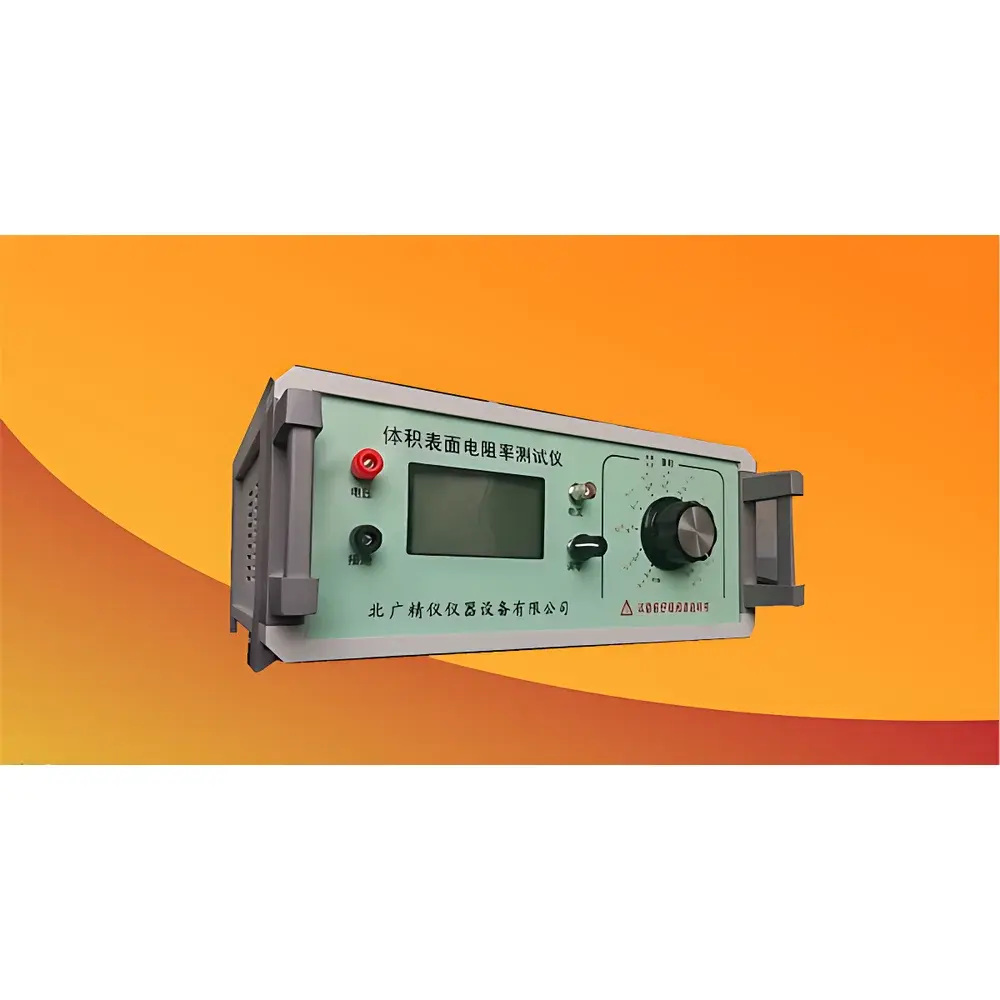
Beijing Guangjing BEST121 High-Resistance Meter for Liquid Plasticizers
| Brand | Beijing Guangjing / All Precision Instrument |
|---|---|
| Origin | Beijing, China |
| Manufacturer Type | Direct Manufacturer |
| Product Origin | Domestic (China) |
| Model | BEST121 |
| Price | USD 170 (approx. based on ¥1200 at 7.06 exchange rate) |
Overview
The Beijing Guangjing BEST121 High-Resistance Meter is a precision digital electrometer engineered for the accurate measurement of volume and surface resistivity of insulating liquids—particularly plasticizers—as defined in GB 1672–1988 and aligned with international high-resistance metrology principles. It operates on the constant-voltage, guarded two-terminal method, applying regulated DC test voltages (10 V to 1000 V) across standardized electrode configurations to determine resistive behavior under controlled electrostatic conditions. The instrument employs a high-input-impedance (>1015 Ω) electrometer amplifier and auto-zeroing circuitry to ensure stable baseline performance during ultra-low-current measurements. Its dual-display architecture simultaneously shows resistance value (Ω) and corresponding current (A), enabling direct verification of Ohm’s Law compliance without manual calculation. Designed for laboratory-grade reproducibility in QC, R&D, and regulatory testing environments, the BEST121 supports traceable resistivity evaluation in accordance with ASTM D257, IEC 62631-3-1, and ISO 3915, while maintaining full compatibility with Chinese national standards including GB/T 1410–2006 and GB 12158–2006.
Key Features
- Ultra-wide resistance measurement range: 1 × 10⁴ Ω to 1 × 10¹⁸ Ω across ten calibrated decades
- Simultaneous dual-parameter readout: resistance (Ω) and current (A) displayed in real time on a high-contrast LCD screen
- Six selectable DC test voltages: 10 V, 50 V, 100 V, 250 V, 500 V, and 1000 V (±10% tolerance), each optimized for material-specific polarization and leakage response
- Current measurement capability from 2 × 10⁻⁴ A down to 1 × 10⁻¹⁶ A—enabling dark current characterization and low-conductivity liquid analysis
- Integrated guarding and shielding architecture compliant with IEEE Std 116–2020 for minimized stray current interference
- Auto-zero function activated during open-circuit power-up; eliminates manual nulling drift errors
- Compact benchtop form factor (300 mm × 280 mm × 150 mm); net weight ≈ 3.0 kg; power consumption <10 W (AC 220 V ±10%, 50 Hz)
- Full-range linearity verified per IEC 61000-4-8 for electromagnetic immunity in industrial lab settings
Sample Compatibility & Compliance
The BEST121 is validated for use with liquid plasticizers, polymer solutions, antistatic additives, and other low-conductivity organic media per GB 1672–1988 methodology. It accommodates standard three-electrode cells (high-voltage, measuring, and guard electrodes) as specified in GB/T 1410–2006, with electrode geometry conforming to nominal diameters (146 mm HV, 120 mm measuring, 8 mm guard width) and surface roughness ≤1.6 µm. The system meets functional requirements for GMP/GLP-aligned laboratories: input impedance >100× instrument input resistance, zero drift ≤4% full scale/hour, and shielded test circuits per IEC 61326-1. It supports audit-ready operation under FDA 21 CFR Part 11 when paired with validated data logging software (optional). Compliance documentation includes traceable calibration certificates against NIM (National Institute of Metrology, China) reference standards.
Software & Data Management
While the BEST121 operates as a standalone electrometer, its RS232 interface enables integration with third-party acquisition platforms for automated data capture, statistical process control (SPC), and long-term trending. When used with compliant PC-based software, it supports timestamped measurement logs, user-defined test protocols (e.g., voltage ramping, dwell timing), and automatic resistivity calculation using entered geometric parameters (electrode area, gap, sample thickness). Audit trails include operator ID, calibration status, environmental metadata (temperature/humidity if externally logged), and instrument configuration history—satisfying ISO/IEC 17025 clause 7.7 and GLP Annex 11 requirements. Export formats include CSV and XML for LIMS interoperability.
Applications
- Volume resistivity testing of plasticizers (e.g., DINP, DIDP, DOTP) per GB 1672–1988 and ASTM D257 Annex A4
- Surface resistivity validation of antistatic coatings, conductive polymers, and ESD-safe packaging materials
- Quality control of insulating oils, transformer fluids, and dielectric solvents in electrical equipment manufacturing
- Research into charge transport mechanisms in soft matter, ionomers, and polymer electrolytes
- Compliance verification for footwear, flooring, garments, and cleanroom textiles per GB 4385–1995, GB/T 22042–2008, and GB 26539–2011
- Low-current characterization of photodetectors, OLED materials, and semiconductor interfaces
FAQ
What is the recommended electrode configuration for liquid plasticizer testing?
Use the supplied three-terminal stainless steel electrode set with guarded geometry per GB 1672–1988: 146 mm outer diameter HV electrode, 120 mm inner measuring electrode, and 8 mm guard ring. Ensure liquid level aligns precisely with the measuring surface.
Can the BEST121 measure resistivity below 10⁴ Ω?
No—the lower limit is 1 × 10⁴ Ω. For conductive or semiconductive liquids, a four-point probe or conductivity meter is recommended.
Is temperature and humidity control required during testing?
Yes. Per GB 1672–1988, tests must be conducted at 23 ± 2 °C and 60–70 % RH after 2-hour sample equilibration. Ambient deviations beyond ±5 °C or ±15 % RH invalidate compliance reporting.
How often should calibration be performed?
Annual calibration against certified high-resistance standards (e.g., 10¹² Ω, 10¹⁴ Ω) is recommended. Internal zero-check should be verified before each test session.
Does the instrument support automated resistivity calculation?
Yes—when geometric parameters (electrode area, gap, thickness) are entered manually or via software interface, the unit computes volume resistivity (Ω·m) and surface resistivity (Ω/sq) per ISO 3915 equations.



