
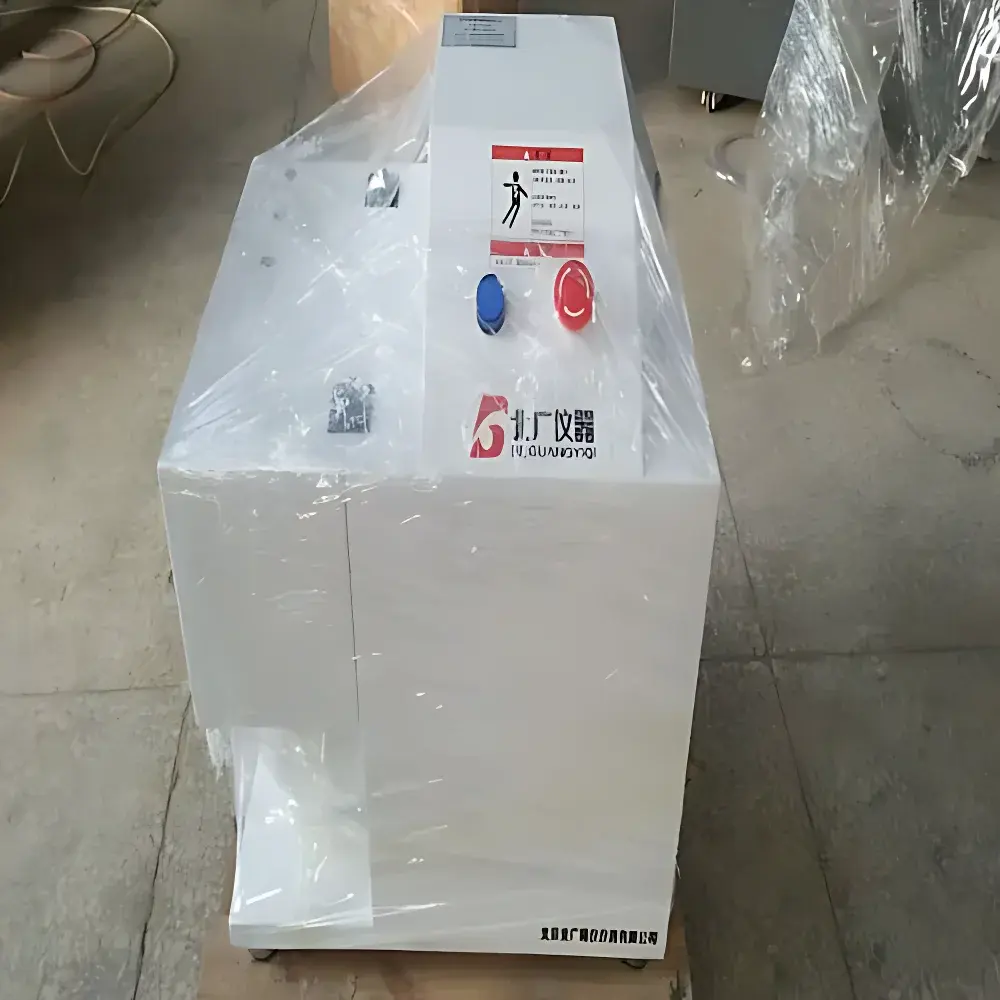
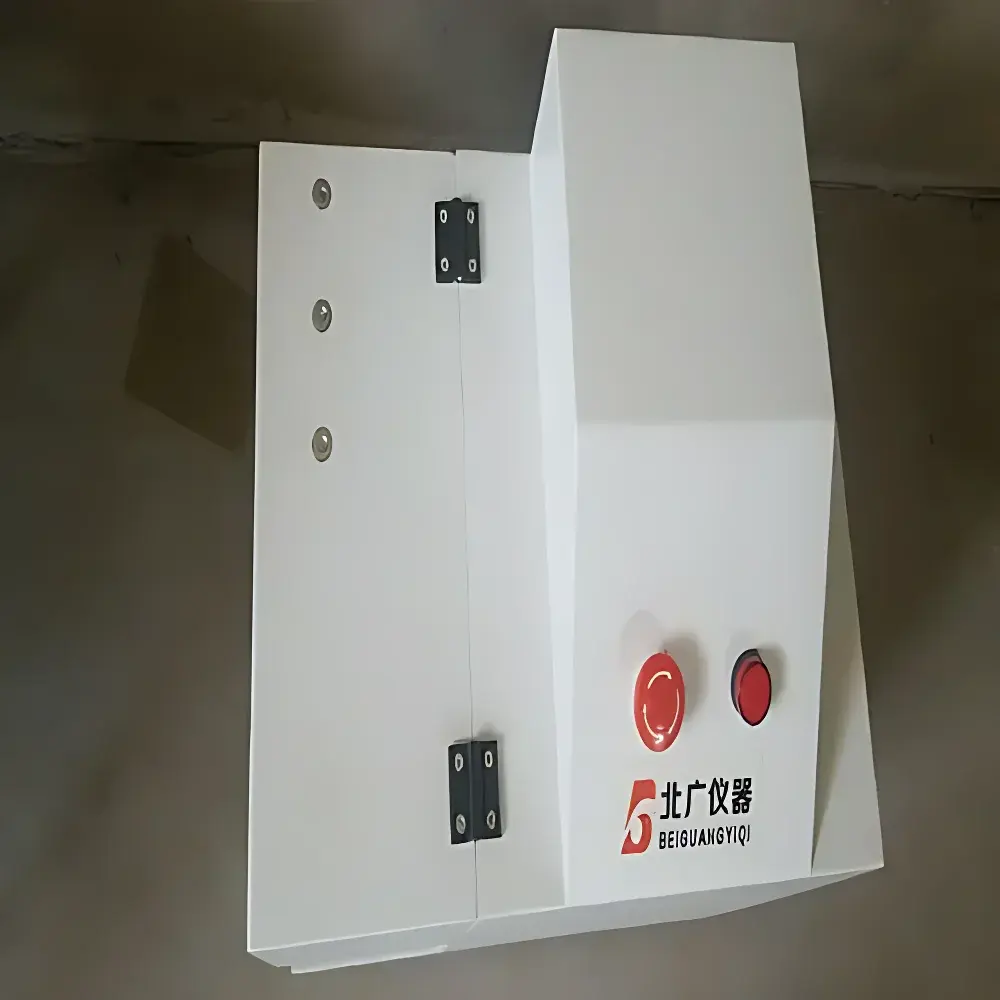
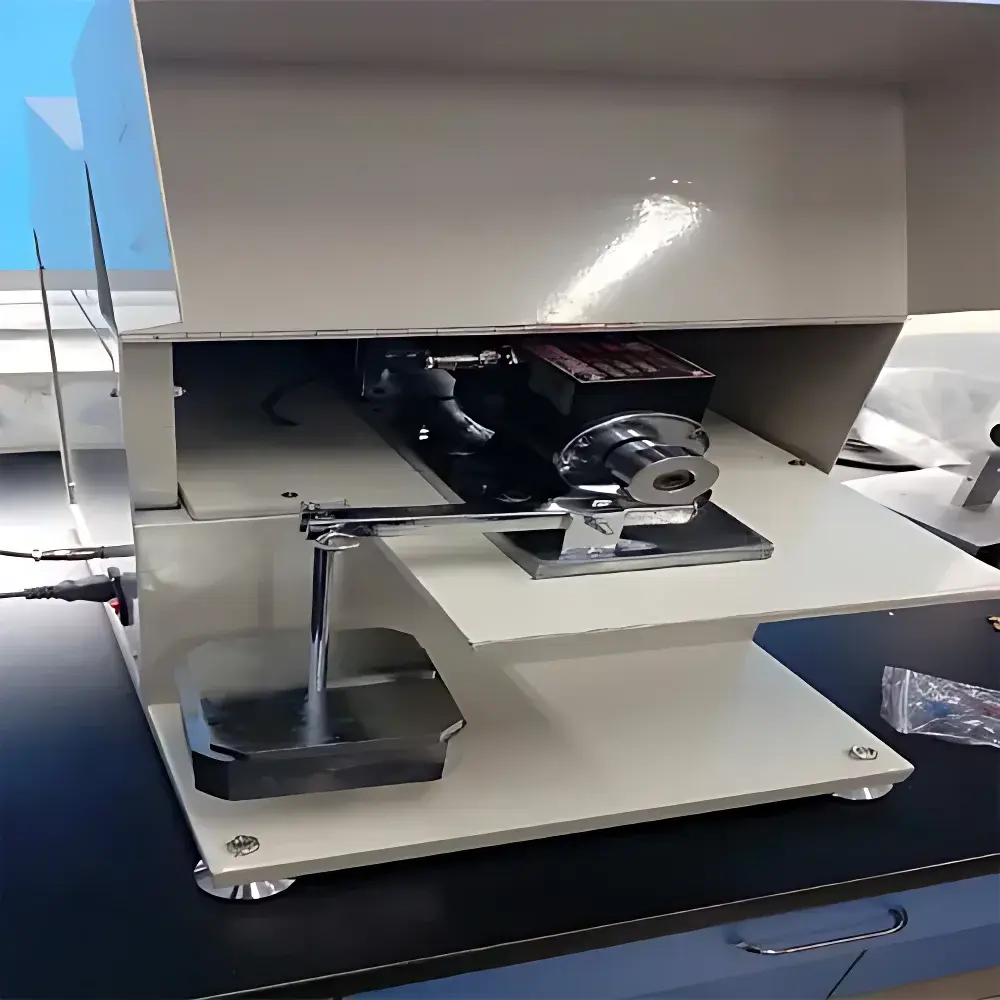
Beijing North Guang Precision Instruments M-200 New Sliding Friction and Wear Tester
| Brand | Beijing North Guang Precision Instruments |
|---|---|
| Origin | Beijing, China |
| Manufacturer Type | Direct Manufacturer |
| Product Category | Domestic |
| Model | M-200 New |
| Instrument Type | Coefficient of Friction Tester |
| Maximum Friction Torque | 0–4 N·m ±0.5% |
| Rotational Speed Range | 1–500 rpm (adjustable, standard test speed: 200 rpm) |
| Normal Load Accuracy | ±0.2% at 196 N (20 kgf) |
| Load Capacity | Up to 392 N (40 kgf) |
| Friction Torque Resolution | 0.001 N·m |
| 同心度偏差 (Concentricity Tolerance) | <0.01 mm |
| Counter Accuracy | ±0.1 s |
| Specimen Dimensions | 30 mm × 7 mm × 6 mm ±0.1 mm |
| Counter Range | 0–10,000 h |
| Standard Counterpart Ring | Ø40 mm × 10 mm, 45# steel, HRC 40–45, surface finish Ra ≤ 1.6 µm (▽8), chamfer 0.5×45° |
Overview
The Beijing North Guang Precision Instruments M-200 New Sliding Friction and Wear Tester is a precision-engineered tribological testing system designed in strict accordance with GB/T 3960–2016 (“Determination of the coefficient of friction and wear rate of plastics under sliding conditions”). It operates on the pin-on-disk (or ring-on-block) principle, where a standardized rotating steel counterface (ring) slides against a stationary polymer or elastomeric specimen under controlled normal load and rotational velocity. This configuration enables quantitative evaluation of dynamic friction behavior, wear resistance, and energy dissipation characteristics—critical parameters for material selection in bearing surfaces, seals, gears, and structural components exposed to dry or lubricated sliding contact. The instrument employs a high-stiffness mechanical architecture with radial runout <0.01 mm at the drive shaft, ensuring minimal parasitic motion and high repeatability across extended test durations (up to 10,000 hours). Its modular design supports both routine QC screening and advanced research into wear mechanisms—including adhesive, abrasive, and fatigue-driven degradation—under ambient environmental conditioning per GB/T 2918–1998 (23 ± 5 °C, 50 ± 10 % RH).
Key Features
- High-precision DC servo motor with closed-loop speed control (1–500 rpm, resolution 0.1 rpm; standard test speed 200 rpm ± 1%)
- Dual-range torque sensor calibrated to ±0.5% full scale (0–4 N·m), with digital signal conditioning and 16-bit ADC resolution
- Load application system using calibrated deadweight masses (1 kg × 4 + 4 kg × 1), enabling stepwise normal force from 9.8 N to 392 N (1–40 kgf), traceable to national mass standards
- Integrated real-time data acquisition: simultaneous logging of friction torque, rotational speed, elapsed time, and calculated coefficient of friction (µ = torque / (radius × normal load))
- Automated test sequencing: one-click start/stop, programmable dwell time, auto-shutdown upon completion, and post-test wear assessment trigger
- Modular specimen fixture compliant with GB/T 3960 geometry (30 mm × 7 mm × 6 mm ±0.1 mm), secured via M3×0.35 countersunk screws (GB 848–1976) and precision-ground washers to eliminate axial play
- Standardized counterpart ring (Ø40 mm × 10 mm, 45# steel, HRC 40–45, Ra ≤ 1.6 µm) with concentricity <0.01 mm; regrindable until outer diameter ≥36 mm
Sample Compatibility & Compliance
The M-200 New accommodates rigid and semi-crystalline thermoplastics (e.g., POM, PA66, PTFE), thermosets (e.g., phenolics, epoxy composites), elastomers (e.g., NR, SBR, silicone), and fiber-reinforced polymer matrix composites. All specimens must be conditioned per GB/T 2918–1998 prior to testing. The system meets mechanical and metrological requirements specified in GB/T 3960–2016 and is compatible with comparative assessments referenced in ASTM D3702 (standard practice for wear testing of plastics), ISO 683-18 (heat-treated steels for tribological applications), and ISO 20806 (tribological testing terminology). While not certified for GLP or GMP environments out-of-the-box, its audit-ready data structure—including timestamped raw values, operator ID, parameter logs, and calibration metadata—supports implementation of 21 CFR Part 11-compliant workflows when integrated with validated third-party LIMS or ELN platforms.
Software & Data Management
The embedded 16-bit microcontroller-based control system runs proprietary firmware supporting multi-user access with role-based permissions (administrator, technician, viewer). The Windows-compatible GUI provides real-time visualization of µ–t and torque–t curves, configurable alarm thresholds (e.g., torque deviation >5%), and automated report generation in editable PDF or CSV formats. Each report includes: test identifier, environmental conditions, specimen batch ID, load/speed settings, raw torque/time arrays, mean coefficient of friction (±SD), volumetric wear rate (mm³/N·m), and optional annotations. All data files are stored with SHA-256 checksums; modification history is retained in non-volatile memory. Calibration records, user activity logs, and system diagnostics are exportable for internal QA audits or regulatory review.
Applications
- Quantitative ranking of polymer formulations for low-friction, high-wear-resistance applications (e.g., automotive bushings, medical device articulation surfaces)
- Evaluation of solid lubricant additives (MoS₂, graphite, PTFE particles) in thermoplastic matrices
- Accelerated aging studies correlating wear volume with thermal oxidative exposure (when used inside environmental chambers)
- Validation of surface treatments (plasma etching, fluorination, hard coating) on polymeric substrates
- Interlaboratory round-robin testing under ISO/IEC 17043 guidelines for proficiency assessment
- Teaching laboratories for tribology fundamentals: Amontons’ laws, Stribeck curve approximation, and wear map construction
FAQ
What standards does the M-200 New comply with?
It is fully aligned with GB/T 3960–2016 and supports test protocols referenced in ASTM D3702, ISO 683-18, and ISO 20806.
Can the system operate beyond ambient temperature?
The base unit is rated for 10–35 °C operation. Integration with external environmental chambers (–70 to +250 °C) is possible via custom mounting interfaces and analog I/O expansion modules.
Is the counterpart ring included, and how often must it be replaced?
One standard Ø40 mm ring (45# steel, HRC 40–45) is supplied. It may be reground up to three times; discard when outer diameter falls below 36 mm. Arbitration tests require a fresh Ø40 mm ring.
How is traceability ensured for calibration and maintenance?
Torque sensor and speed encoder calibrations are performed annually using NIST-traceable reference standards; certificates include uncertainty budgets. All calibration events are logged with operator ID and equipment IDs.
Does the software support electronic signatures and audit trails per FDA 21 CFR Part 11?
The native software provides audit trail functionality (user login/logout, parameter changes, report generation) but requires integration with a validated third-party electronic signature platform to meet full Part 11 compliance.



