
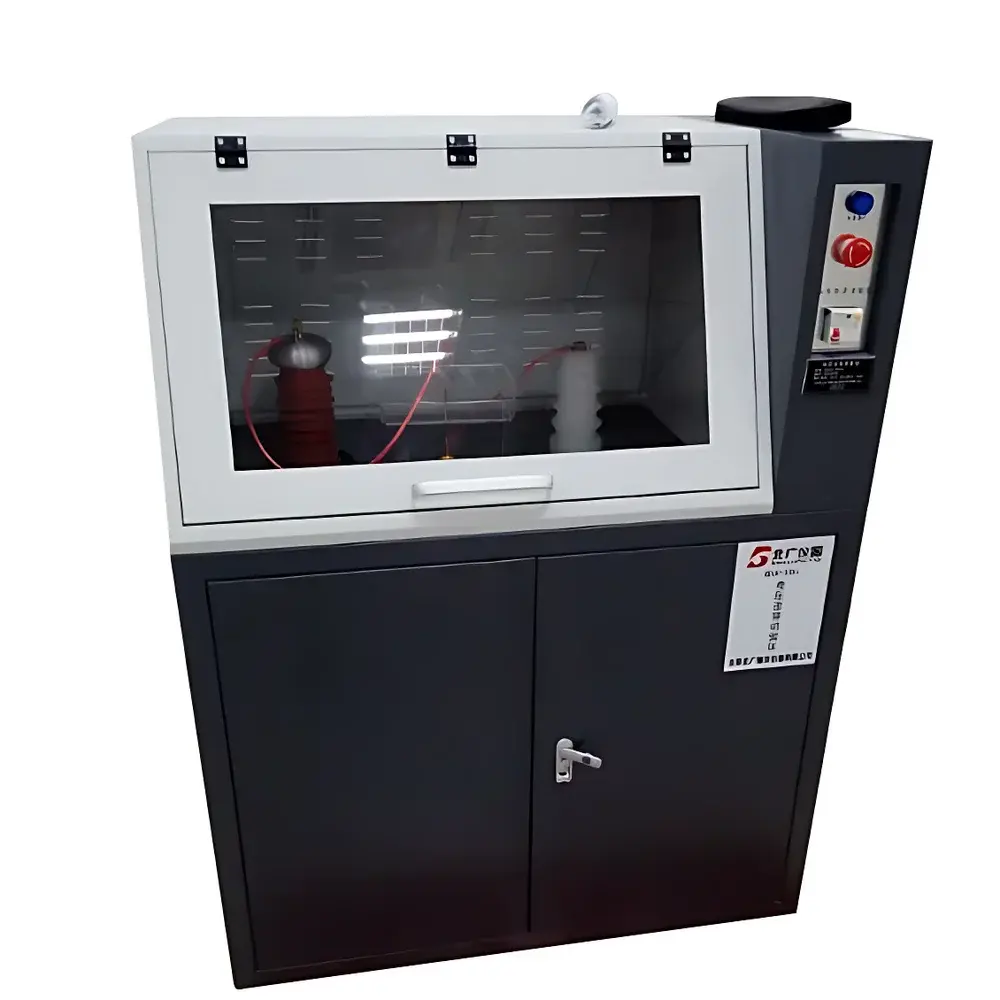
Beijing North Guang Precision Instruments BDJC Series Dielectric Strength Tester
| Brand | Beijing North Guang Precision Instruments |
|---|---|
| Origin | Beijing, China |
| Manufacturer Type | OEM Manufacturer |
| Model | BDJC-50KV |
| Maximum Breakdown Voltage | 50 kV |
| Compliance Standards | GB/T 1408.1–2006, ASTM D149, IEC 60243-1, GB/T 1695–2005, HG/T 3330, GB 12656 |
| Voltage Accuracy | ≤ ±1% to ±5% (full scale) |
| Ramp Rate | 0.01–3 kV/s (continuously adjustable) |
| Test Modes | AC/DC, Withstand, Breakdown, Stepwise Voltage Ramp |
| Electrode Options | 25 mm & 75 mm diameter brass electrodes (per GB/T 1408.1), optional wire/cable and tubular electrodes |
| Transformer Capacity | 3–10 kVA |
| Safety Protection | 9-level interlock system including door limit switch, zero-voltage startup, overvoltage cutoff, mechanical high-voltage limiter, overcurrent trip, real-time arc detection, exhaust ventilation, and visual HV indicator |
| Dimensions (L×W×H) | 1000×600×1400 mm or 1700×600×1400 mm |
| Weight | 100–200 kg |
| Warranty | 3 years comprehensive, lifetime technical support |
Overview
The Beijing North Guang Precision Instruments BDJC Series Dielectric Strength Tester is a fully programmable, microprocessor-controlled high-voltage testing system engineered for precise determination of dielectric breakdown voltage and electrical strength of solid and liquid insulating materials. Operating on the principle of controlled voltage ramping under standardized electrostatic stress conditions, the BDJC platform complies with core international test methodologies—including ASTM D149 (dielectric breakdown voltage of solid electrical insulating materials at commercial power frequencies), IEC 60243-1 (electrical strength of insulating materials), and GB/T 1408.1–2006 (electrical strength testing of insulating materials in China). Designed for laboratory and quality control environments, the system delivers repeatable, traceable, and auditable results across rubber, plastics, polymer films, ceramics, glass, varnishes, insulating oils, and composite laminates used in aerospace, power transmission, automotive wiring, and medical device manufacturing.
Key Features
- High-fidelity voltage acquisition using Japan-made Matsusada precision voltage sensors, coupled with dual-channel current sensing for real-time leakage monitoring.
- Siemens S7-1200 PLC-based control architecture with 1 ms sampling resolution and sub-millisecond breakdown response time—ensuring accurate event capture during transient failure.
- Optically isolated PC communication interface eliminates ground-loop interference and guarantees data integrity during high-voltage transients.
- Continuously variable ramp rate (0.01–3 kV/s) with no fixed stepping—enabling compliance with both slow-ramp qualification tests and rapid screening protocols.
- Dual termination logic: simultaneous voltage- and current-triggered stop criteria, minimizing false negatives from surface tracking or partial discharge artifacts.
- Integrated nine-tier safety architecture—including door interlock, automatic zero-voltage reset after power interruption, software-defined upper voltage limit, mechanical HV cutoff, overcurrent tripping, and visible HV status indicators.
- Transformer cooling vents and forced-air exhaust system mitigate thermal drift and suppress combustion byproducts during catastrophic failure events.
Sample Compatibility & Compliance
The BDJC-50KV supports standardized electrode configurations per GB/T 1408.1–2006, including 25 mm and 75 mm diameter brass disk electrodes (standard), plus optional wire, cable, and tubular fixtures for specialized geometries. It accommodates specimens ranging from thin films (<0.1 mm) to thick molded parts (up to 25 mm), with thickness input enabling automatic calculation of dielectric strength (kV/mm) post-test. The system is validated for use with air, transformer oil, silicone fluid, and other dielectric test media. All hardware and firmware meet requirements for GLP-compliant documentation, and raw test logs include timestamped metadata suitable for FDA 21 CFR Part 11–aligned audit trails when deployed with validated software configuration.
Software & Data Management
The proprietary Windows-based control software provides role-based access control (multi-user login with password protection), configurable test templates, and granular parameter assignment—including selectable withstand duration, step size, dwell time, and sensitivity thresholds for leakage current and voltage deviation. Test results are stored in structured binary + CSV format with embedded metadata (operator ID, ambient temperature/humidity, electrode type, specimen ID, standard reference). Comparative analysis supports overlay of up to five test curves; automated report generation includes customizable fields aligned with ISO/IEC 17025 reporting requirements. Remote diagnostics, firmware updates, and calibration log import/export are supported via encrypted TCP/IP connection.
Applications
This instrument serves critical functions across R&D, incoming material inspection, and production line QA/QC workflows. Typical applications include: evaluation of polymeric encapsulants for EV battery modules; validation of ceramic substrates for high-frequency RF components; qualification of aerospace-grade silicone elastomers per MIL-STD-202; assessment of insulating varnishes in motor windings; verification of dielectric integrity in medical-grade PVC tubing; and comparative aging studies of cable jacketing exposed to UV/thermal cycling. Its capacity to execute both AC and DC breakdown protocols makes it suitable for investigating space charge accumulation effects in modern high-k dielectrics.
FAQ
What standards does the BDJC-50KV comply with?
It conforms to GB/T 1408.1–2006, ASTM D149, IEC 60243-1, GB/T 1695–2005, HG/T 3330, and GB 12656—covering solid, liquid, and flexible insulating materials.
Can the system perform both AC and DC breakdown tests?
Yes—dual-mode operation is standard, with independent waveform conditioning and measurement circuitry optimized for each regime.
Is the test software compliant with regulatory data integrity requirements?
When configured with user authentication, electronic signatures, and audit trail logging enabled, the software meets baseline expectations for 21 CFR Part 11 and ISO/IEC 17025 documentation practices.
How is electrode selection determined for a given material?
Electrode geometry follows material-specific standards: disk electrodes (25 mm or 75 mm) for flat sheet specimens per GB/T 1408.1; custom fixtures are available for wires, tubes, or irregular geometries under ASTM D149 Annex A1.
What maintenance and calibration services are provided?
Three-year full warranty includes remote diagnostics, software updates, and on-site technician training. Third-party calibration certificates are available from accredited national institutes including China Academy of Metrology (CAM), No. 514 Institute, and China Academy of Engineering Physics (CAEP) No. 304 Institute.



