
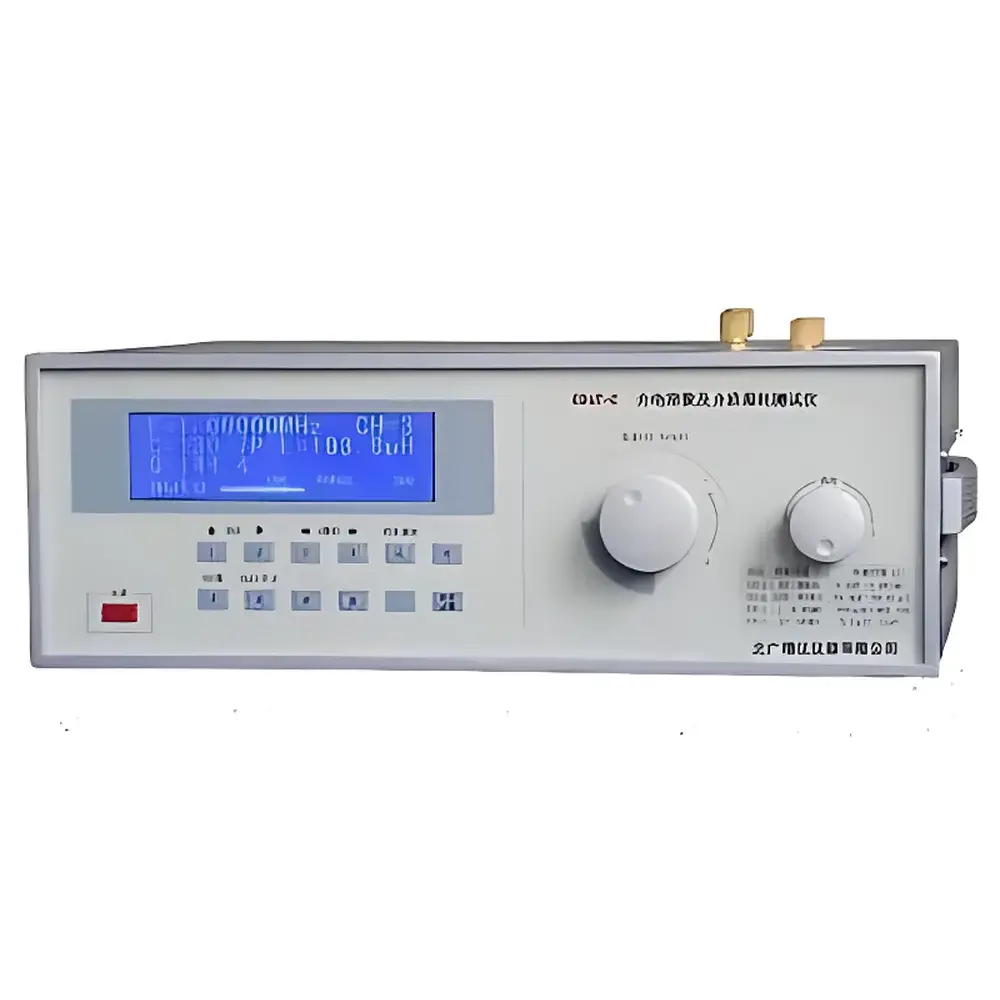
Beijing North Guang Precision Instruments GDAT-A High-Frequency Dielectric Constant and Loss Tangent Analyzer
| Brand | Beijing North Guang Precision Instruments |
|---|---|
| Origin | Beijing, China |
| Manufacturer Type | Direct Manufacturer |
| Model | GDAT-A |
| Frequency Range | 100 kHz – 160 MHz |
| Q Factor Measurement Range | 2–1023 |
| Capacitance Measurement Range | 1–200 pF |
| Main Capacitance Tuning Range | 18–220 pF |
| Thickness Resolution (with BD916 Fixture) | 0.001 mm |
| Compliance | GB/T 1409–2006 |
Overview
The Beijing North Guang Precision Instruments GDAT-A High-Frequency Dielectric Constant and Loss Tangent Analyzer is a precision impedance measurement system engineered for the quantitative characterization of dielectric properties in insulating solid materials—including ceramics, polymer composites, laminates, and capacitor-grade dielectrics. It operates on the principle of high-frequency resonance, utilizing a calibrated Q-meter architecture to determine complex permittivity (ε* = ε′ − jε″) by measuring changes in resonant Q factor and frequency shift when a sample is introduced into a precisely defined parallel-plate electrode configuration. The system comprises two core components: the GDAT-A high-frequency Q meter (100 kHz to 160 MHz), and the BD916 dielectric test fixture—a temperature-stable, micrometer-adjustable parallel-plate capacitor with Φ38 mm or Φ50 mm electrodes and sub-micron thickness resolution (0.001 mm). This methodology conforms rigorously to the harmonized test protocol specified in GB/T 1409–2006, which aligns with international practices for determining relative permittivity (εr) and loss tangent (tan δ) across power, audio, radio, and microwave frequency bands up to meter-wavelength frequencies.
Key Features
- Wide frequency coverage from 100 kHz to 160 MHz, segmented into four virtual bands (100 kHz–1 MHz, 1–10 MHz, 10–100 MHz, 100–160 MHz) for optimized signal-to-noise performance and calibration stability.
- Q-factor measurement range of 2–1023 with automatic or manual range selection across four sensitivity steps (30, 100, 300, 1000), supporting high-resolution evaluation of low-loss and high-loss dielectrics.
- Integrated BD916 test fixture featuring digital micrometer readout, adjustable electrode spacing (≥15 mm), and dual electrode diameter options (Φ38 mm / Φ50 mm) to accommodate varied sample geometries and ASTM/IEC-compliant test area requirements.
- Main capacitance tuning range of 18–220 pF with accuracy of ±1 pF below 100 pF and ±1% above, enabling precise nulling of stray capacitance and repeatable resonance establishment.
- Frequency indication accuracy of ±3 × 10⁻⁵ plus one digit, traceable to internal quartz reference, ensuring metrological integrity for comparative and regulatory testing.
- Low inherent fixture loss: tan δ ≤ 4 × 10⁻⁴ at 1 MHz, minimizing systematic error contribution and preserving measurement fidelity for ultra-low-loss materials (e.g., fused silica, sapphire, polyimide films).
Sample Compatibility & Compliance
The GDAT-A system is validated for rigid, flat, and homogeneous solid dielectrics with thicknesses between 0.1 mm and 15 mm. Samples must exhibit uniform density, minimal porosity, and surface flatness within ±2 µm to ensure consistent electrode contact and avoid fringing-field distortion. Compatible material classes include alumina and zirconia ceramics, epoxy-glass laminates (FR-4), polytetrafluoroethylene (PTFE), polyetheretherketone (PEEK), silicone elastomers, and solvent-cast polymer films. All measurements comply with GB/T 1409–2006, which specifies conditioning protocols (23 °C / 50% RH, 24 h minimum), electrode geometry tolerances, and uncertainty budgeting methods consistent with ISO/IEC 17025–2017 general requirements for competence of testing and calibration laboratories. While not FDA 21 CFR Part 11–certified out-of-the-box, the instrument’s analog front-end design supports integration into GLP/GMP environments via external data logging systems with audit-trail capability.
Software & Data Management
The GDAT-A operates as a benchtop manual instrument with analog Q-meter readout and digital micro-positioning display—intentionally designed for direct operator control and real-time resonance tuning without software dependency. Raw data (resonant frequency f0, unloaded Q0, loaded QL, main capacitance C0, sample thickness d) are recorded manually or exported via optional RS-232 interface to third-party spreadsheet or lab information management systems (LIMS). Calculated parameters—including ε′, ε″, tan δ, and conductivity σ—are derived using standardized equations per GB/T 1409–2006 Annex B. For automated workflows, users may implement custom Python or MATLAB scripts interfacing with the instrument’s serial output to generate traceable test reports compliant with ISO 17025 documentation requirements.
Applications
- Quality control of high-frequency substrate materials used in RF/microwave PCBs and antenna modules.
- R&D evaluation of novel ceramic formulations for multilayer ceramic capacitors (MLCCs) and high-k gate dielectrics.
- Comparative analysis of moisture absorption effects on epoxy resin systems via tan δ elevation at 1–10 MHz.
- Validation of thermal aging behavior in polymeric insulators through tracking of ε′ dispersion and loss peak shifts.
- Characterization of ferroelectric phase transitions via temperature-dependent permittivity profiling (when paired with environmental chamber).
- Verification of coating uniformity and interfacial void content in laminated dielectric stacks using thickness-normalized capacitance deviation analysis.
FAQ
What standards does this instrument support?
It fully implements GB/T 1409–2006, which is technically equivalent to IEC 60250 and ASTM D150 for dielectric constant and loss tangent measurement in solid insulating materials.
Can it measure liquid or powder samples?
No—the BD916 fixture is designed exclusively for solid, self-supporting specimens. Liquids require coaxial probe or waveguide-based systems; powders necessitate pelletization under controlled pressure prior to testing.
Is calibration certificate included?
A factory calibration report is supplied with each unit, covering frequency accuracy, Q-scale linearity, and main capacitance linearity at three representative frequencies (1 MHz, 30 MHz, 100 MHz). NIST-traceable recalibration services are available upon request.
What is the typical measurement uncertainty for tan δ?
Under controlled laboratory conditions (23 ± 1 °C, 0.1, per GB/T 1409–2006 uncertainty model.
Does the system support automated sweep or network analysis?
No—it is a single-frequency, resonance-nulling instrument. For broadband permittivity spectra, users should consider vector network analyzer (VNA)-based solutions or time-domain reflectometry (TDR) platforms.
Related Products



