
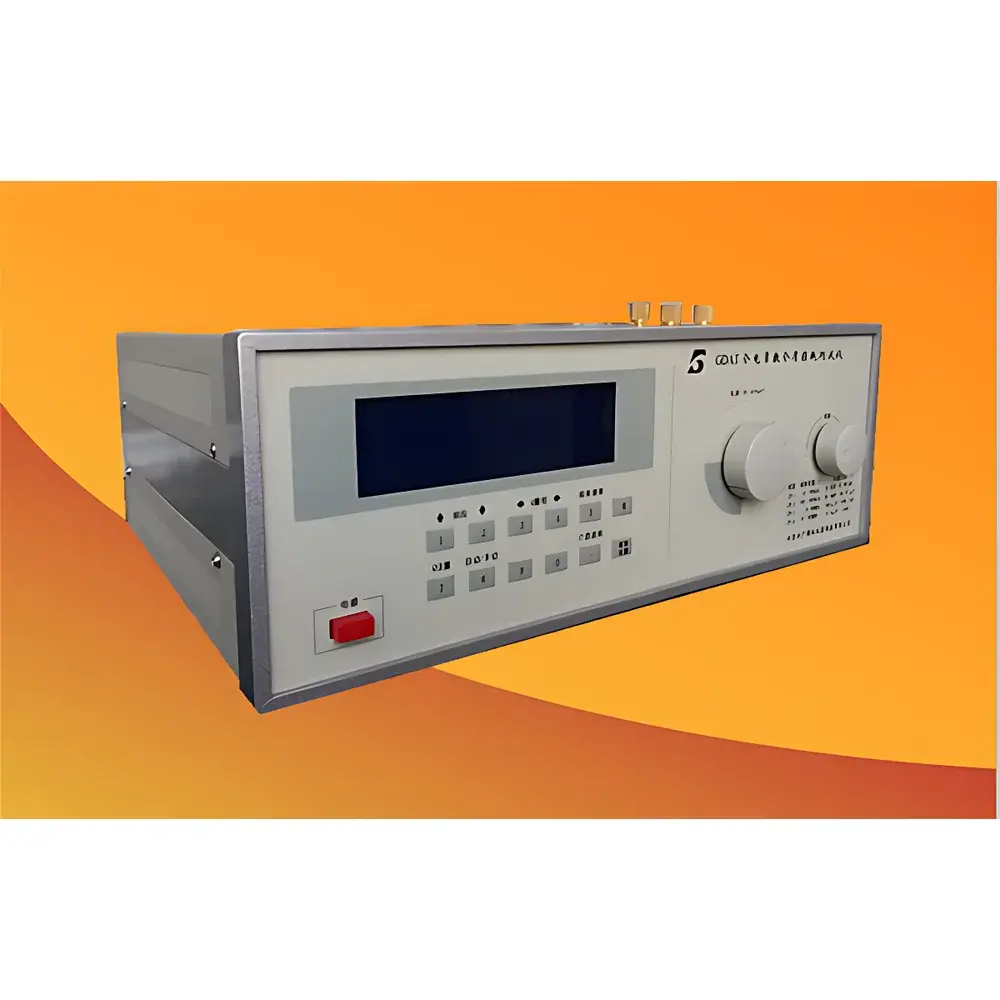
Beijing North Guang Precision Instruments GDAT/A High-Frequency Q Meter for Dielectric Constant and Loss Tangent Measurement of Plastics and Ceramics
| Brand | Beijing North Guang Precision Instruments |
|---|---|
| Origin | Beijing, China |
| Manufacturer Type | Direct Manufacturer |
| Product Origin | Domestic (China) |
| Model | GDAT/A |
| Price | USD 170 (approx. based on ¥1200 at 7.06 exchange rate) |
Overview
The Beijing North Guang Precision Instruments GDAT/A High-Frequency Q Meter is a precision impedance measurement system engineered for the quantitative characterization of dielectric properties—including complex permittivity (εr′ and εr″), loss tangent (tan δ), and quality factor (Q)—of solid and semi-solid insulating materials such as thermoplastics, engineering ceramics, elastomers, and polymer films. Operating on the principle of resonant cavity perturbation and series/parallel RLC resonance analysis, the instrument employs a high-stability DDS (Direct Digital Synthesis) signal source to generate calibrated sinusoidal excitation across two frequency ranges: 1 kHz–60 MHz and 50 kHz–160 MHz. This enables broadband dielectric spectroscopy under controlled RF conditions, supporting both fixed-frequency point measurements and automated resonance tracking. The system’s low-residual-inductance tuning circuit (<8 nH) minimizes parasitic phase error, ensuring traceable accuracy in tan δ down to 0.00005 and Q resolution of ±0.1—critical for compliance-driven material qualification in electronics packaging, aerospace composites, and medical device insulation validation.
Key Features
- DDS-based dual-range RF signal generation: 1 kHz–60 MHz and 50 kHz–160 MHz, with <0.01% frequency stability and THD <−70 dBc
- Auto-resonance search function: Automatically locates series/parallel resonance points by sweeping capacitance or frequency, then computes C, L, Q, tan δ, and εr in real time
- Digital sensor-assisted main capacitance adjustment (GDAT/A variant): Capacitance readout resolution ≤0.1 pF; step-motor-controlled version offers enhanced repeatability for GLP-critical workflows
- Multi-parameter digital display: Simultaneous readout of Q, test frequency, capacitance, inductance, tan δ, and tuning status on backlit LCD interface
- Low-loss test fixture architecture: Optimized for minimal stray inductance and distributed capacitance; supports standardized electrode configurations per IEC 60250 and ASTM D150
- Independent RF output port: Functions as a calibrated signal source for external impedance analyzers or custom test benches
Sample Compatibility & Compliance
The GDAT/A accommodates flat, rigid, or flexible solid dielectrics—including injection-molded plastic specimens (e.g., PEEK, polyethylene, PET), sintered ceramic substrates (Al2O3, ZrO2), silicone rubber sheets, and thin polymer films (≥25 µm thickness). Sample mounting follows parallel-plate electrode geometry per GB/T 1409–2006, with optional guarded-electrode fixtures available for surface-conductivity suppression. The system meets essential metrological requirements of ASTM D150–22 (Standard Test Methods for Dielectric and Resistivity Properties of Solid Electrical Insulating Materials), IEC 60250 (Measurement of the Permittivity and Dielectric Dissipation Factor of Electrical Insulating Materials at Power, Audio and Radio Frequencies), and aligns with data integrity expectations under FDA 21 CFR Part 11 when integrated with validated laboratory information management systems (LIMS). Traceable calibration is supported via supplied LKI-1 inductor reference set (not NIST-traceable; intended for system verification only).
Software & Data Management
While the GDAT/A operates as a standalone benchtop instrument with embedded firmware, its digital parameter outputs (RS-232 interface standard, USB optional) enable seamless integration with third-party data acquisition platforms. Users may log time-stamped Q, C, fres, tan δ, and εr values into CSV or Excel formats for post-processing in MATLAB, Python (SciPy), or JMP. Audit trails—including operator ID, environmental temperature/humidity tags (via optional external sensors), and calibration event timestamps—can be maintained externally to satisfy GLP/GMP documentation requirements. Firmware updates are delivered via secure FTP upon registration; no cloud connectivity or proprietary software installation is required.
Applications
- Quality control of high-frequency PCB substrate materials (e.g., Rogers RO4000®, Teflon-based laminates)
- Development and screening of low-loss ceramic dielectrics for 5G mmWave antenna modules
- Moisture content estimation in hygroscopic polymers via tan δ peak shift analysis at 1–30 MHz
- Thermal aging studies: Tracking εr and tan δ drift in epoxy encapsulants after 85°C/85% RH stress testing
- Evaluation of filler dispersion homogeneity in conductive polymer composites through frequency-dependent permittivity dispersion
- Validation of space-grade insulation per ECSS-Q-ST-70-02C (Electrical Materials Testing)
FAQ
What standards does the GDAT/A comply with for dielectric measurements?
It conforms to GB/T 1409–2006, ASTM D150–22, and IEC 60250 for test methodology, electrode configuration, and uncertainty reporting frameworks.
Can the instrument measure liquid samples?
No—the GDAT/A is configured exclusively for solid or semi-solid dielectrics using parallel-plate contact electrodes; liquid measurement requires a dedicated coaxial probe or waveguide cell not included with this model.
Is NIST-traceable calibration provided?
The instrument ships with factory calibration against internal references; NIST-traceable calibration certificates require third-party service and are not included by default.
What is the minimum sample thickness recommended?
For reliable εr extraction, specimens should be ≥0.5 mm thick with parallel, polished surfaces; thinner films (≥25 µm) require guarded-electrode fixtures and empirical correction factors.
Does the GDAT/A support automated temperature-controlled testing?
Not natively—the base unit lacks integrated thermal chambers; however, it is compatible with external environmental chambers via analog trigger I/O and synchronized data logging protocols.




