
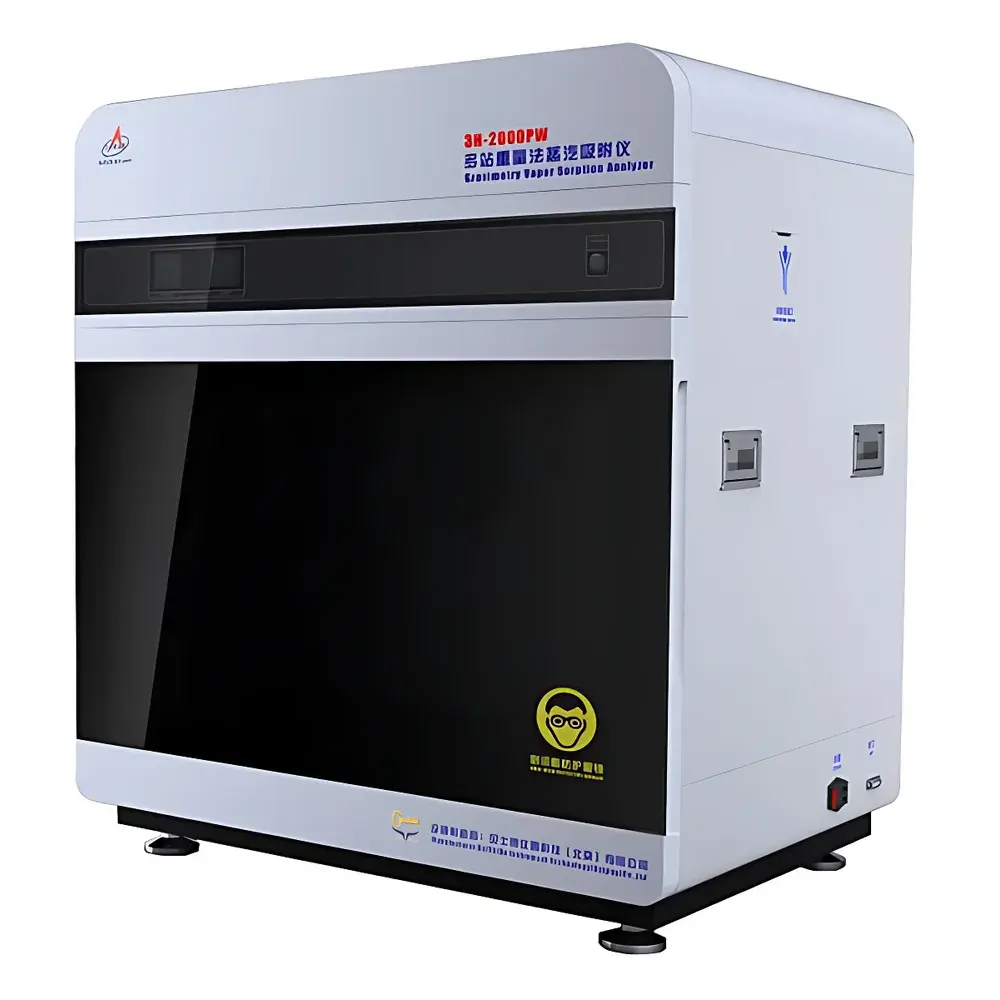
Beishide 3H-2000PWP2 Automated Saturated Vapor Pressure Analyzer
| Brand | Beishide Instrument |
|---|---|
| Origin | Beijing, China |
| Manufacturer Type | Direct Manufacturer |
| Product Category | Domestic |
| Model | 3H-2000PWP2 |
| Price Range | USD 70,000–140,000 |
| Instrument Type | Static/Dynamic Vapor Adsorption Analyzer |
| Measurement Principle | Knudsen Effusion Mass Loss Method |
| Analysis Stations | 2 sample + 2 reference stations (total 4) |
| Sample Mass Range | 10–1000 mg |
| Mass Resolution | 1 µg |
| Vacuum System | Dual-stage mechanical pump (base pressure ≤ 1×10⁻² Pa) + turbo-molecular pump (base pressure ≤ 1×10⁻⁶ Pa) |
| Pressure Range | 0–1 torr & 0–1000 torr (dual-range, segmented measurement) |
| Temperature Range | –180 °C to 900 °C (accuracy ±0.1 °C, stability < 0.1 °C) |
| Isothermal Control Range | Ambient to 60 °C (accuracy ±0.2 °C, stability < 0.1 °C) |
| Temperature Programming | 32-segment ramping with overtemperature protection |
| Sealing Design | Oil-resistant, corrosion-resistant valves and tubing |
| Dimensions | H 110 cm × W 100 cm × L 70 cm |
| Weight | 200 kg |
Overview
The Beishide 3H-2000PWP2 Automated Saturated Vapor Pressure Analyzer is an advanced physical property testing instrument engineered for high-precision determination of saturated vapor pressure (SVP) of low-volatility substances across solid, liquid, and viscous oil phases. It operates on the fundamental principles of Knudsen effusion mass loss—where a thermally stabilized sample in a micro-orifice effusion cell undergoes controlled sublimation or evaporation under ultra-high vacuum conditions. Under Knudsen regime (mean free path ≫ orifice diameter), molecular effusion rate is directly proportional to vapor pressure, enabling quantitative derivation of SVP from real-time mass loss kinetics measured via microbalance. This method is uniquely suited for substances exhibiting vapor pressures between 10−5 Pa and 10 Pa—spanning critical applications in pesticide formulation stability, plasticizer migration kinetics, pharmaceutical excipient volatility screening, and high-temperature metallurgical vapor thermodynamics. Unlike conventional static manometric or gas saturation methods, the 3H-2000PWP2 eliminates equilibrium lag and adsorption artifacts by decoupling mass transport from gas-phase detection—ensuring traceable, reproducible results compliant with ASTM E1782 (Standard Test Method for Determining Vapor Pressure by the Knudsen Effusion Technique).
Key Features
- Dual-mode operation: seamless switching between vapor adsorption analysis and inert gas-based physical property characterization (e.g., thermal desorption profiling)
- Automated leak integrity verification: integrated pressure-rise diagnostics with pass/fail logic per ASTM E1024, ensuring system readiness before each run
- Controlled atmospheric recovery: programmable venting sequence prevents sample dispersion during post-analysis depressurization
- Graphical user interface (GUI): fully hardware-integrated control panel supporting real-time valve actuation, temperature setpoint adjustment, and vacuum stage selection
- Comprehensive audit trail: timestamped operational log (precision to 1 second) recording all thermal cycles, pressure transitions, balance readings, and error events—fully exportable for GLP/GMP compliance
- Voice-guided workflow: multilingual audio prompts synchronized with procedural milestones (e.g., “Effusion cell temperature stabilized”, “Reference station tare complete”)
- Remote monitoring: SMTP-enabled email alerts for status updates, completion notifications, and anomaly reporting—including attachment of raw data files and summary reports
- Critical subsystem sourcing: high-stability quartz crystal microbalance, ceramic-heated effusion cells, and metal-sealed UHV-compatible valves supplied by Tier-1 European and Japanese OEMs
Sample Compatibility & Compliance
The 3H-2000PWP2 accommodates heterogeneous sample forms—including crystalline powders, molten salts, polymer melts, silicone oils, and organometallic complexes—without requiring derivatization or carrier gas dilution. Its dual-reference architecture enables simultaneous blank correction for thermal buoyancy, outgassing drift, and chamber wall condensation effects—reducing systematic uncertainty to <±2% relative at 10−4 Pa. All thermal protocols adhere to ISO 11357-1 for thermal analysis nomenclature and calibration traceability. Vacuum integrity meets ISO 20483 Class 3 requirements for ultra-low-pressure instrumentation. Data acquisition firmware complies with FDA 21 CFR Part 11 Annex 11 guidelines, supporting electronic signatures, role-based access control, and immutable record retention.
Software & Data Management
Proprietary VAPORCALC™ software provides end-to-end workflow automation—from method definition (temperature ramp profiles, dwell times, pressure range selection) to kinetic modeling (Langmuir-Knudsen transformation, Arrhenius activation energy fitting). Raw mass vs. time datasets are processed using Savitzky-Golay smoothing and numerical differentiation to extract dm/dt with sub-nanogram/sec resolution. Output includes vapor pressure isotherms, enthalpy of vaporization maps, and uncertainty propagation reports per GUM (JCGM 100:2018). Export formats include CSV, XML, and ASTM E1309-compliant .tdf files compatible with third-party statistical platforms (e.g., JMP, MATLAB). Audit logs are stored in SQLite databases with SHA-256 hashing for tamper evidence.
Applications
- Stability assessment of agrochemical active ingredients under tropical storage conditions (ASTM D5511)
- Volatility screening of GRAS food additives and fragrance compounds per IFRA standards
- Thermodynamic modeling of rare-earth oxide vapors in high-temperature metallurgy
- Accelerated aging studies of plasticizers in PVC medical tubing (ISO 10993-12)
- Reference material certification for NIST-traceable vapor pressure standards
- Quality-by-Design (QbD) parameter mapping in lyophilized biopharmaceutical formulations
FAQ
What vapor pressure range does the 3H-2000PWP2 cover?
The instrument measures saturated vapor pressures from 1×10⁻⁵ Pa to 10 Pa with calibrated accuracy across its full temperature range.
Can it analyze reactive or air-sensitive samples?
Yes—integrated glovebox-compatible transfer ports and inert-gas purging capability enable handling of pyrophoric, hygroscopic, or oxygen-sensitive materials.
Is calibration traceable to national standards?
All temperature sensors are NIST-traceable; pressure transducers are certified against primary mercury manometers; mass calibration uses certified weights per ISO/IEC 17025.
How is data integrity ensured during long-duration runs (e.g., >72 h)?
Continuous memory mirroring, redundant power-fail recovery, and cyclic checksum validation prevent data corruption—even during unattended overnight operation.
Does the system support custom kinetic models beyond standard Knudsen analysis?
Yes—the software SDK permits integration of user-defined differential equations and external thermodynamic databases via Python API hooks.



