
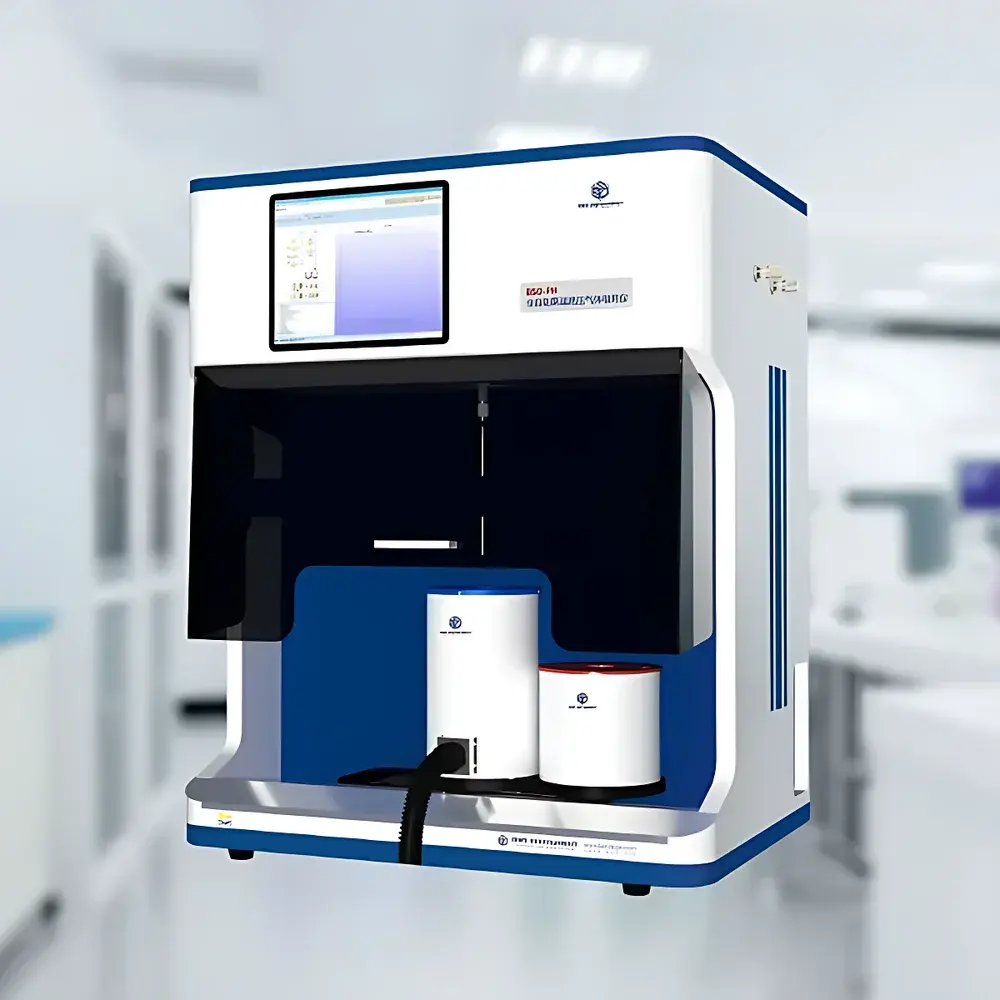
Beishide BSD-660H High-Pressure Gas Sorption Analyzer
| Brand | Beishide Instrument |
|---|---|
| Origin | Beijing, China |
| Manufacturer Type | Manufacturer |
| Model | BSD-660H |
| Measurement Method | Static Volumetric Method |
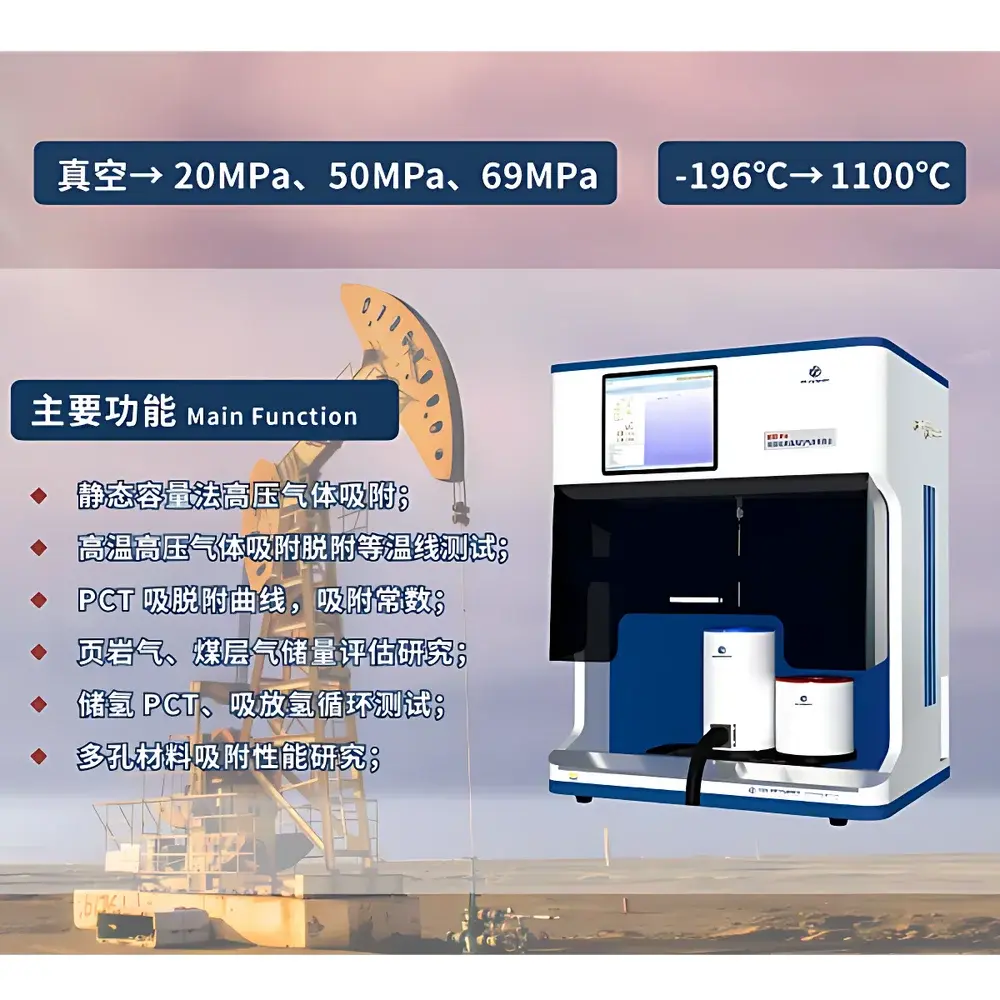
| Temperature Range | −196 °C to 300 °C (extendable to 1100 °C with optional furnace) |
| Pressure Range | High vacuum to 690 bar (69 MPa) |
| Ultimate Vacuum | 1 × 10⁻⁷ mbar |
| Repeatability | < ±2% |
| Pressure Sensor Accuracy | ±0.01% FS |
| Air-Bath Temperature Control | 40.0 °C ± 0.1 °C |
| Safety | Integrated combustible gas alarm, pressure-tested gas circuitry, optional alarm interlock system |
Overview
The Beishide BSD-660H is a fully automated, high-precision static volumetric high-pressure gas sorption analyzer engineered for quantitative characterization of gas–solid interactions under extreme thermodynamic conditions. It operates on the fundamental principle of gravimetrically invariant volumetric gas dosing: after helium pycnometry to determine sample skeletal volume and system dead volume, controlled incremental doses of adsorptive gas (e.g., H₂, CH₄, CO₂, N₂) are introduced into a thermostatically stabilized sample cell; equilibrium pressures are recorded at each step to construct absolute adsorption isotherms. The instrument supports both isothermal and temperature-programmed protocols—including PCT (pressure–composition–temperature), TPD (temperature-programmed desorption), and TPA (temperature-programmed adsorption)—enabling rigorous thermodynamic and kinetic analysis of porous and reactive solids. Designed for research-grade reproducibility and long-term stability, the BSD-660H meets the operational demands of materials science laboratories engaged in hydrogen storage development, unconventional reservoir evaluation, and advanced adsorbent screening.
Key Features
- Fully automated operation with integrated heating furnace (up to 300 °C standard; optional 1100 °C high-temp furnace) and cryogenic bath compatibility (77 K liquid nitrogen, 87 K liquid argon, or 110–273 K continuous low-temperature control)
- Ultra-high pressure capability: calibrated range from 10⁻⁷ mbar to 69 MPa (690 bar), supported by dual-range, high-stability pressure transducers (0.01% FS accuracy, 0.025% FS long-term drift)
- Triple- or six-position analysis configuration with independent thermal management per station, enabling parallel multi-sample testing without cross-contamination
- Robust safety architecture: ASME-certified pressure vessels, leak-tested gas pathways, built-in combustible gas detection, and optional emergency shutdown interlock with external ventilation systems
- Helium pycnometry module for precise skeletal density and void volume determination prior to sorption measurement
- Modular gas handling: optional dedicated gas booster systems for H₂, CH₄, and CO₂ (30/60/80 MPa configurations), MFC-controlled flow for kinetic studies, and high-fidelity micro-circulation for multicomponent gas mixing
Sample Compatibility & Compliance
The BSD-660H accommodates powdered, granular, and monolithic samples—ranging from milligram-scale MOFs and activated carbons to gram- to kilogram-scale metal hydrides and intact core plugs. Its mechanical stress module (optional BSD-PHC configuration) applies axial and radial confining pressure to simulate in-situ geological stress states, directly supporting ASTM D7955 (coalbed methane capacity), ISO 15903 (hydrogen storage materials), and USP (gas sorption in pharmaceutical excipients). All pressure and temperature control subsystems comply with IEC 61000-6-2/4 electromagnetic compatibility standards. Data acquisition and audit trails conform to FDA 21 CFR Part 11 requirements when configured with electronic signature and role-based access control—ensuring full traceability for GLP/GMP-regulated environments.
Software & Data Management
The proprietary Beishide SorptionStudio™ software provides end-to-end workflow automation—from method definition and real-time instrument monitoring to nonlinear regression fitting of Langmuir, Freundlich, Sips, and Toth isotherm models. Advanced modules support IAST (Ideal Adsorbed Solution Theory) multicomponent selectivity prediction, Clausius–Clapeyron enthalpy derivation, and kinetic modeling of t-P/t-V transient curves. Raw pressure–time datasets are stored in HDF5 format with embedded metadata (timestamp, calibration ID, operator, environmental logs). Export options include CSV, Excel, and standardized ASTM E2918-compliant XML reports. Audit trail functionality records all user actions, parameter modifications, and data exports with immutable timestamps—fully satisfying regulatory documentation requirements for QC/QA laboratories.
Applications
- Hydrogen storage R&D: PCT hysteresis analysis, cyclic absorption/desorption durability testing, and thermodynamic assessment of Mg-based alloys, TiFe intermetallics, and complex hydrides
- Unconventional energy resources: CH₄/CO₂ competitive adsorption in shale and coal matrixes under reservoir-relevant pressure–temperature–stress conditions
- Porous material benchmarking: surface area, pore volume distribution, and affinity constants for MOFs, COFs, zeolites, and carbon aerogels
- Catalyst support characterization: metal dispersion effects on gas uptake kinetics and adsorption enthalpy profiles
- Nuclear waste form screening: radionuclide gas retention behavior in cementitious and ceramic matrices
FAQ
What is the difference between the BSD-660H and the BSD-PHU series?
The BSD-660H is optimized for high-temperature–high-pressure isotherm generation and thermodynamic modeling, while the BSD-PHU extends maximum pressure to 50–69 MPa and integrates full-oil-bath thermal stabilization for ultra-low-adsorption-quantity measurements at elevated pressures.
Can the BSD-660H perform dynamic kinetic measurements?
Yes—when equipped with the optional MFC and high-speed pressure transducers, it supports constant-pressure adsorption/desorption rate analysis, TPD/TPA ramping, and transient t-V curve acquisition.
Is helium pycnometry performed in situ?
Yes—helium intrusion and expansion cycles occur automatically within the same sample cell used for sorption, eliminating transfer errors and ensuring consistent void-volume calibration.
How is temperature uniformity maintained across the gas circuit?
The entire manifold—including valves, sensors, and sample cells—is housed in a precision air-bath environment controlled to ±0.1 °C at 40.0 °C; optional oil-bath or cryostat integration enables tighter thermal control for critical low-adsorption applications.
Does the system support multicomponent gas mixtures?
With the BSD-PHM configuration, it implements high-pressure micro-circulation and sequential gas injection to mitigate stratification, enabling IAST-based selectivity quantification for binary and ternary gas systems.



