
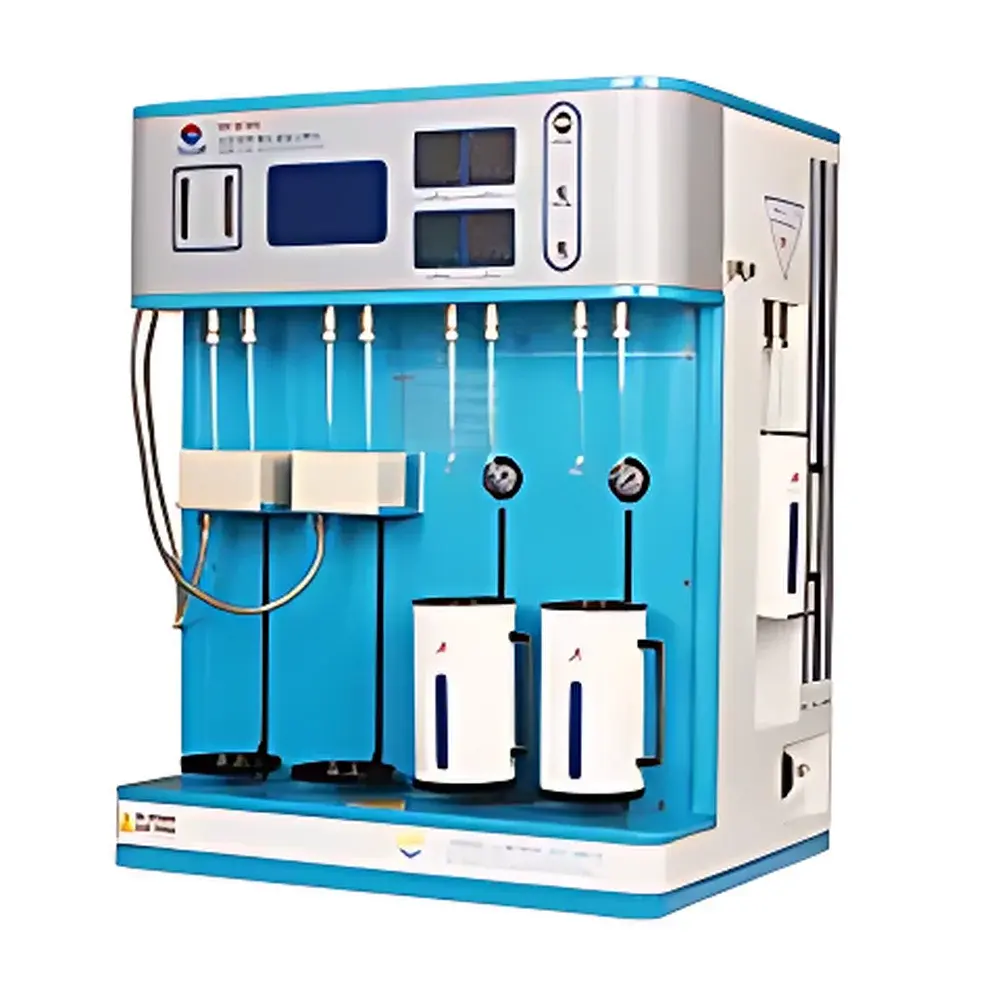
Beishide BSD-BET400 Automated Nitrogen Adsorption BET Specific Surface Area Analyzer
| Brand | Beishide Instrument |
|---|---|
| Origin | Beijing, China |
| Manufacturer Type | Manufacturer |
| Product Category | Domestic |
| Model | BSD-BET400 |
| Pricing | Upon Request |
Overview
The Beishide BSD-BET400 is an automated nitrogen adsorption analyzer engineered for high-precision, high-throughput specific surface area measurement based on the Brunauer–Emmett–Teller (BET) theory. It employs dynamic chromatographic gas-phase detection—rather than static volumetric or gravimetric methods—to quantify nitrogen uptake at liquid nitrogen temperature (77 K) under controlled flow conditions. This dynamic approach enables rapid, reproducible analysis without vacuum pumping, reducing system complexity and operational dependency on ultra-high vacuum integrity. The instrument is designed for routine QC/QA labs, R&D centers, and materials development facilities requiring robust, GLP-aligned surface characterization of powders, granules, fibers, and porous solids—including battery cathode/anode materials, metal oxides, catalysts, MOFs, and pharmaceutical excipients.
Key Features
- Dynamic BET chromatography method compliant with ISO 9277:2010 and GB/T 19587–2017, ensuring regulatory traceability in industrial and academic reporting.
- Integrated constant-temperature volumetric dosing system (patented): A thermostatically stabilized volume meter eliminates ambient thermal drift, directly contributing to long-term signal stability and inter-run reproducibility.
- Liquid nitrogen temperature monitoring (patented): Real-time cryogenic temperature feedback compensates for variations in LN₂ purity and boil-off rate—critical for accurate monolayer adsorption calculation.
- Programmable forced-air heating desorption unit (Patent ZL200920110451.5): Delivers sharp, symmetrical desorption peaks with minimized baseline curvature, improving peak integration fidelity and reducing systematic background error.
- Dual-path parallel gas circuit architecture: Isolates sample and reference flow paths to nullify effects from atmospheric pressure fluctuations, humidity ingress, and lab temperature gradients—no vacuum pump required.
- Gas purification cryo-trap (Patent ZL200920110450.0): Enhances carrier gas purity by >10×, suppressing detector noise and eliminating interference from residual moisture or hydrocarbons.
- Beishide U-shaped sample tube (Patent ZL200920110452.X): Accommodates irregular geometries (e.g., fibers, pellets, foams) while maintaining consistent thermal contact and gas accessibility—enabling broader material compatibility beyond fine powders.
- Detector zero-drift suppression: Thermally regulated detector housing ensures <0.1 mV signal drift over 10 minutes, supporting high-resolution quantification of low-surface-area samples down to 0.01 m²/g.
Sample Compatibility & Compliance
The BSD-BET400 accepts solid samples in powder, granular, fibrous, or sheet-like forms, with no requirement for pelletization or binder addition. Sample mass is optimized per surface area range (typically 0.05–1.0 g), and pre-treatment can be performed either in situ via integrated hot-gas purging or externally using the optional BSD-AD8 eight-station degassing manifold—enabling up to 12 samples/hour including 30-minute thermal conditioning. All hardware and firmware comply with electromagnetic compatibility (EMC) standards IEC 61326-1 and safety standard IEC 61010-1. Data acquisition and processing meet audit-trail requirements for GLP environments; raw sensor outputs, calibration logs, and user actions are timestamped and non-erasable within the proprietary software environment.
Software & Data Management
The Beishide proprietary data acquisition suite operates at 100 Hz sampling frequency and supports fully automated sequence control—from degassing ramping and isothermal equilibration to multi-point BET linear regression and t-plot micropore analysis. Output includes ASTM-compliant reports with uncertainty estimation per ISO/IEC 17025 guidelines, full raw chromatograms, and exportable CSV/Excel datasets. Software architecture supports role-based access control, electronic signatures, and 21 CFR Part 11–compliant audit trails when deployed on validated Windows OS platforms. Calibration records, maintenance logs, and instrument performance verification (IPV) templates are embedded for internal QA documentation.
Applications
This analyzer is routinely deployed in lithium-ion battery material qualification (e.g., NMC, LFP, SiOₓ anodes), catalyst activity correlation studies (Pt/C, zeolites), pharmaceutical solid-state characterization (excipient surface energetics), additive manufacturing feedstock screening (Ti-6Al-4V, Inconel 718 powders), and environmental sorbent evaluation (activated carbons, biochars). Its stability and speed make it suitable for production-line SPC monitoring where batch-to-batch surface area deviation must remain within ±1% RSD.
FAQ
Does the BSD-BET400 require liquid nitrogen refills during operation?
Yes—continuous LN₂ supply is necessary for maintaining 77 K adsorption temperature; the system includes a calibrated Dewar level sensor and auto-shutdown protocol upon low-level detection.
Can the instrument perform micropore analysis beyond BET?
Yes—software includes t-plot, αs-plot, and DFT-based pore size distribution modules compatible with IUPAC-recommended models for slit/cylindrical carbon and silica frameworks.
Is external degassing equipment mandatory?
No—integrated programmable hot-gas purge supports basic degassing; however, the BSD-AD8 manifold is recommended for high-throughput labs requiring concurrent pretreatment of multiple samples under controlled temperature/vacuum profiles.
What gas purity is required for carrier and adsorptive gases?
High-purity nitrogen (99.999%) is required for both carrier and adsorptive phases; the built-in cryo-trap further filters sub-ppm contaminants to ensure detector longevity and measurement fidelity.
How is calibration verified?
Certified reference materials (e.g., NIST SRM 1990a silica gel) are used for daily system suitability testing; slope-intercept deviation from certified values triggers automatic recalibration prompts within the software interface.



