
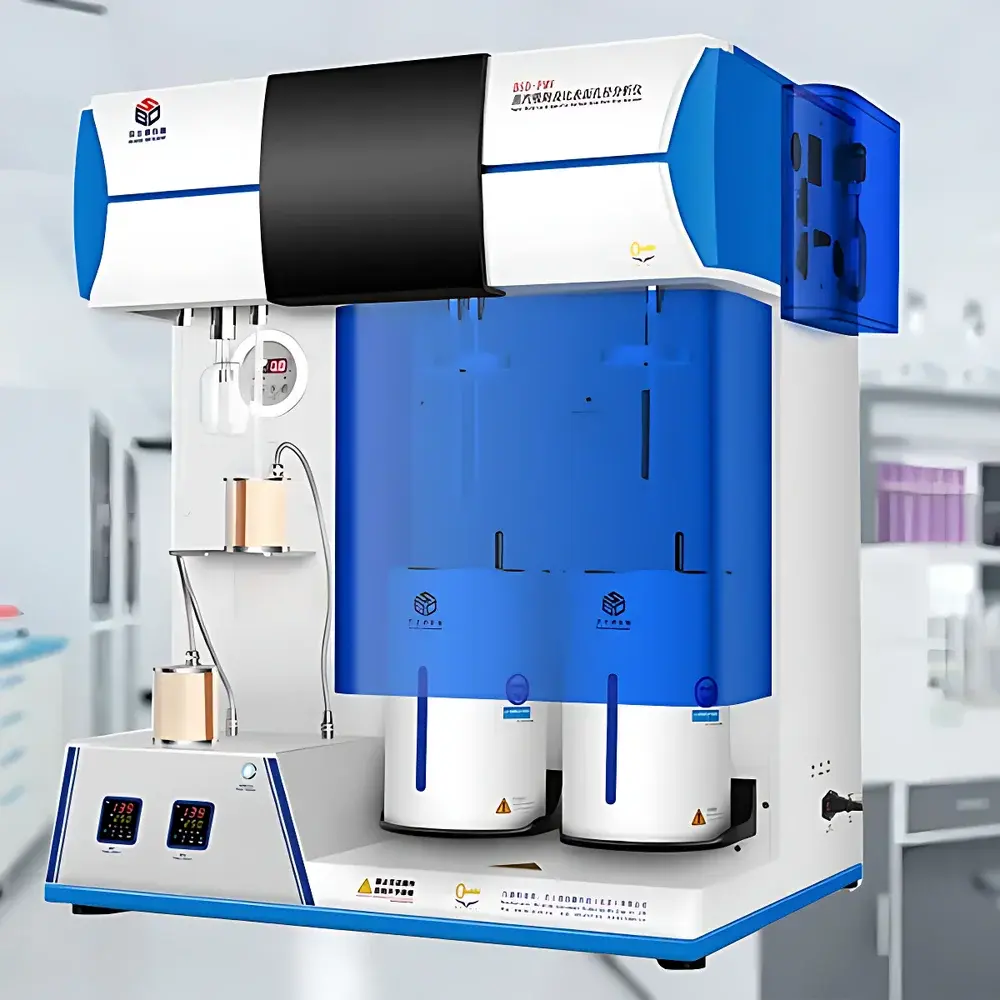
Beishide BSD-PMV Volumetric Vapor Adsorption Analyzer
| Brand | Beishide Instrument |
|---|---|
| Origin | Beijing, China |
| Manufacturer Type | Manufacturer |
| Origin Category | Domestic |
| Model | BSD-PMV |
| Instrument Type | Static Vapor Adsorption Analyzer |
| Mass Resolution | 0.01 µg |
| Mass Range | 0.001 g |
| Temperature Range | 0–105 °C |
| Relative Humidity Range | 0.01–98 % P/P₀ |
| Humidity Accuracy | Better than 0.001 torr (7×10⁻⁶ mbar) |
Overview
The Beishide BSD-PMV Volumetric Vapor Adsorption Analyzer is a high-precision, fully automated static gravimetric instrument engineered for quantitative characterization of vapor adsorption and desorption behavior on porous and non-porous solid materials. Operating on the principle of controlled vapor dosing into a thermostatically isolated sample chamber coupled with ultra-sensitive microbalance detection, the system delivers reproducible isotherms under rigorously maintained thermal equilibrium conditions. Unlike dynamic or flow-through systems, the BSD-PMV employs a true static volumetric method—where vapor partial pressure is precisely regulated via calibrated dose injection into a fixed-volume manifold, and mass uptake is recorded gravimetrically at equilibrium. This architecture ensures minimal hysteresis, eliminates convective artifacts, and supports thermodynamically rigorous analysis across a wide range of adsorbates—including water, alcohols, hydrocarbons, ammonia, formaldehyde, and other volatile organic compounds (VOCs). Designed for both R&D laboratories and quality control environments, the analyzer meets foundational requirements for ISO 15901-2, ASTM D6567, and IUPAC recommendations on physisorption and chemisorption characterization.
Key Features
- Two independent degassing stations (1–2 analysis stations), enabling simultaneous sample preparation and measurement without cross-contamination or thermal interference;
- Full-system thermostatic enclosure: sample tube, manifold, valves, and vapor generator are all maintained at uniform temperature up to 105 °C, eliminating cold spots and ensuring true isothermal adsorption;
- Dedicated real-time saturated vapor pressure (P₀) monitoring station with dual cold traps—optimized for high-boiling-point vapors and protecting the turbomolecular pump from condensable species;
- VCR-fitted stainless-steel gas pathways and perfluoroelastomer (FFKM) seals throughout; all solenoid and pneumatic valves rated for organic solvent and corrosive vapor compatibility;
- Intelligent dual-mode dosing control: adaptive stepwise and continuous vapor delivery algorithms balance measurement precision with throughput efficiency;
- Four or more independent gas inlets support multi-adsorbate studies—including optional NH₃, benzene, toluene, ethanol, formaldehyde, H₂O, N₂, O₂, H₂, Ar, Kr, CO₂, and CH₄—without hardware modification;
- Fully autonomous operation with voice-guided interface, real-time fault diagnostics, and second-resolution experimental logging compliant with GLP audit trails;
- Non-obstructive anti-contamination design prevents sample carryover into the manifold, preserving long-term calibration stability and reducing maintenance intervals;
- Power-loss resilience: experiments resume automatically from last saved state after interruption, retaining all equilibrium data points and dosing history.
Sample Compatibility & Compliance
The BSD-PMV accommodates powders, granules, monoliths, fibers, and thin films—compatible with catalysts, MOFs, zeolites, activated carbons, silica gels, pharmaceutical excipients, battery electrode materials, and polymer membranes. Its corrosion-resistant fluidic architecture enables safe operation with aggressive adsorbates such as ammonia and low-molecular-weight aldehydes. The system adheres to key regulatory frameworks for analytical instrumentation: vacuum integrity and pressure calibration traceable to NIST standards; software features audit-trail functionality aligned with FDA 21 CFR Part 11 requirements for electronic records; and full compliance with ISO/IEC 17025 documentation practices for accredited testing laboratories.
Software & Data Management
Control and analysis are performed via Beishide’s proprietary AdsorpMaster™ platform—a Windows-based application supporting method scripting, real-time visualization, and post-acquisition modeling. Raw mass vs. time and pressure vs. mass datasets are stored in HDF5 format with embedded metadata (operator ID, timestamp, environmental logs, calibration certificates). Built-in modules implement standard surface area and pore analysis protocols including BET, BJH, t-plot, MP, DR, HK, and DFT kernel models. Customizable report generation supports export to PDF, CSV, and XML formats; batch processing allows parallel evaluation of multiple isotherms using identical fitting parameters. All software updates, calibration utilities, and security patches are distributed through authenticated firmware channels—no third-party dependencies or cloud synchronization.
Applications
- Hydration kinetics and moisture sorption hysteresis in pharmaceutical formulations (ICH Q5C guidance);
- Organic solvent uptake in battery separator membranes and solid electrolytes;
- Hydrocarbon adsorption capacity and selectivity in shale gas and CCS-related adsorbents;
- Ammonia storage performance of metal–organic frameworks under ambient and elevated temperatures;
- Water vapor isotherms for humidity-sensitive packaging materials and desiccant development;
- Pore network characterization of catalyst supports under realistic process-relevant vapor environments;
- IAST (Ideal Adsorbed Solution Theory) predictions for multicomponent vapor mixtures in separation process design.
FAQ
What adsorbates can be measured with the BSD-PMV?
The system supports water, ethanol, methanol, toluene, benzene, formaldehyde, ammonia, CO₂, N₂, O₂, H₂, Ar, Kr, CH₄, and other non-corrosive or moderately corrosive vapors—subject to appropriate seal and valve selection.
Is P₀ measurement performed in situ or externally calibrated?
A dedicated, temperature-stabilized P₀ station continuously monitors saturated vapor pressure during each experiment, eliminating reliance on literature values or external calibration.
How does the BSD-PMV prevent contamination during repeated organic vapor cycles?
Its non-intrusive anti-pollution module isolates the sample zone from the main manifold, while dual-stage cryogenic trapping captures residual condensables before they reach the vacuum pump.
Can the instrument perform low-temperature nitrogen physisorption alongside vapor adsorption?
Yes—the BSD-PMV integrates cryogenic nitrogen capability (77 K) for complementary BET surface area and mesopore analysis within the same platform, though liquid nitrogen handling requires optional accessories.
What data security and audit capabilities does the software provide?
AdsorpMaster™ includes user-level access controls, electronic signatures, immutable experimental logs with timestamps, and full 21 CFR Part 11 compliance for regulated industries including pharmaceuticals and medical devices.



