
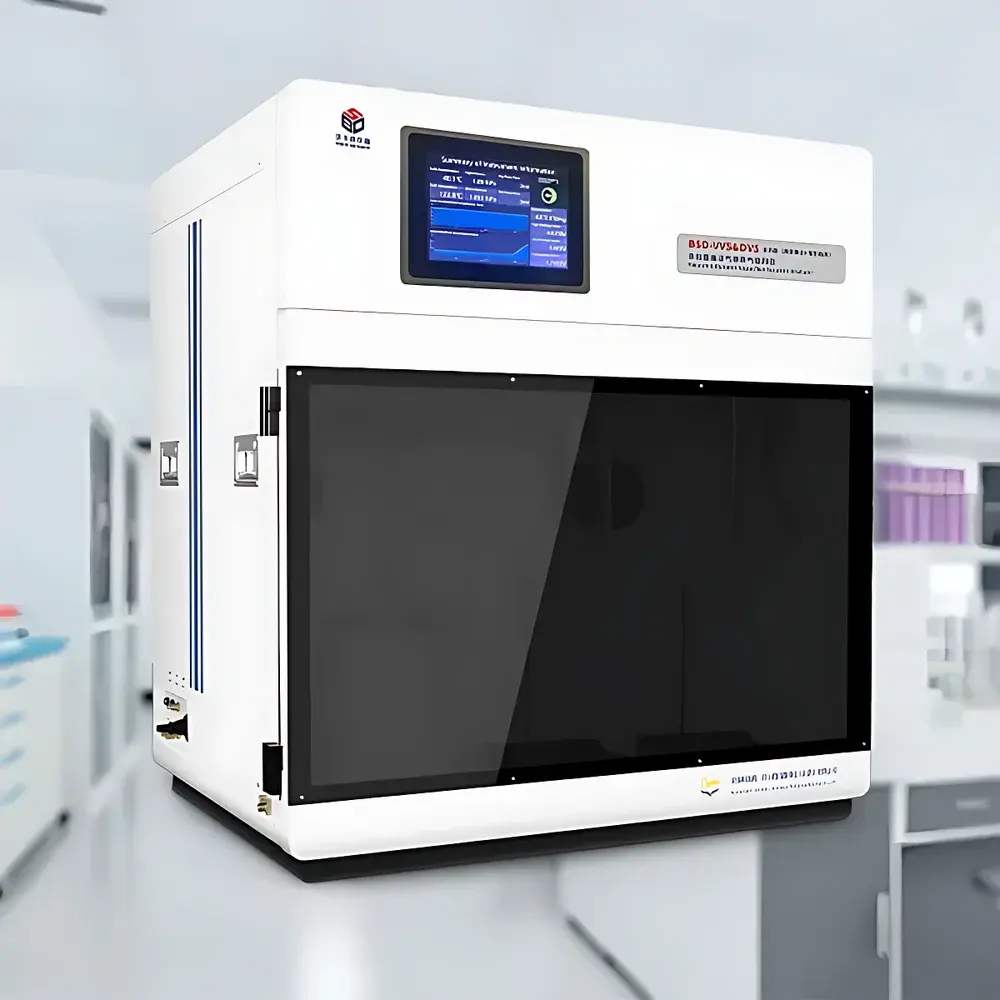
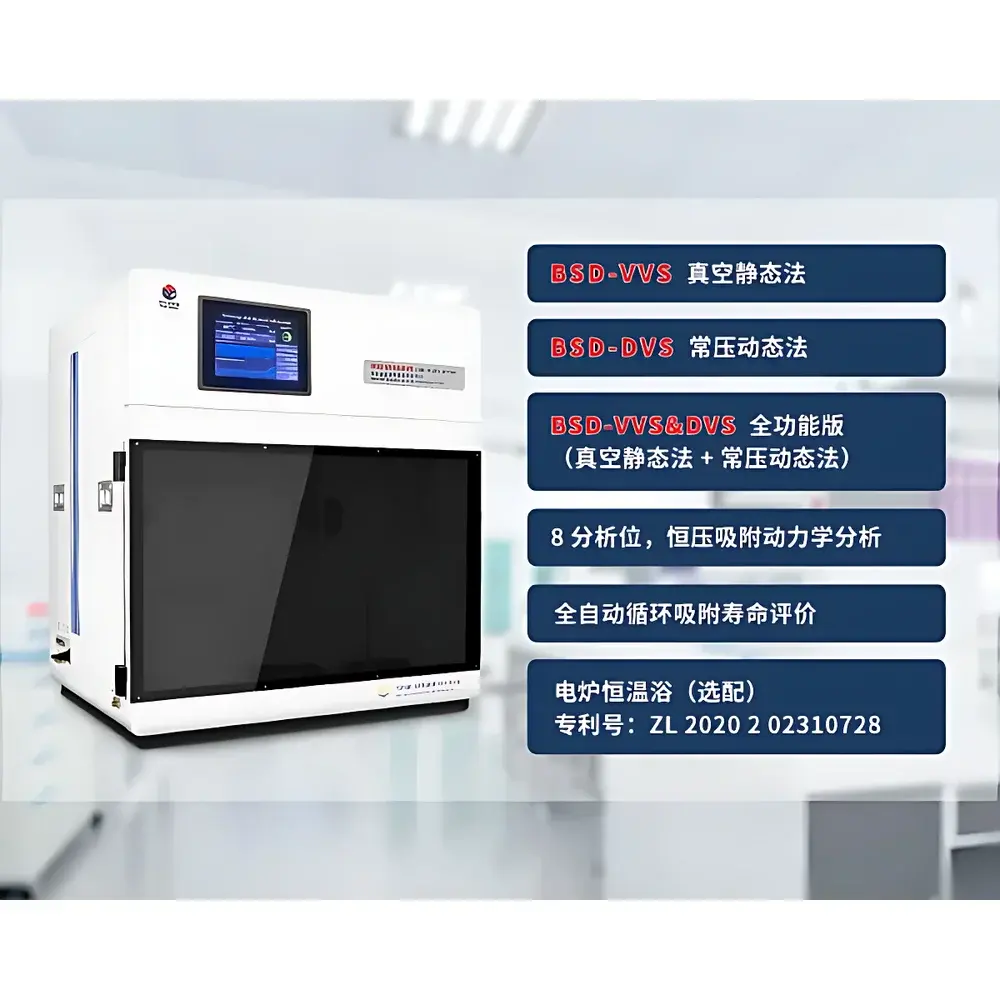
Beishide BSD-VVS Multi-Station Gravimetric Vapor and Gas Sorption Analyzer
| Brand | Beishide Instrument |
|---|---|
| Origin | Beijing, China |
| Manufacturer Type | Direct Manufacturer |
| Product Type | Static Vapor Sorption Analyzer |
| Model | BSD-VVS |
| Weighing Resolution | 1 µg / 2000 mg |
| Weighing Range | 10–1000 mg (0.1 µg resolution for 10–100 mg range) |
| Temperature Range | Ambient to 400 °C |
| Humidity Control Range | 0.01–99% RH |
| Humidity Accuracy | ±0.01% RH |
Overview
The Beishide BSD-VVS is a high-precision, multi-station gravimetric sorption analyzer engineered for quantitative characterization of vapor and gas interactions with solid materials under controlled thermodynamic conditions. It operates on the principle of vacuum microgravimetry—measuring mass changes of a sample exposed to precisely regulated partial pressures of vapors (e.g., H₂O, ethanol, toluene, NH₃, SO₂) or non-corrosive gases (e.g., CO₂, N₂, CH₄, C₂H₄) within ultra-high vacuum (UHV) or dynamic flow environments. Unlike optical or volumetric methods, gravimetric measurement eliminates assumptions about adsorbate density or pore geometry, delivering direct, absolute uptake data traceable to SI mass standards. The system supports both static (equilibrium) and dynamic (kinetic) sorption protocols—including isotherms, isobars, temperature-programmed desorption (TPD), reduction (TPR), oxidation (TPO), and multi-component competitive adsorption—making it suitable for catalyst development, MOF/COF screening, pharmaceutical stability assessment, battery electrode hydration studies, and porous material certification per ASTM D6886, ISO 15901-2, and IUPAC recommendations.
Key Features
- Multi-station architecture: Configurable for 4 or 8 independent analysis positions, enabling parallel, identical-condition testing to assess batch-to-batch variability or accelerate high-throughput screening.
- Ultra-stable microbalance: Factory-calibrated industrial-grade balance with 1 µg resolution over 2000 mg full scale (0.1 µg option available for 10–100 mg samples), minimizing drift and maximizing signal-to-noise in low-uptake regimes.
- Dual vacuum architecture: Integrated high-vacuum molecular pump (base pressure <1×10⁻⁶ torr) paired with dedicated vapor-handling pumps and programmable vapor purge cycles—critical for eliminating residual background vapor and ensuring reproducible low-P/P₀ measurements.
- Full thermal management: Independent temperature control for sample furnace (ambient to 400 °C, ±0.1 °C), vapor generation manifold (room temperature to 60 °C, ±0.1 °C), and thermostatic bath (−5 °C to 150 °C, ±0.1 °C), preventing condensation and enabling precise thermodynamic mapping.
- Flexible vapor generation: Supports both static saturation and carrier-gas dilution modes, with programmable P/P₀ control from 0.01% to 99% RH (extendable to <0.01% with optional saturation traps).
- Corrosive vapor compatibility: Optional chemically resistant fluidic path (Hastelloy C-276, PFA-lined valves, ceramic-sealed MFCs) enables safe, repeatable sorption studies with NH₃, H₂S, SO₂, HCl, and other reactive species—fully compliant with ISO 15901 Annex E safety guidelines.
- Integrated blank compensation: Three floating baseline correction modes (theoretical buoyancy calculation, concurrent blank position subtraction, or full background curve interpolation) eliminate systematic mass artifacts from thermal expansion, convection, and vapor condensation.
Sample Compatibility & Compliance
The BSD-VVS accommodates powders, pellets, monoliths, fibers, and thin films (10–1000 mg typical loading). Its inert, UHV-compatible sample pans and modular furnace design support aggressive pretreatment—including vacuum degassing (up to 400 °C), inert-gas purging (up to 300 °C), and 32-step programmable TPD with real-time mass monitoring. All hardware and software modules are designed to meet GLP/GMP documentation requirements: audit trails, electronic signatures, user role-based access control, and 21 CFR Part 11–compliant data integrity features are embedded in the acquisition firmware. Calibration certificates (mass, temperature, pressure, humidity) are NIST-traceable and provided with each system shipment.
Software & Data Management
The proprietary SorptionMaster™ software provides fully automated method scripting, real-time kinetic visualization, and ISO-compliant report generation. Raw mass vs. time, P/P₀, and temperature datasets are stored in HDF5 format with embedded metadata (instrument ID, operator, calibration dates, environmental logs). Built-in analysis modules compute BET surface area (single-point and multi-point), Langmuir capacity, BJH mesopore distribution, t-plot and D-R micropore volumes, and diffusion coefficients via Fickian or Maxwell–Stefan modeling. Export options include CSV, Excel, and ASTM E2938-compliant PDF reports with digital signatures and revision history.
Applications
- Catalyst and sorbent R&D: Quantifying water poisoning effects on zeolites, CO₂ capture kinetics in amine-functionalized MOFs, and sulfur tolerance of transition metal oxides.
- Pharmaceutical science: Mapping moisture-induced phase transitions (e.g., amorphous-to-crystalline conversion), excipient hygroscopicity ranking, and packaging barrier validation per USP <1151>.
- Energy materials: Evaluating Li-ion cathode hydration pathways, solid electrolyte interfacial stability, and hydrogen storage reversibility in nanoporous carbons.
- Environmental engineering: Screening activated carbons for volatile organic compound (VOC) breakthrough behavior and quantifying heavy metal vapor adsorption on functionalized biochars.
- Academic research: Validating DFT-predicted adsorption energies, benchmarking grand canonical Monte Carlo simulations, and developing new isotherm models for mixed-gas systems.
FAQ
What vapor pressure ranges can the BSD-VVS achieve?
The system delivers precise P/P₀ control from 0.01% to 99% RH using dual-mode vapor generation; sub-0.01% operation is achievable with optional cold-trap saturation units.
Can the instrument perform simultaneous multi-gas or multi-vapor co-adsorption experiments?
Yes—via integrated mass flow controllers (MFCs) and programmable valve sequencing, the BSD-VVS supports dynamic binary and ternary vapor/gas mixtures with independent concentration control for each component.
Is remote monitoring and operation supported?
All instruments ship with secure TLS-encrypted remote desktop access, live dashboard streaming, and API-driven integration into LIMS or ELN platforms via RESTful web services.
How is buoyancy correction handled during high-temperature vapor exposure?
Three independent correction algorithms are implemented—including real-time concurrent blank-position referencing—to compensate for thermal convection, density shifts, and condensate redistribution across the entire temperature and humidity operating envelope.
What maintenance intervals are recommended for the molecular pump and vapor-handling system?
Molecular pump oil replacement is scheduled every 12 months or 5000 operational hours; vapor trap cartridges require replacement after 200 saturated cycles or when pressure rise exceeds 5×10⁻⁵ torr during base vacuum hold tests.



