
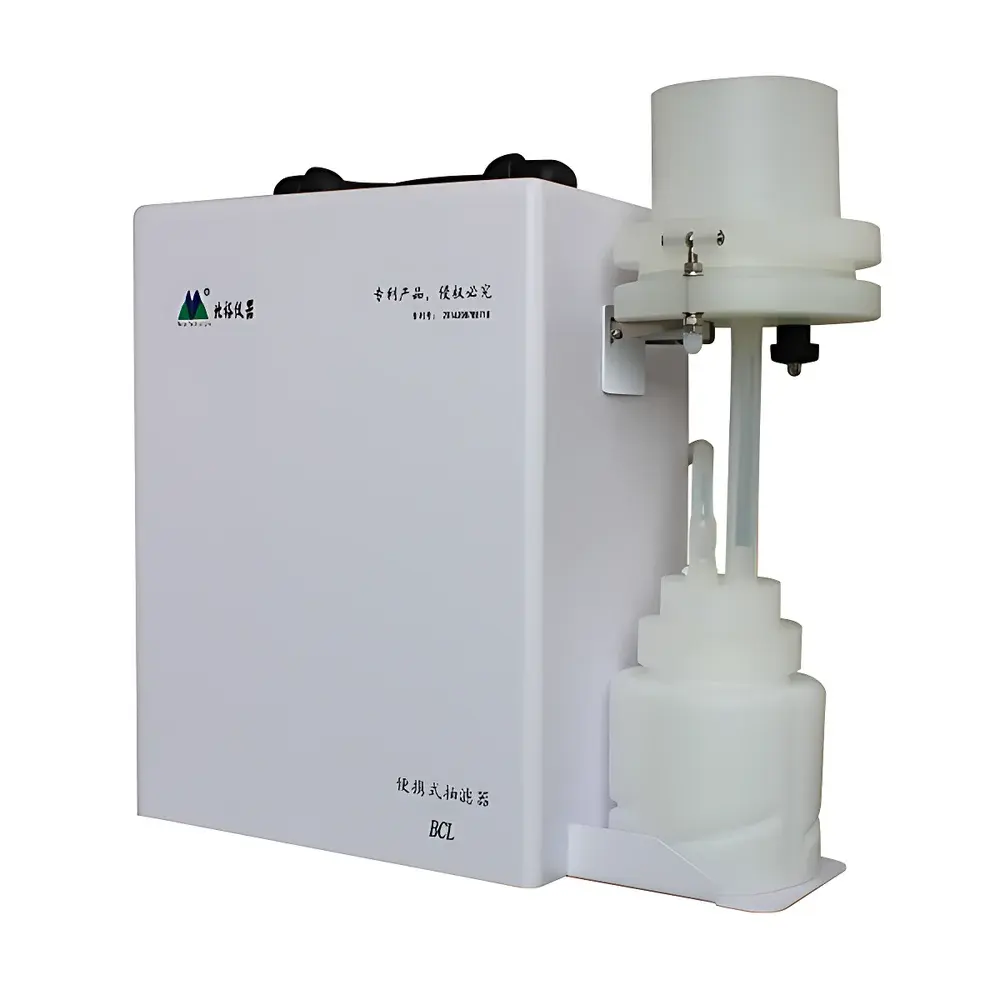
Beiyu BCL-100 Portable Vacuum Filtration Unit
| Brand | Beiyu Technologies |
|---|---|
| Origin | Shanghai, China |
| Manufacturer Type | Direct Manufacturer |
| Model | BCL-100 |
| Power Source | Rechargeable Lithium-ion Battery (20 h runtime) |
| Weight | 5 kg |
| Filtration Membrane | 0.45 µm Hydrophilic Membrane (Aqueous Phase) |
| Sample/Bottle Capacity | 600 mL |
| Vacuum Pump | Corrosion-Resistant Imported Diaphragm Pump |
| Display | LCD Battery Level Indicator |
| Bottle Material | Metal-Ion-Free Polymer Compliant with Chinese National Standards (e.g., HJ 489–2009, HJ 490–2009) |
| Membrane Replacement | Tool-Free Quick-Release Mechanism |
Overview
The Beiyu BCL-100 Portable Vacuum Filtration Unit is an engineered field-deployable solution designed explicitly for on-site aqueous sample preparation in environmental monitoring, geochemical surveying, and regulatory compliance workflows. It operates on the principle of pressure-driven vacuum filtration—utilizing a sealed, corrosion-resistant diaphragm pump to generate controlled negative pressure across a hydrophilic 0.45 µm microporous membrane. This configuration ensures consistent particle retention while preserving soluble elemental speciation integrity, making it suitable for applications governed by standardized methods such as China’s HJ 489–2009 (Determination of Dissolved Elements in Water by Graphite Furnace Atomic Absorption Spectrometry) and HJ 490–2009 (Determination of Dissolved Elements in Water by Inductively Coupled Plasma Mass Spectrometry). Unlike benchtop filtration systems requiring fixed power infrastructure, the BCL-100 integrates a high-capacity lithium-ion battery pack and lightweight structural architecture to maintain metrological fidelity under variable ambient conditions—including humidity, temperature fluctuation, and vibration encountered during transport and field deployment.
Key Features
- Integrated 20-hour runtime lithium-ion battery system with real-time LCD charge-level display—enabling uninterrupted operation across multi-point sampling campaigns without AC dependency.
- Compact, ergonomic design weighing only 5 kg; optimized for backpack or hand-carry transport in rugged terrain or confined sampling locations (e.g., wellheads, riverbanks, remote boreholes).
- Corrosion-resistant imported diaphragm vacuum pump rated for continuous duty with acid- and alkali-tolerant wetted components—ensuring long-term stability when processing aggressive matrices (e.g., acidified leachates, saline groundwater).
- Single-vessel architecture combining sample introduction and filtrate collection in one 600 mL metal-ion-free polymer bottle—eliminating cross-contamination risk and reducing procedural steps between sequential samples.
- Tool-free membrane holder with spring-loaded sealing mechanism—allowing rapid, glove-compatible replacement of 0.45 µm hydrophilic membranes without disassembly or torque calibration.
- Automatic pressure relief valve integrated into the filtration head—preventing membrane rupture during sudden vacuum surges and ensuring reproducible flow rates across varying sample viscosities.
Sample Compatibility & Compliance
The BCL-100 is validated for use with low-turbidity natural waters, groundwater, surface water, and pre-acidified environmental extracts. Its 600 mL sample capacity supports standard EPA Method 200.7–200.9 and ISO 17294-2 compliant volume requirements for trace metal analysis. The collection vessel conforms to GB/T 17671–2021 and HJ 489–2009 specifications for extractable cation content (<0.1 ng/mL background leaching for Al, Fe, Cu, Zn, Pb, Cd), verified via ICP-MS blank testing. All wetted surfaces are certified non-reactive toward nitric, hydrochloric, and hydrofluoric acid solutions at concentrations up to 2% v/v. The unit meets CE safety directives (2014/30/EU EMC, 2014/35/EU LVD) and is compatible with GLP-aligned field documentation protocols.
Software & Data Management
While the BCL-100 operates as a standalone hardware platform without embedded firmware or wireless connectivity, its mechanical design supports full auditability within regulated environments. Each unit carries a unique serial number laser-engraved on the chassis, enabling traceability across calibration logs, maintenance records, and field deployment reports. Battery discharge cycles and pump operational hours can be manually logged per sample event using standardized field notebooks aligned with ISO/IEC 17025 documentation templates. Optional accessories include calibrated pressure transducers (0–100 kPa range) and time-stamped digital loggers for integration into LIMS-based QA/QC workflows.
Applications
- Field-based filtration of water samples prior to trace metal analysis (ICP-OES, ICP-MS, GF-AAS) in accordance with national and international method standards.
- Routine monitoring of drinking water sources, wastewater effluents, and industrial discharge points where rapid turnaround and contamination control are critical.
- Geochemical exploration programs requiring mobile, battery-powered filtration units capable of operating beyond grid infrastructure.
- Educational and training deployments in environmental science curricula emphasizing hands-on method validation and field analytical rigor.
- Emergency response scenarios involving rapid screening of floodwater, post-fire runoff, or contaminated aquifer samples.
FAQ
What filtration membrane is required for the BCL-100?
The unit is configured for standard 47 mm diameter, 0.45 µm hydrophilic microporous membranes intended for aqueous-phase particulate removal—compatible with common cellulose acetate, mixed ester, and polyethersulfone formulations.
Can the BCL-100 be used with organic solvents?
No. The pump diaphragm and bottle material are not chemically rated for acetone, methanol, chloroform, or other organic solvents. Use is restricted to aqueous and dilute acidic/alkaline solutions.
Is the unit suitable for sterile or microbiological filtration?
It is not certified for sterile applications. While 0.45 µm membranes retain many bacteria, the device lacks HEPA-filtered air intake, autoclavable components, or ISO 14644-compliant cleanroom assembly—thus unsuitable for pharmaceutical or clinical microbiology use.
How is calibration and verification performed?
Vacuum performance is verified using a NIST-traceable digital manometer; flow rate consistency is confirmed via gravimetric measurement of 500 mL deionized water filtration time (target: 2.5–3.5 min at 25°C). Annual pump performance checks are recommended.
Does the BCL-100 support regulatory audit trails under 21 CFR Part 11?
As a non-computerized instrument, it does not generate electronic records. However, its mechanical design enables full manual traceability—serial-numbered components, dated maintenance logs, and documented field use align with FDA and CNAS expectations for paper-based GLP/GMP adherence.




