
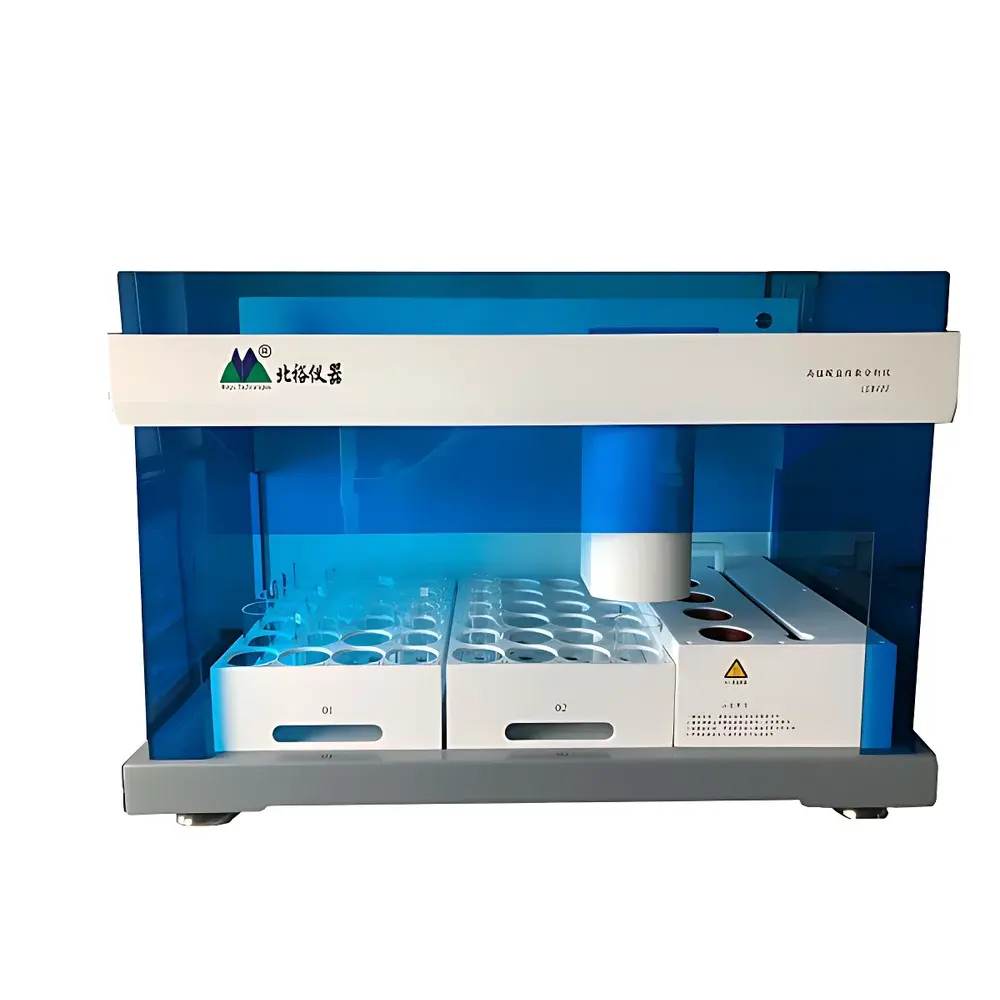
BEIYU CGM400 Advanced Permanganate Index Analyzer
| Brand | BEIYU TECHNOLOGIES |
|---|---|
| Origin | Shanghai, China |
| Manufacturer Type | Direct Manufacturer |
| Instrument Type | Laboratory Benchtop Analyzer |
| Model | CGM400 |
| Measurement Principle | Automated Potentiometric/Colorimetric Endpoint Detection with Controlled Thermal Oxidation |
| Range | 0–5.0 mg/L as O₂ |
| Repeatability | ≤4% RSD |
| Accuracy | ±5% of reading |
| LOD | 0.05 mg/L |
| Resolution | 0.02 mg/L |
| Analysis Time per Sample | 7.5 minutes |
| Compliance | Fully aligned with GB/T 11892–1989, ISO 8467:1993, and APHA Standard Methods 5210 B |
Overview
The BEIYU CGM400 Advanced Permanganate Index Analyzer is a fully automated, benchtop laboratory instrument engineered for precise, reproducible determination of the permanganate index (also known as oxygen consumption or KMnO₄ index) in surface water, groundwater, drinking water, and low-pollution wastewater samples. It implements a standardized thermal oxidation protocol—identical in reagent composition, reaction stoichiometry, and endpoint criteria to classical manual titration per GB/T 11892–1989 and ISO 8467:1993—while eliminating human variability through integrated robotics and real-time endpoint detection. The system employs electrically regulated heating blocks to maintain exact temperature profiles (typically 100 °C for 30 min), ensuring consistent oxidation of organic and inorganic reductants by potassium permanganate under acidic conditions. Endpoint recognition combines high-sensitivity colorimetric monitoring (via calibrated CMOS vision sensor) with optional potentiometric verification, enabling robust discrimination of the faint pink endpoint without operator interpretation bias.
Key Features
- Fully automated “digestion–titration” workflow: robotic arm handles sample vial positioning, reagent dispensing (H₂SO₄, KMnO₄), heated digestion, cooling, Na₂C₂O₄ addition, and back-titration—all without manual intervention.
- Machine-vision endpoint detection: proprietary algorithm analyzes RGB intensity decay in real time during titration, triggering termination at the defined chromatic threshold (±0.5% ΔE*ab), validated against certified reference materials.
- Stable thermal architecture: Peltier-assisted heating modules maintain ±0.3 °C temperature control across ambient ranges (10–35 °C) and altitudes up to 3000 m, guaranteeing inter-laboratory comparability independent of local atmospheric pressure.
- Chemical safety by design: sealed reagent reservoirs, acid-resistant PTFE fluidic pathways (imported from DuPont), and closed-loop waste containment eliminate operator exposure to concentrated sulfuric acid, hot digestates, and strong oxidizers.
- Intuitive 10.1″ capacitive touchscreen interface with multilingual OS support (English, Chinese, Spanish), contextual help, and real-time graphical display of digestion progress, titration curve, and intermediate absorbance values.
- Onboard reagent management: level sensors monitor KMnO₄, H₂SO₄, and Na₂C₂O₄ stock volumes; predictive alerts trigger before depletion, minimizing assay interruption.
Sample Compatibility & Compliance
The CGM400 accepts standard 50 mL borosilicate glass vials and accommodates turbid or colored samples within the specified matrix tolerance (NTU < 10, absorbance at 450 nm < 0.5). It meets essential regulatory requirements for environmental testing laboratories, including full traceability per ISO/IEC 17025:2017, audit-ready electronic records compliant with FDA 21 CFR Part 11 (when paired with validated LIMS integration), and alignment with GLP documentation standards. All calibration, blank, and QC runs are timestamped, user-logged, and digitally signed. The instrument’s performance verification protocol includes daily system suitability checks using potassium hydrogen phthalate (KHP) and certified river water reference materials (CRM-WW-1 series).
Software & Data Management
Embedded firmware (v4.2+) supports local data storage (≥10,000 result records with full metadata), CSV/PDF report export, and secure Ethernet/Wi-Fi connectivity. The BEIYU LabLink™ software suite enables remote instrument monitoring, method library synchronization, and bidirectional LIMS integration via ASTM E1384-compliant HL7 or direct SQL database push. Audit trails record all critical events—including method changes, calibration updates, reagent swaps, and user logins—with immutable timestamps and digital signatures. Data integrity safeguards include automatic backup to external NAS, encrypted local storage, and configurable retention policies aligned with ISO 14001 environmental management system requirements.
Applications
The CGM400 delivers reliable permanganate index quantification for routine compliance monitoring under China’s GB 3838–2002 Surface Water Environmental Quality Standards and EU WFD (2000/60/EC) surveillance programs. It is routinely deployed in municipal water plants for source water screening, in environmental monitoring stations for river/lake health assessment, and in third-party testing labs supporting ISO 14001-certified facilities. Its precision and automation make it especially suited for high-throughput QA/QC workflows where batch consistency, personnel safety, and regulatory defensibility are prioritized over manual throughput flexibility.
FAQ
Does the CGM400 comply with international standard methods beyond Chinese national standards?
Yes—it is operationally equivalent to ISO 8467:1993 and APHA Standard Methods 5210 B, with documented method equivalence reports available upon request.
Can the instrument be validated for GMP or pharmaceutical water testing?
While optimized for environmental matrices, its accuracy, repeatability, and 21 CFR Part 11 readiness support qualification for purified water (PW) and water-for-injection (WFI) monitoring when used with appropriate risk-based validation protocols.
Is method customization supported for non-standard digestion times or temperatures?
Yes—advanced users may define custom thermal profiles and titration parameters via administrator-level access, subject to internal validation and change control documentation.
What maintenance intervals are recommended for long-term reliability?
PTFE tubing replacement every 6 months; optical sensor cleaning weekly; annual calibration verification using NIST-traceable KHP standards and certified CRM blanks.
How is data security ensured during network transmission?
All remote communications use TLS 1.2+ encryption; LIMS integration requires mutual certificate authentication; no cloud storage is enabled by default.
Related Products







