
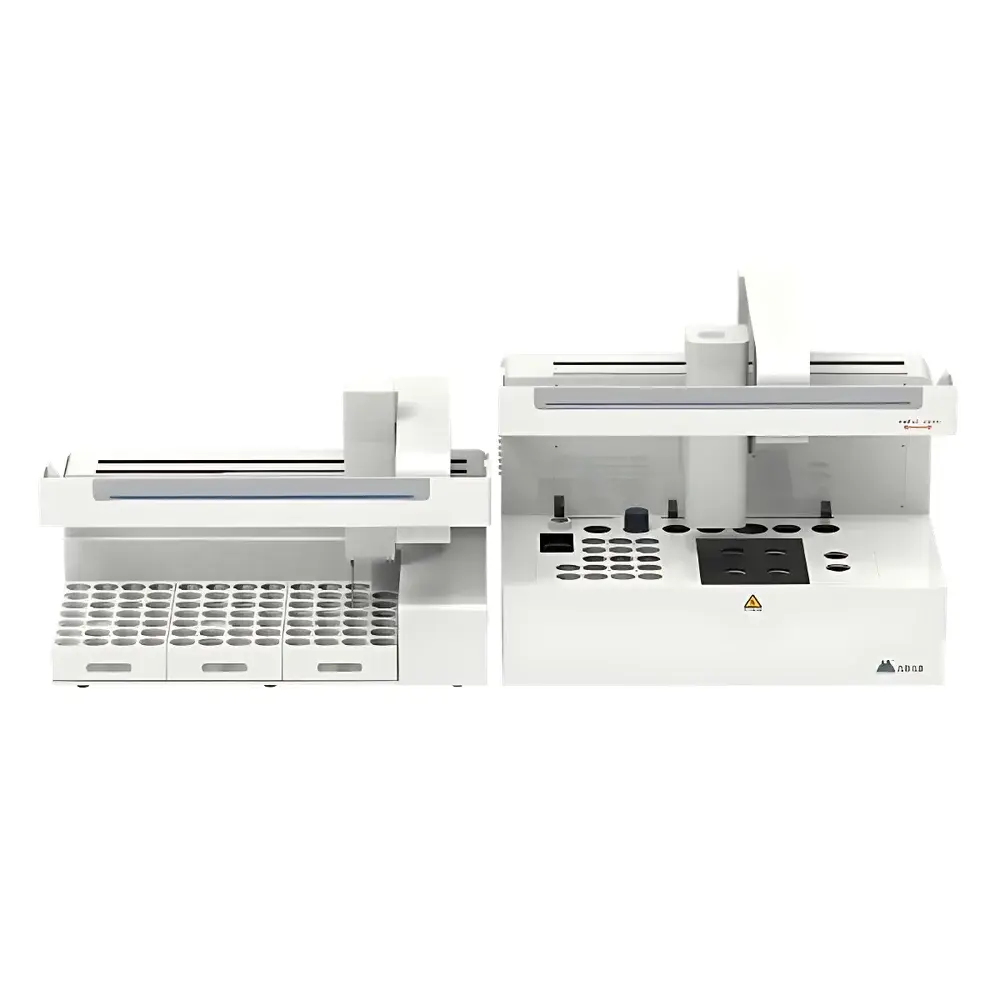
BEIYU TECHNOLOGIES CGM400H / CGM400H-FT Automated Permanganate Index Analyzer for Seawater
| Brand | BEIYU TECHNOLOGIES |
|---|---|
| Origin | Shanghai, China |
| Manufacturer Type | OEM Manufacturer |
| Country of Origin | China |
| Model | CGM400H / CGM400H-FT |
| Pricing | Upon Request |
Overview
The BEIYU TECHNOLOGIES CGM400H and CGM400H-FT are fully automated analytical systems engineered for the precise determination of permanganate index (CODMn) in seawater and marine environmental samples. Based on the standardized alkaline potassium permanganate oxidation method specified in GB 17378.4–2007 “Specification for Marine Monitoring – Part 4: Chemical Analysis of Seawater – Chemical Oxygen Demand (Alkaline Potassium Permanganate Method)”, these instruments implement a complete, unattended workflow encompassing sample transfer, controlled thermal digestion, redox titration, endpoint detection, and post-analysis cleaning. The system operates on classical volumetric redox principles: under alkaline conditions, potassium permanganate oxidizes reducible organic and inorganic substances; residual permanganate is then back-titrated with sodium oxalate, and the endpoint is identified by a distinct color transition (purple → colorless or yellow → pale yellow). Designed for high-throughput marine monitoring laboratories, the CGM400H series ensures strict method fidelity, operator independence, and compliance with national marine quality assurance frameworks.
Key Features
- End-to-end automation: Integrated robotic arm handles sample vial positioning, reagent dispensing, and reaction vessel manipulation—eliminating manual intervention across digestion and titration stages.
- Machine vision-based endpoint recognition: Full-spectrum color sensing detects subtle hue shifts during titration (e.g., persistent yellow to near-colorless, or blue to decolorized), enabling reproducible endpoint determination without subjective visual assessment.
- Graphite-block heating module: Provides rapid, uniform temperature ramping and ±0.5 °C thermal stability at the target digestion temperature (typically 97–100 °C), critical for consistent oxidation kinetics across variable salinity matrices.
- Cold-water bath integration: Accelerates post-digestion cooling to ambient temperature within defined time windows, minimizing analyte degradation and ensuring titration accuracy.
- Reusable reaction cup architecture with automatic rinsing: Each cup undergoes multi-stage wash cycles (deionized water, acid rinse, air dry) between analyses, supporting unlimited sample throughput without consumable cup replacement.
- Modular autosampler compatibility: Supports interchangeable sample trays (e.g., 40-, 60-, or 120-position configurations) to match daily workload requirements while maintaining ISO/IEC 17025 traceability per run.
- Independent six-channel fluidic system: Dedicated peristaltic pumps and solenoid valves for KMnO4, Na2C2O4, NaOH, H2SO4, indicator, and rinse solutions—preventing cross-contamination and enabling precise reagent metering (±1% volumetric accuracy).
- Real-time reagent level monitoring: Optical sensors track liquid volume in each reservoir and trigger configurable alerts via the HMI interface when thresholds fall below user-defined limits.
- Intelligent boiling detection: Vision-assisted algorithm identifies onset of vigorous boiling and initiates a fixed 10-minute digestion timer—compensating for minor atmospheric pressure or salinity-induced boiling point elevation.
Sample Compatibility & Compliance
The CGM400H series is validated for direct analysis of undiluted seawater, estuarine water, and brackish matrices with salinities up to 40 psu. It complies with GB 17378.4–2007 and aligns with international methodological equivalents including ISO 8467:1993 (Water quality – Determination of permanganate index). Instrument design supports GLP-compliant operation: audit trails record all critical events (sample ID, reagent lots, digestion time/temperature, titrant volume, endpoint timestamp), and electronic signatures meet FDA 21 CFR Part 11 requirements when deployed with validated software configuration. All wetted components are chemically resistant (PTFE, borosilicate glass, PEEK), ensuring long-term integrity in chloride-rich environments.
Software & Data Management
The embedded control software provides intuitive method setup, real-time process visualization, and automated report generation (PDF/CSV). Raw data—including titrant consumption curves, color intensity profiles, and thermal profiles—are stored with full metadata. LIMS integration is achieved via standard ASTM E1384-compliant HL7 or XML interfaces, enabling bidirectional data exchange with laboratory information management systems. Audit logs are immutable and time-stamped, supporting regulatory inspections under CNAS-CL01 or equivalent accreditation schemes.
Applications
- Routine monitoring of coastal and offshore seawater quality in national marine observation networks
- Environmental impact assessments for port development, desalination discharge, and aquaculture effluent
- Method validation and inter-laboratory comparison studies under China’s State Oceanic Administration (SOA) protocols
- Research on organic carbon dynamics in marine biogeochemical cycles
- QA/QC for certified reference materials (CRMs) used in marine chemistry proficiency testing
FAQ
Does the instrument support method customization beyond GB 17378.4–2007?
Yes—users may define alternative digestion temperatures, durations, reagent concentrations, and endpoint color thresholds via the method editor, provided such modifications are documented and verified per internal SOPs.
How is carryover prevented between high-salinity and low-salinity samples?
The system executes a mandatory triple-rinse sequence (acid wash, DI water, air purge) before each new sample, validated to achieve <0.1% cross-sample contamination for Mn and oxalate ions.
Is calibration traceable to national standards?
All volumetric modules are calibrated using NIM-certified (National Institute of Metrology, China) Class A glassware and gravimetric standards; calibration certificates are exportable and include uncertainty budgets.
What maintenance intervals are recommended?
Weekly inspection of pump tubing wear, monthly verification of temperature uniformity across the graphite block, and quarterly optical alignment of the color sensor—detailed in the included Preventive Maintenance Manual.
Can the system operate unattended overnight?
Yes—the hardware includes safety interlocks (overheat cutoff, liquid leak detection, door-open pause) and software supports scheduled start/stop, making it suitable for extended batch runs under supervised remote monitoring.







