
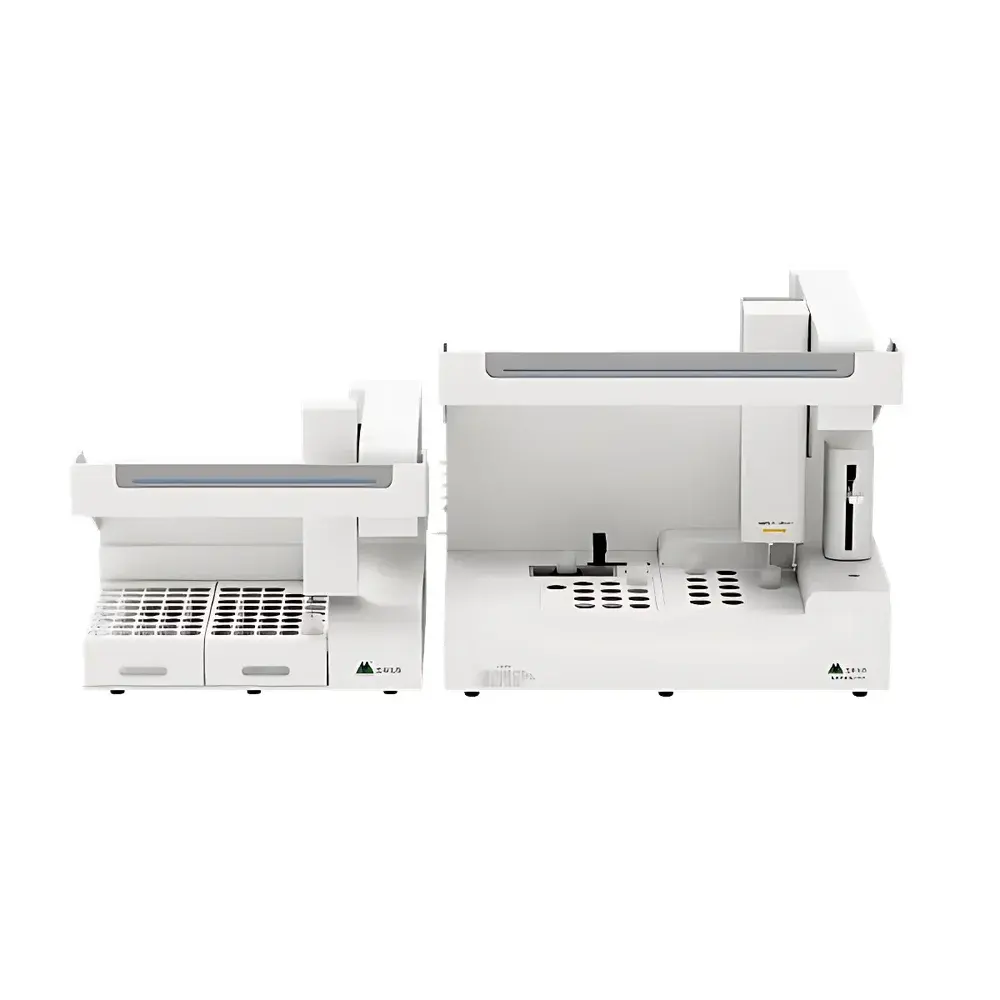
Beiyu Technologies ECF-100 Intelligent Fluoride Ion Analyzer
| Brand | Beiyu Technologies |
|---|---|
| Origin | Shanghai, China |
| Manufacturer Type | Authorized Distributor |
| Country of Origin | China |
| Model | ECF-100 |
| Pricing | Available Upon Request |
| Sample Capacity | 78 or 118 positions |
| Reaction Vessel | 120 mL plastic tube |
| Constant-Temperature Positions | 10 |
| Detection Limit | 0.05 mg/L |
| Upper Detection Range | 1900 mg/L |
| Sensor | Fluoride Ion-Selective Electrode (ISE) |
| Compliance Standard | GB/T 7484–1987 |
Overview
The Beiyu Technologies ECF-100 Intelligent Fluoride Ion Analyzer is a fully automated benchtop instrument engineered for precise, trace-level quantification of fluoride ions (F⁻) in environmental and industrial water matrices—including drinking water, surface water, groundwater, and wastewater effluents. It operates on the fundamental electrochemical principle of ion-selective electrode (ISE) potentiometry: when a fluoride-specific membrane electrode contacts an aqueous sample, a Nernstian potential develops across the sensing interface, proportional to the logarithm of free fluoride ion activity. The ECF-100 integrates this established measurement principle with closed-loop automation—employing a programmable robotic arm, multi-position thermostatic reaction stations, and real-time electrode potential monitoring—to eliminate manual handling variability and ensure metrological traceability per national standard GB/T 7484–1987, which aligns methodologically with ISO 10304-1 and ASTM D6919 for anion analysis by ISE.
Key Features
- Fully automated sample introduction, calibration, measurement, and electrode rinsing—no manual pipetting or electrode conditioning required.
- Intelligent dilution module: automatically detects out-of-range signals and initiates on-board serial dilution using calibrated syringe pumps, extending effective dynamic range without operator intervention.
- Real-time reagent level monitoring with optical liquid-level sensors; system alerts and triggers auto-refill from auxiliary reagent reservoirs to prevent assay interruption.
- 10-position Peltier-controlled water bath maintains reaction temperature at ±0.2 °C stability—critical for minimizing thermal drift in ISE response and ensuring reproducibility across ambient fluctuations.
- Self-diagnostic firmware continuously monitors electrode slope, offset, response time, and membrane integrity; flags deviations against pre-defined acceptance criteria and recommends corrective actions (e.g., recalibration, membrane replacement).
- Compliant with GLP data integrity requirements: all analytical events—including calibration points, sample IDs, timestamps, electrode potentials, and dilution factors—are immutably logged with electronic signatures and audit trails.
Sample Compatibility & Compliance
The ECF-100 accepts standard 120 mL polypropylene sample tubes compatible with routine laboratory workflows. It accommodates turbid, colored, or mildly suspended samples without filtration—provided total suspended solids (TSS) remain below 50 mg/L, as higher particulate loads may interfere with electrode contact or cause fouling. Matrix tolerance has been validated for common interferents including chloride (up to 1000 mg/L), sulfate (≤500 mg/L), and nitrate (≤200 mg/L); elevated aluminum or iron concentrations (>0.5 mg/L) require prior complexation with total ionic strength adjustment buffer (TISAB). Method validation meets GB/T 7484–1987 specifications and supports compliance with ISO/IEC 17025:2017 for testing laboratories. Instrument design adheres to IEC 61010-1 safety standards for electrical equipment used in measurement, control, and laboratory applications.
Software & Data Management
The embedded Windows-based control software provides intuitive method setup, sequence programming, and real-time visualization of electrode potential decay curves and calibration linearity (R² ≥ 0.9995). All raw and processed data—including intermediate dilution logs, electrode diagnostics, and QC check results—are stored in encrypted SQLite databases with configurable retention policies. Native HL7 and ASTM E1384-compliant export modules enable bidirectional integration with Laboratory Information Management Systems (LIMS), supporting automated result transmission, electronic batch records, and 21 CFR Part 11–compliant user authentication, role-based access control, and electronic signature workflows. Audit trail generation includes operator ID, action timestamp, parameter changes, and data modification history—fully retrievable for regulatory inspection.
Applications
- Regulatory compliance monitoring for municipal drinking water utilities under national fluoride concentration limits (e.g., 1.0 mg/L in China, 4.0 mg/L US EPA MCL).
- Industrial effluent characterization from semiconductor manufacturing, aluminum smelting, and fluoropolymer synthesis facilities.
- Environmental field labs conducting watershed-scale fluoride mapping and geochemical speciation studies.
- Research laboratories investigating fluoride bioavailability, adsorption kinetics on activated alumina, or leaching behavior from dental materials and ceramics.
- Quality control in bottled water production and pharmaceutical excipient testing where residual fluoride must be verified against pharmacopoeial monographs (e.g., USP ).
FAQ
What is the recommended maintenance schedule for the fluoride ISE?
Electrode performance should be verified daily using two-point calibration (0.1 mg/L and 10 mg/L F⁻ standards); full membrane cleaning and reconditioning are advised every 72 hours of continuous operation or after 500 measurements.
Can the ECF-100 analyze seawater or high-salinity brines?
No—samples with ionic strength exceeding 0.1 mol/L (e.g., seawater ≈ 0.7 mol/L) require matrix-matched standardization and TISAB addition; direct analysis without dilution may yield non-Nernstian responses due to activity coefficient deviation.
Does the system support remote monitoring and troubleshooting?
Yes—via optional secure VPN-enabled web interface, allowing authorized technicians to view real-time instrument status, download diagnostic logs, and initiate remote calibration sequences without physical access.
Is method validation documentation provided?
Yes—each unit ships with a Factory Acceptance Test (FAT) report, Certificate of Conformance, and a comprehensive IQ/OQ protocol package aligned with ISO/IEC 17025 requirements.
How does the system handle carryover between high- and low-concentration samples?
A three-stage post-measurement rinse protocol (deionized water → 0.1% NaOH → deionized water) is executed before each new sample, with conductivity verification confirming rinse completion; carryover is consistently <0.5% for sequential 1000 mg/L → 0.1 mg/L transitions.







