
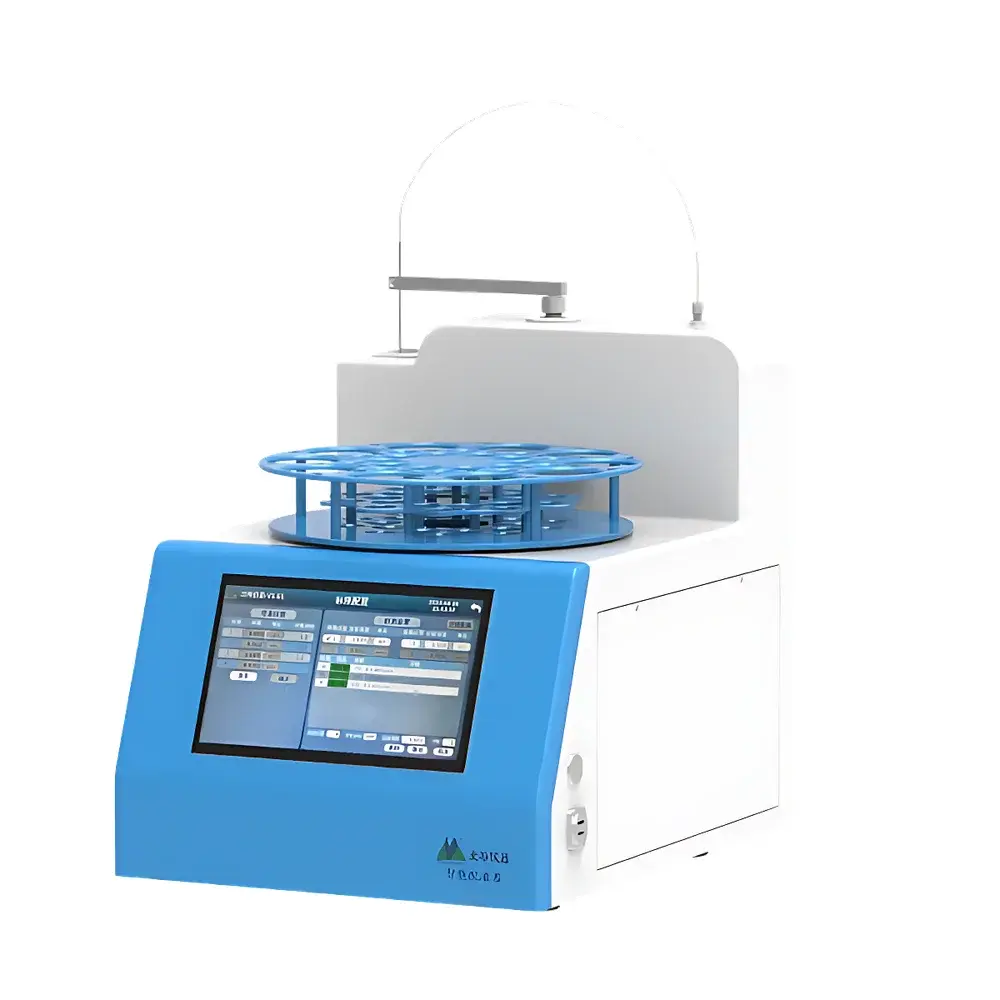
BEIYU TECHNOLOGIES PYQ-101 Intelligent Liquid Dispensing System
| Brand | BEIYU TECHNOLOGIES |
|---|---|
| Origin | China |
| Manufacturer Type | Instrument Manufacturer |
| Model | PYQ-101 |
| Sample Positions | 10 × 100 mL + 20 × 50 mL (customizable) |
| Concentration Ratio Range | 0–100% |
| Dispensing Accuracy | ±0.5% |
| Temperature Operating Range | 10–30 °C |
| Display | 10.1-inch capacitive touchscreen |
| Maximum Dilution Factor | 10,000× |
| Power Supply | 220 V AC, 96 W |
| Syringe Pump Accuracy | ≤0.5% |
| Integrated Homogenization Function | Yes |
| Automatic Line Cleaning | Yes |
| Multi-Solution Mixing Capability | Yes |
| Auto-Spiking Function | Configurable |
Overview
The BEIYU TECHNOLOGIES PYQ-101 Intelligent Liquid Dispensing System is an automated, integrated solution engineered for precise and traceable standard solution preparation in regulated laboratory environments. Based on high-accuracy positive-displacement syringe pump technology, the system performs sequential operations—including primary stock solution aspiration, volumetric transfer, diluent addition, programmable mixing, and post-run line rinsing—without manual intervention. Unlike conventional pipetting workflows requiring manual dilution factor calculation, the PYQ-101 employs an embedded algorithm that computes optimal stepwise or single-step dilution paths based on user-input parameters: stock concentration, target concentration, and final volume. This architecture eliminates arithmetic errors and enforces procedural consistency across analysts and shifts—critical for laboratories operating under ISO/IEC 17025, GLP, or GMP frameworks where documentation integrity and operator-independent reproducibility are mandatory.
Key Features
- Integrated syringe pump module with ≤0.5% volumetric accuracy per ISO 8655-3, calibrated against NIST-traceable standards
- 10.1-inch industrial-grade capacitive touchscreen interface supporting multi-touch gestures and real-time graphical feedback of fluidic status
- Modular sample carrier accommodating 10 positions for 100 mL vials and 20 positions for 50 mL vials; configurable layouts available upon request
- Onboard homogenization via programmable vortex-assisted mixing or magnetic stirring integration (optional)
- Automated fluid path cleaning using dual-solvent rinse cycles (e.g., water followed by ethanol), minimizing carryover between samples to <0.01%
- Configurable auto-spiking function enabling precise addition of internal standards or surrogates during dilution
- Unattended operation capability: full sequence execution with electronic log generation and end-of-run notification
Sample Compatibility & Compliance
The PYQ-101 handles aqueous, organic, and mildly corrosive liquid matrices commonly encountered in environmental testing (e.g., EPA Method 200.8, 6020B), pharmaceutical QC (USP <1058> Analytical Instrument Qualification), food safety analysis (AOAC Official Methods), and clinical immunoassay calibration. Its wetted components—including chemically resistant PTFE tubing, stainless-steel pump heads, and borosilicate glass vial holders—are compatible with HCl, HNO₃, acetonitrile, methanol, and buffered saline solutions. The system supports audit-ready data integrity through time-stamped event logs, user authentication (role-based access control), and optional 21 CFR Part 11-compliant software modules with electronic signatures and change history tracking.
Software & Data Management
The embedded firmware provides intuitive method creation via guided workflow wizards—users define input stock concentration, desired output concentration, and final volume; the software calculates and validates feasible dilution paths within the instrument’s 10,000× maximum dilution range. All sequences are saved as encrypted .pyq files with metadata (operator ID, timestamp, version). Raw dispensing logs—including actual delivered volumes, pressure profiles, and error codes—are exportable in CSV format for LIMS integration. Optional PC-based software enables remote monitoring, method library management, and PDF report generation compliant with ISO 17025 clause 7.8.2 (Reporting of Results).
Applications
- Preparation of certified reference material (CRM) dilutions for ICP-MS, ICP-OES, and AAS calibration curves
- Automated serial dilution series for ELISA, lateral flow assay development, and antibody titer determination
- QC sample spiking in environmental labs performing PFAS, heavy metal, or pesticide residue analysis
- Standardization of titrants and buffer solutions in central analytical labs
- High-throughput dilution of biologics and small-molecule drug candidates during preclinical formulation screening
- Teaching laboratories requiring reproducible, safe, and pedagogically transparent liquid handling practices
FAQ
Does the PYQ-101 support gravimetric verification of dispensed volumes?
Yes—method templates include optional gravimetric validation steps; users may integrate external analytical balances via RS-232 or USB-serial interface for real-time mass confirmation.
Can the system be validated for use in FDA-regulated environments?
The PYQ-101 is designed to support IQ/OQ/PQ protocols; BEIYU provides documented test scripts, factory calibration certificates, and DQ templates aligned with ASTM E2500 and Annex 11.
Is remote software update capability available?
Firmware updates are performed via secure USB key or Ethernet connection with SHA-256 signature verification to ensure code authenticity and traceability.
What maintenance intervals are recommended for the syringe pump module?
Syringe seals require replacement every 6 months under continuous operation; full pump head recalibration is advised annually or after seal replacement, using BEIYU-certified calibration kits.
How does the system handle viscous or volatile solvents?
Viscosity compensation algorithms adjust dwell times and acceleration profiles; volatile solvent handling is supported via closed-vial sampling and inert gas purging (optional accessory kit).



