
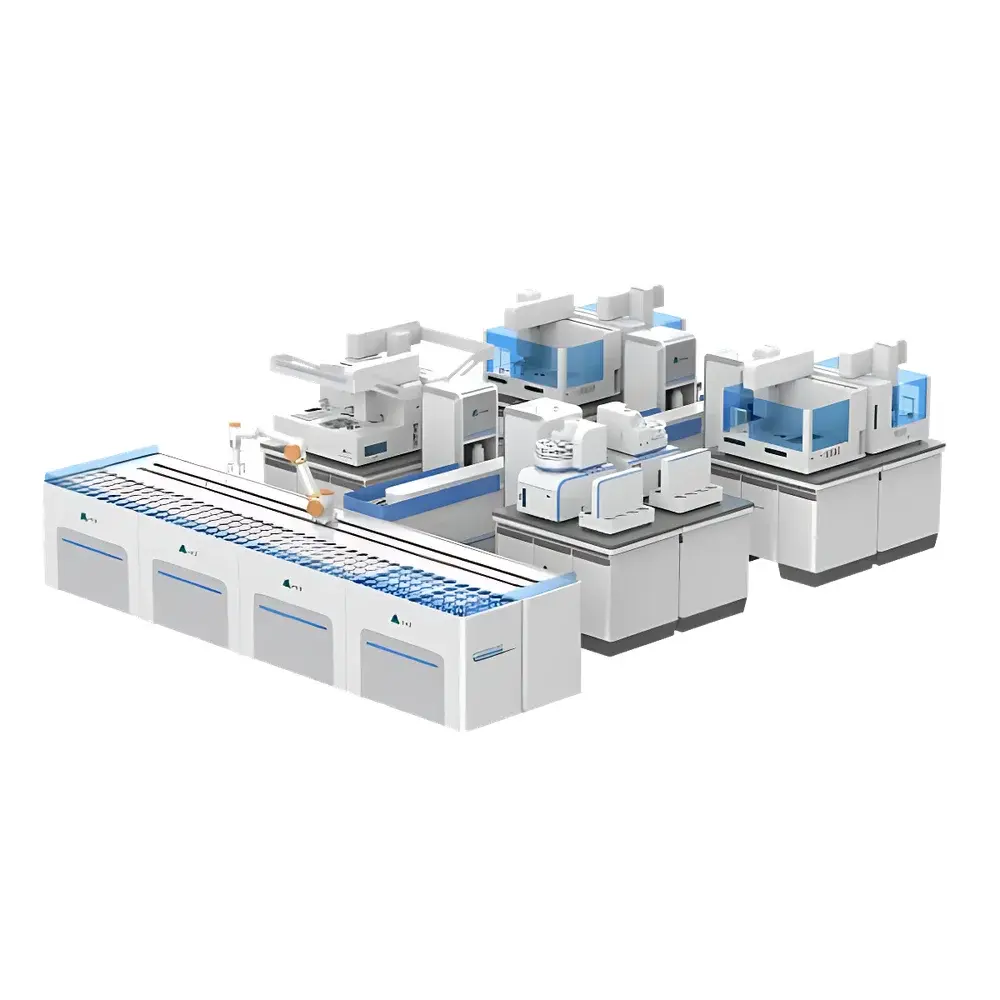
BEIYU TECHNOLOGIES Smart Unmanned Water Quality Analysis System
| Brand | BEIYU TECHNOLOGIES |
|---|---|
| Origin | Shanghai, China |
| Manufacturer Type | Authorized Distributor |
| Country of Origin | China |
| Model | Smart Unmanned System |
| Pricing | Available Upon Request |
Overview
The BEIYU TECHNOLOGIES Smart Unmanned Water Quality Analysis System is an integrated, modular laboratory automation platform engineered for continuous, unattended operation in environmental monitoring laboratories and water quality control centers. Built upon a distributed architecture grounded in ISO/IEC 17025-compliant workflow principles, the system implements standardized wet-chemistry analytical methodologies—including spectrophotometry, ion chromatography, atomic fluorescence, flow injection analysis (FIA), and gas-phase molecular absorption spectroscopy (GPMAS)—to deliver trace-level quantification of key water quality parameters. Unlike conventional single-instrument analyzers, this system functions as a programmable analytical orchestration hub: it coordinates sample transport, reagent dispensing, reaction incubation, detection, and data validation across heterogeneous instrumentation—enabling method-agnostic deployment while maintaining full traceability per GLP and GMP-aligned QA/QC protocols.
Key Features
- Fully automated 24/7 operation with zero manual intervention after initial setup—capable of processing up to 200 samples per day under baseline configuration
- Open-system architecture supporting seamless integration of third-party analytical instruments via standardized hardware interfaces (RS-232, TCP/IP, Modbus RTU) and software middleware (OPC UA-compliant drivers)
- Modular station-based design: individual analytical modules—including GPMAS for nitrite, nitrate, sulfide; intelligent total phosphorus/total nitrogen analyzers; and electrochemical sensor arrays—operate independently or in synchronized parallel mode
- Comprehensive built-in QA/QC suite: automated spike recovery testing, dilution verification, duplicate analysis, trend-based anomaly detection, and cross-parameter correlation checks (e.g., NO₃⁻–NO₂⁻–NH₄⁺ balance validation)
- Scalable hardware and software framework:预留 I/O expansion slots, additional instrument bays, and API-accessible control logic for future upgrades without system reconfiguration
- Method compliance assurance: all embedded analytical procedures align with GB/T (China National Standards), HJ (China Environmental Protection Standards), and harmonized equivalents of ISO 7027, ISO 6878, ISO 15681, and ASTM D3370
Sample Compatibility & Compliance
The system accepts raw, filtered, or digested aqueous samples from surface water, groundwater, wastewater effluent, drinking water distribution networks, and industrial process streams. Sample matrices include turbid suspensions (up to 50 NTU), saline waters (≤35 g/L TDS), and low-organic-content potable sources. All onboard digestion, filtration, and preconcentration steps adhere to ISO 5667-3 and HJ 493 for representative sampling integrity. Instrument calibration and verification follow ISO/IEC 17025 Clause 7.7 requirements, with documented uncertainty budgets for each reported parameter. Audit trails—including operator actions, instrument status logs, calibration records, and raw detector outputs—are retained for ≥12 months in accordance with FDA 21 CFR Part 11 electronic record retention guidelines.
Software & Data Management
The embedded control software provides role-based access (administrator, analyst, auditor), real-time dashboard visualization, and configurable reporting templates compliant with ISO/IEC 17025 Annex A.3. Data export supports CSV, PDF, and XML formats with embedded metadata (sample ID, timestamp, method version, instrument serial number, QC flag status). The system integrates with LIMS via HL7 v2.x or RESTful API endpoints. All analytical sequences are version-controlled, and method changes trigger automatic revision logging with user authentication and time-stamped approval workflows. Software validation documentation—including IQ/OQ/PQ protocols—is available upon request for regulatory submissions.
Applications
- Regulatory compliance monitoring for municipal water utilities (GB 5749–2022, HJ 91.1–2019)
- Environmental impact assessment (EIA) field laboratories requiring multi-parameter consistency across dispersed sampling nodes
- Industrial pretreatment verification for electroplating, pharmaceutical, and food processing facilities
- Research-grade nutrient cycling studies (N/P/S speciation dynamics in eutrophic systems)
- Emergency response screening during chemical spills or algal bloom events
FAQ
Does the system support ASTM or ISO standard methods alongside Chinese national standards?
Yes—the platform’s method library includes validated implementations of ISO 11923 (spectrophotometric phosphate), ISO 14429 (total nitrogen by persulfate digestion), and ASTM D1253 (residual chlorine), in addition to GB/T and HJ references.
Can existing lab instruments from Agilent, Thermo Fisher, or PerkinElmer be retrofitted into the system?
Yes—provided the instrument offers industry-standard communication protocols (e.g., SCPI over GPIB/Ethernet, ASCII command sets, or vendor SDKs), integration is achievable through BEIYU’s certified driver development kit.
How is data integrity ensured during unattended overnight operation?
All measurements undergo real-time validity checks: signal-to-noise ratio thresholds, blank drift compensation, calibration curve R² validation (>0.995), and outlier rejection using Grubbs’ test at α = 0.05 prior to result release.
Is remote diagnostics and software update capability available?
Yes—secure TLS 1.2-encrypted remote maintenance access is supported, with firmware updates delivered via signed package verification and rollback-safe dual-boot partitioning.
What level of technical documentation is provided for regulatory audits?
Full validation packages—including URS, FRS, DQ/IQ/OQ/PQ reports, cybersecurity risk assessments (per IEC 62443-3-3), and traceability matrices linking each functional requirement to test evidence—are supplied with system commissioning.







