
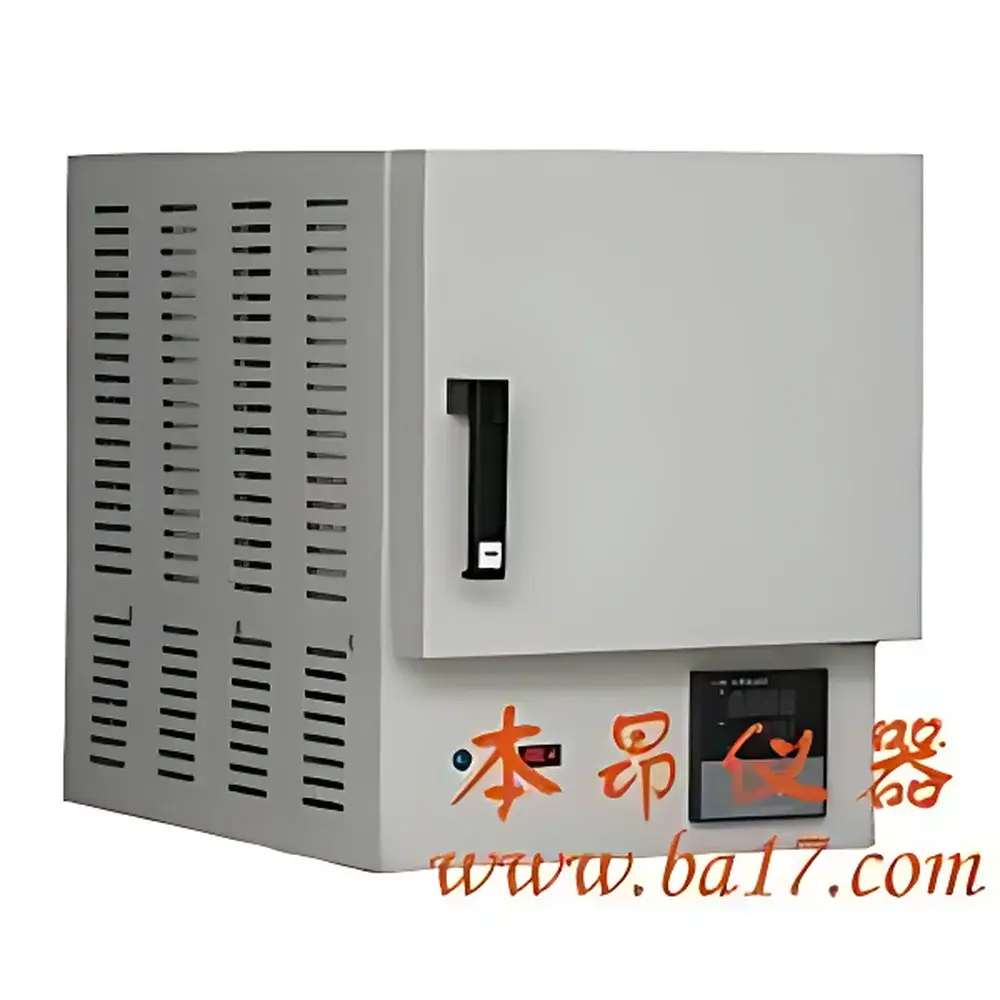
BenAng BA-1.5-10B Ceramic Fiber Muffle Furnace
| Brand | BenAng |
|---|---|
| Origin | Shanghai, China |
| Model | BA-1.5-10B |
| Maximum Temperature | 1000 °C |
| Chamber Dimensions | 165 × 120 × 105 mm |
| Heating Power | 1.5 kW |
| Temperature Control Accuracy | ±1 °C |
| Heating Rate | ≥60 °C/min |
| Thermocouple Type | K-type (NiCr–NiSi) |
| Insulation Thickness | 50 mm ceramic fiber |
| Heating Element | Kanthal® A1 alloy resistance wire |
| Voltage | AC 220 V, single-phase |
Overview
The BenAng BA-1.5-10B Ceramic Fiber Muffle Furnace is a compact, high-performance laboratory box furnace engineered for rapid thermal processing in research, quality control, and routine analytical workflows. Designed around the principles of low thermal mass and high-efficiency radiant heating, it employs a dual-layer insulation architecture featuring 50 mm of ultra-pure, low-conductivity ceramic fiber—sourced from U.S.-based manufacturers meeting ASTM C892 Class 1 specifications. The furnace utilizes Kanthal® A1 alloy resistance heating elements (manufactured by Sandvik Heat Treatment AB, Sweden), known for exceptional oxidation resistance up to 1400 °C and long-term dimensional stability under cyclic thermal stress. Unlike traditional brick-lined muffle furnaces, this model achieves 1000 °C in ≤12 minutes—a performance benchmark aligned with ISO 8573-1:2010 thermal response validation protocols for laboratory ovens. Its lightweight construction (net weight <25 kg), combined with a sealed chamber and integrated door interlock, ensures reproducible thermal environments suitable for ashing, calcination, heat treatment, and pre-conditioning of reference materials.
Key Features
- Ultra-low thermal inertia design enabling ramp rates ≥60 °C/min to 1000 °C, reducing cycle time by >85% versus conventional refractory-lined furnaces
- 50 mm thick high-purity ceramic fiber insulation (density: 128 kg/m³, thermal conductivity: ≤0.08 W/m·K at 800 °C), minimizing standby power consumption and surface temperature rise
- Kanthal® A1 heating elements mounted on corrosion-resistant ceramic supports, delivering uniform radial heat distribution with ≤±2 °C spatial uniformity across the working zone (per IEC 60068-3-5)
- PID-based digital temperature controller with auto-tuning capability, supporting programmable multi-segment ramp/soak profiles and real-time deviation logging
- Comprehensive safety architecture: door-activated cut-off switch, overtemperature protection (independent limit controller), power-fail recovery lockout, and surface temperature monitoring with automatic shutdown if external casing exceeds 60 °C
- Compliant with EN 61000-6-3 (EMC emission limits) and EN 61000-6-2 (immunity requirements) for laboratory electromagnetic environments
Sample Compatibility & Compliance
The BA-1.5-10B accommodates standard crucibles (alumina, platinum, quartz, or stainless steel) up to Ø80 mm × 60 mm height within its 165 × 120 × 105 mm chamber. It is routinely deployed in GLP-compliant laboratories for USP , ASTM D3174 (ash content), ASTM D3175 (volatile matter), and ISO 1171 (determination of ash) procedures. Its stable thermal profile meets the repeatability criteria outlined in ISO/IEC 17025:2017 clause 7.2.2 for equipment used in accredited testing. The furnace does not emit particulates or volatile organic compounds during operation—verified per ISO 16000-6—and is certified free of asbestos and heavy-metal binders per RoHS Directive 2011/65/EU.
Software & Data Management
While the base unit operates via front-panel interface, optional RS485 Modbus RTU output enables integration into centralized lab data acquisition systems (e.g., LabVIEW, DeltaV, or custom SCADA). Temperature logs—including setpoint, actual reading, ramp rate, and alarm events—are timestamped and exportable as CSV files compliant with FDA 21 CFR Part 11 requirements when paired with validated third-party software. Audit trails record all parameter changes, user logins, and system resets, supporting GMP Annex 11 and ISO 13485 traceability mandates.
Applications
- Residue and ash quantification in pharmaceutical excipients, dietary supplements, and botanical extracts per USP
- Thermal pretreatment of catalysts, battery electrode materials, and nanocomposites prior to XRD or SEM analysis
- Moisture, volatile matter, fixed carbon, and ash fusion point determination in coal and biomass per ASTM D3172–D3176 and ISO 1171
- Ignition loss assays for soil, sludge, and wastewater solids in environmental compliance testing (EPA Method 2540E)
- Pre-baking of ceramic green bodies and sintering trials in materials science R&D
- Calibration of thermocouples and reference standards using fixed-point metals (e.g., Al, Zn, Sn) under controlled inert atmosphere (when used with purge adapter)
FAQ
What is the maximum recommended continuous operating temperature?
The furnace is rated for continuous operation at 1000 °C; short-term excursions to 1050 °C are permissible for ≤30 minutes per cycle, provided cooling intervals exceed 60 minutes.
Can this furnace be used under inert or reducing atmospheres?
Yes—when equipped with a gas inlet port and exhaust adapter (optional accessory), it supports N₂, Ar, or forming gas (5% H₂/95% N₂) purging at flow rates of 0.5–2 L/min, maintaining oxygen levels <100 ppm.
Is calibration documentation provided with shipment?
Each unit ships with a factory-as-tested certificate listing chamber uniformity, temperature accuracy at 500 °C and 1000 °C, and thermocouple verification against NIST-traceable references.
How often should preventive maintenance be performed?
Inspect heating element integrity and insulation compression annually; verify thermocouple drift semiannually using a calibrated reference thermometer per ISO/IEC 17025 clause 6.4.6.
Does the controller support remote monitoring via Ethernet or Wi-Fi?
No—the standard configuration uses RS485 serial communication; Ethernet/Wi-Fi connectivity requires an external protocol converter compatible with Modbus TCP/IP.



