
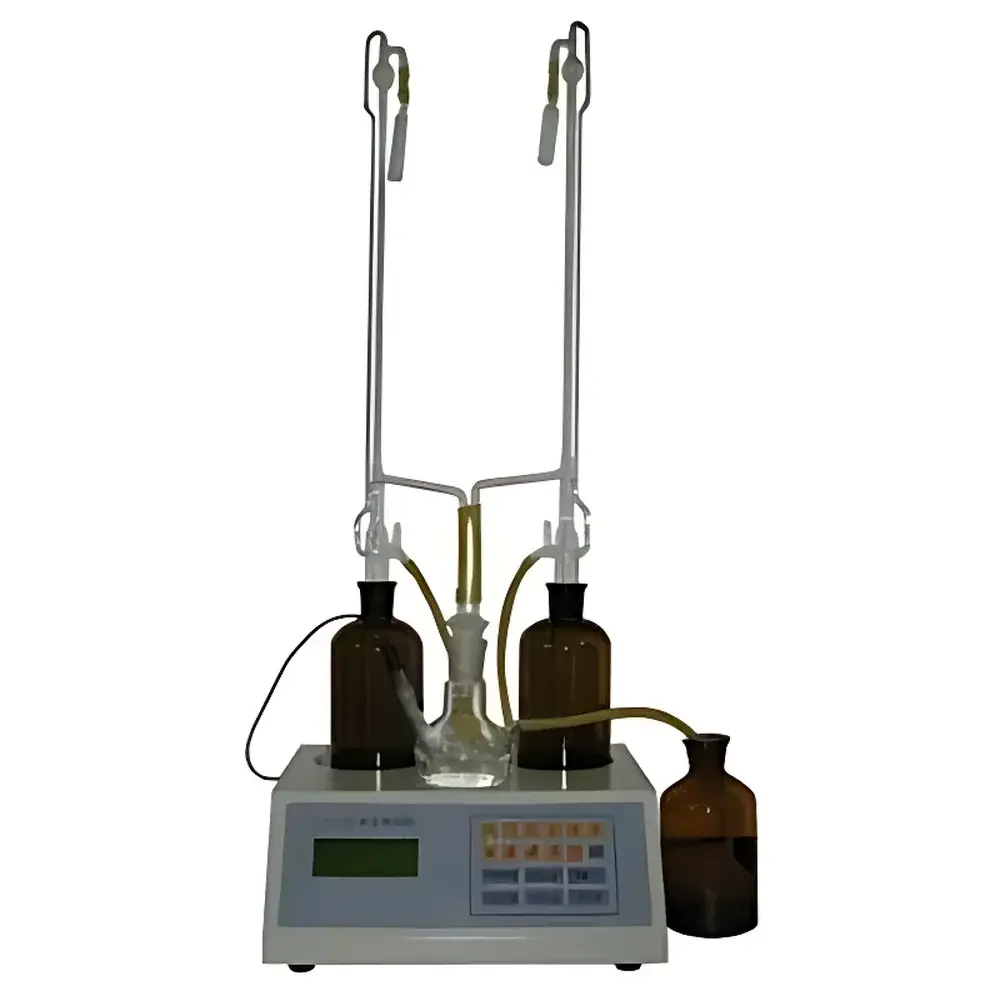
BenAng KF-1B Manual Karl Fischer Moisture Titrator
| Brand | BenAng |
|---|---|
| Origin | Shanghai, China |
| Manufacturer Type | Authorized Distributor |
| Country of Origin | China |
| Model | KF-1B |
| Measurement Range | 30 ppm to 100% (typical range: 0.03–90%) |
| Water Equivalence Precision | RSD ≤3% (using water standard) |
| Power Supply | AC 220 ± 22 V |
| Dimensions (W×D×H) | 335 × 260 × 130 mm |
| Weight | 6 kg |
Overview
The BenAng KF-1B Manual Karl Fischer Moisture Titrator is a dedicated coulometric-free, volumetric titration system engineered for precise and reproducible determination of trace to bulk water content in solid, liquid, and gaseous samples. It operates on the fundamental electrochemical principle of the Karl Fischer reaction—where iodine, generated in situ via stoichiometric oxidation of iodide in the presence of sulfur dioxide, pyridine (or alternative base), and methanol, reacts quantitatively with water: I₂ + SO₂ + H₂O + 3RN + CH₃OH → 2RN·HI + RN·HSO₄CH₃. Unlike automated coulometric systems, the KF-1B employs manual burette-driven titration with real-time endpoint detection via dual-platinum electrode polarization, offering full operator control over titrant addition rate—critical for matrix-sensitive or slow-reacting samples.
Key Features
- Integrated microprocessor-controlled circuitry enabling intelligent titration logic and keyboard-based parameter entry
- Dedicated near-endpoint audible and visual alarm system that activates when the potential gradient across the dual-platinum electrodes approaches the inflection point—allowing operators to reduce titrant delivery speed and minimize overshoot error
- Direct percentage readout functionality: pressing the “%” key instantly displays moisture content (%) calculated from user-input sample mass and titrant volume consumed
- Optimized human-machine interface featuring membrane keypad, high-contrast digital LED display, and ergonomic front-panel layout for glove-compatible operation in laboratory environments
- Robust mechanical architecture with precision-ground glass burette (10 mL capacity, Class A tolerance), corrosion-resistant electrode holder, and chemically inert reagent reservoir design compliant with common KF solvents (e.g., Hydranal®-Composite 5, Riedel-de Haën KF reagents)
Sample Compatibility & Compliance
The KF-1B supports broad-spectrum sample applicability across organic and inorganic matrices. Validated use cases include hydrocarbons (saturated/unsaturated), aldehydes, carboxylic acids, acyl halides, alcohols, amides, weak amines, anhydrides, thioethers, esters, ethers, halogenated compounds, peroxides, orthoesters, sulfites, thiocyanates, and metal oxides (e.g., CuO, Al₂O₃). Inorganic salts—including hydrated sulfates, carbonates, and nitrates—are also compatible when pretreated to avoid side reactions. While the instrument itself does not embed regulatory compliance firmware, its manual titration workflow aligns with GLP documentation requirements: all inputs (sample mass, titrant volume, reagent batch ID) are manually recorded, supporting audit-ready paper-based or LIMS-integrated data capture. The system meets foundational performance criteria referenced in ASTM E203, ISO 760, and USP , particularly for laboratories conducting routine QC testing where full 21 CFR Part 11 electronic record validation is not mandated.
Software & Data Management
The KF-1B operates without embedded software or network connectivity; all calculations are performed in real time by onboard firmware using the classical Karl Fischer stoichiometric equation: % H₂O = (V × T × 100) / W, where V = titrant volume (mL), T = titer (mg H₂O/mL), and W = sample mass (g). Users input V and W via keypad; T is either pre-determined via standardization or entered directly. Results are displayed as % w/w and retained only on-screen until overwritten—consistent with manual titration best practices requiring contemporaneous transcription into bound lab notebooks or validated electronic worksheets. This architecture eliminates cybersecurity risks associated with embedded OS and ensures uninterrupted operation under electromagnetic interference conditions common in industrial QC labs.
Applications
This titrator is routinely deployed in pharmaceutical excipient release testing (e.g., lactose, microcrystalline cellulose), polymer resin moisture qualification prior to extrusion, battery electrolyte purity verification (LiPF₆ solutions), catalyst drying validation in fine chemical synthesis, and quality control of hygroscopic inorganic salts (e.g., Na₂CO₃·10H₂O, CaCl₂). Its manual control mode proves especially valuable for samples exhibiting slow KF reaction kinetics (e.g., certain polysaccharides or highly viscous silicone oils) or those prone to side reactions with methanol—where adaptive titration pacing prevents false endpoints. It is also used in academic teaching laboratories to demonstrate fundamental redox titration principles and endpoint detection theory.
FAQ
Is the KF-1B compliant with 21 CFR Part 11?
No—the instrument lacks electronic signature capability, audit trail logging, or user access controls required for Part 11 compliance. It is intended for environments where manual data recording satisfies regulatory expectations.
What is the minimum detectable water concentration?
At optimal sensitivity (10 mL burette, 5 mg sample), the theoretical lower limit is ~30 ppm, consistent with ISO 760’s definition of volumetric KF detection capability.
Can it be used with non-methanolic KF reagents?
Yes—provided the solvent system maintains stable iodine generation and exhibits low blank drift; users must validate reagent compatibility and recalibrate titer accordingly.
Does it support automatic titer determination?
No—titer must be established separately using certified water standards (e.g., Hydranal®-Water Standard 1.00 mg/mL) and entered manually before sample analysis.
What maintenance is required for long-term accuracy?
Regular cleaning of the platinum electrodes with ethanol and soft tissue, periodic verification of burette seal integrity, and annual calibration of the digital display against NIST-traceable voltage references are recommended.





