
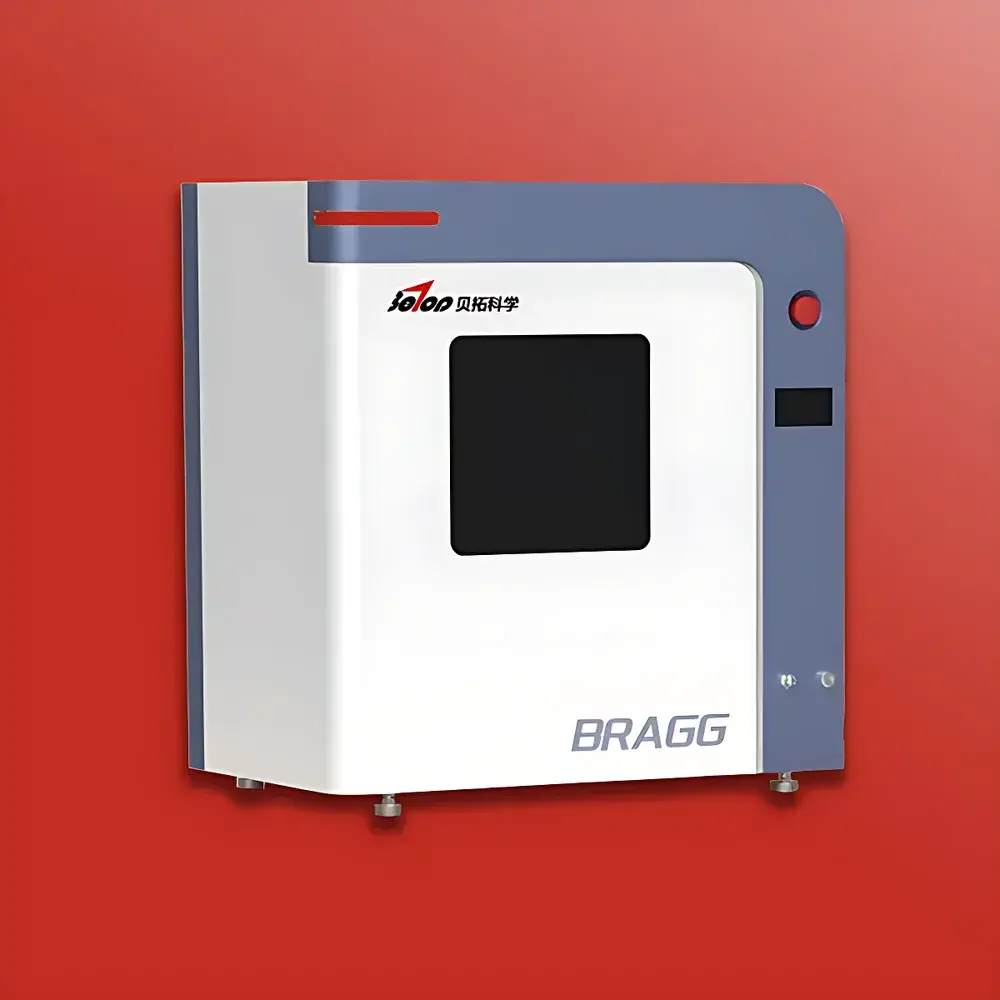
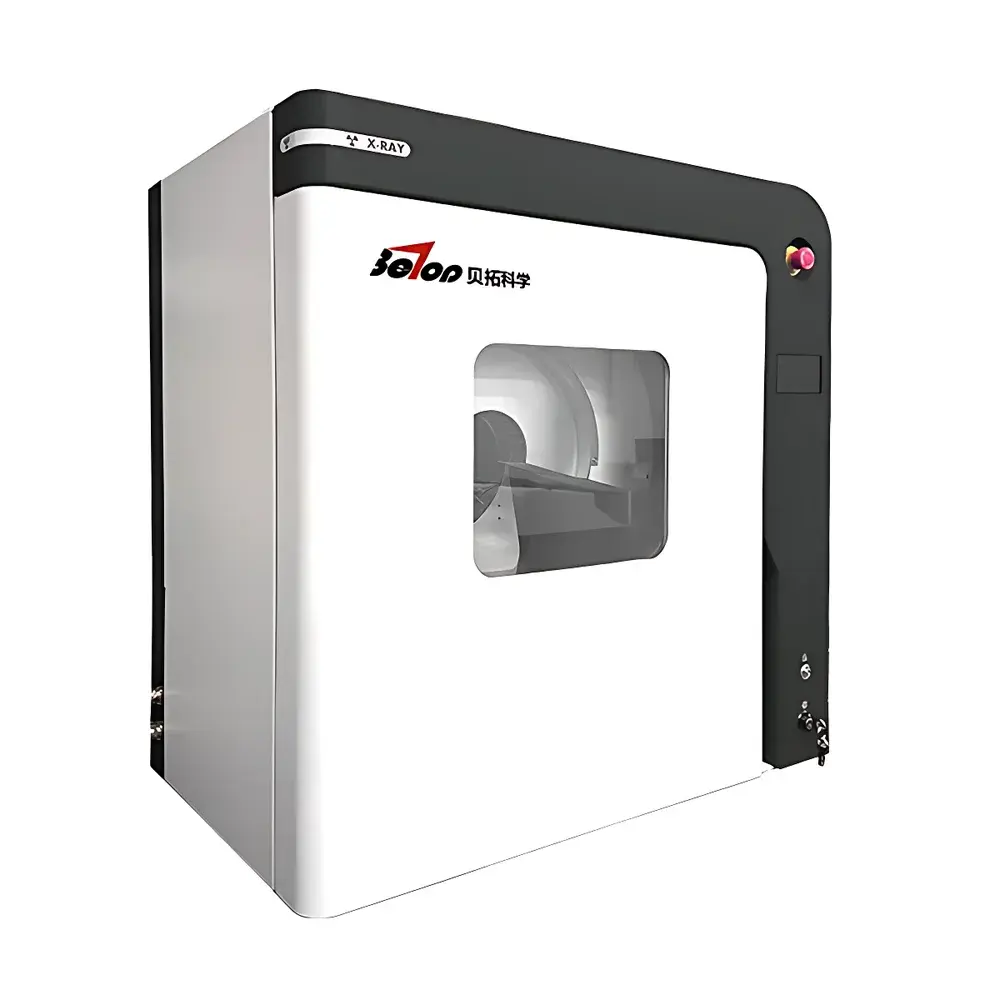
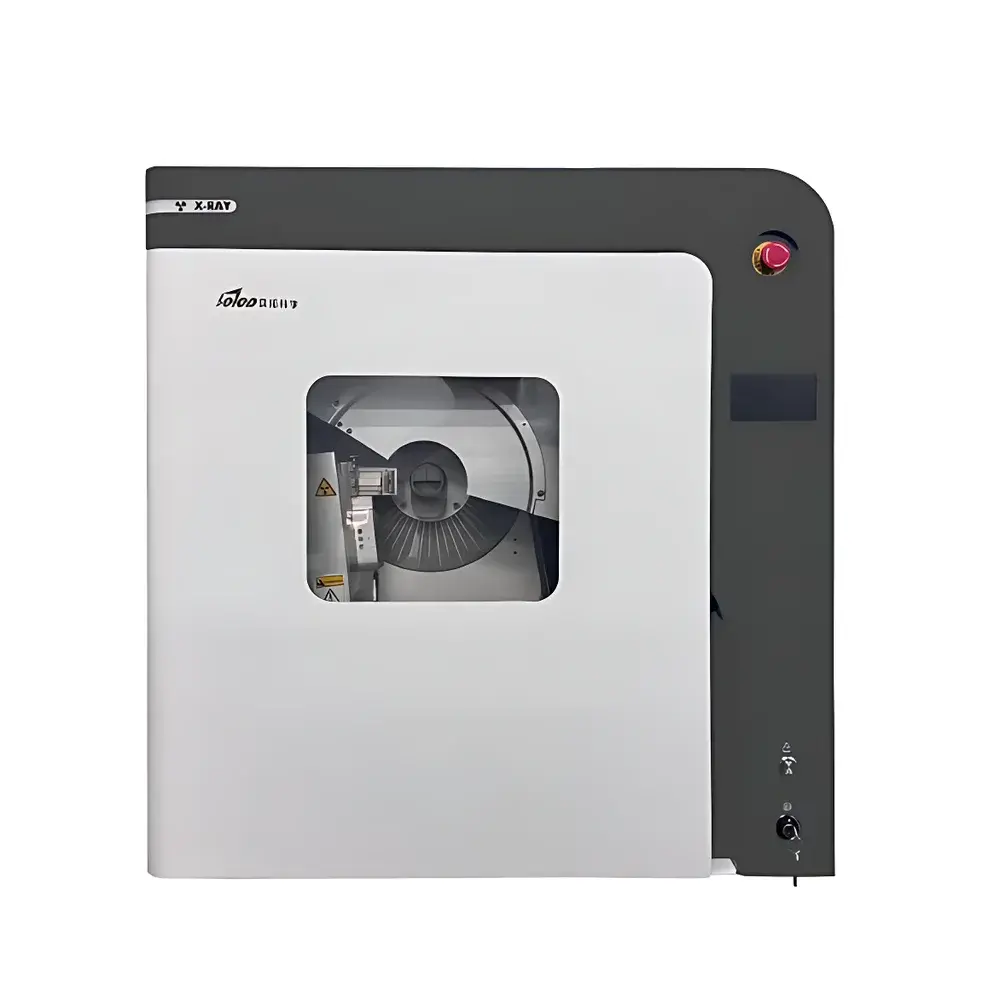
Betop Scientific BRAGG110 Benchtop X-ray Diffractometer
| Brand | Betop Scientific |
|---|---|
| Origin | Guangdong, China |
| Manufacturer Type | Direct Manufacturer |
| Instrument Type | Powder X-ray Diffractometer |
| Form Factor | Benchtop |
| Maximum X-ray Generator Power | 600 W |
| Angular Accuracy | ±0.001° (2θ) |
| Angular Resolution | 0.02° (2θ) |
| X-ray Source | Cu-target Metal-Ceramic Tube (Selectable Anode Materials) |
| Focal Spot | 0.4 × 10 mm or 1 × 10 mm (Point/Line Interchangeable) |
| Tube Voltage Range | 15–40 kV (1 kV step) |
| Tube Current Range | 5–15 mA (1 mA step) |
| Voltage/Current Stability | ≤0.01% (with ±10% line voltage fluctuation) |
| Goniometer Geometry | θ/2θ Bragg-Brentano & Debye-Scherrer Switchable |
| Goniometer Radius | 150 mm |
| Angular Scan Range | –10° to 80° (θ), –3° to 150° (2θ) |
| θ-axis Continuous Scan Speed | 0.125–30°/min |
| θ-axis Max Rotation Speed | 10°/s |
| 2θ Repeatability | ≤±0.001° |
| Detector Type | Hybrid Pixel Photon-Counting Semiconductor Detector |
| Pixel Size | 70 × 70 µm² |
| Single Module Active Area | 20.1 × 20.1 mm² |
| Noise Floor | <1 cps |
| Energy Resolution | 1000 eV |
| Max Linear Count Rate | 3 × 10⁶ cps/pixel |
| Detector Configuration | 11- or 21-module Arc-shaped Array |
| Sample-to-Detector Distance | 150 mm |
| Cabinet Dimensions (L×W×H) | 770 × 520 × 800 mm |
| Weight | 120 kg |
| Radiation Leakage | ≤0.2 µSv/h (excluding natural background) |
| Safety Systems | Interlocked Door, Power Overload Protection, Thermal Cut-off, Ni Filter (Cu-anode optimized) |
Overview
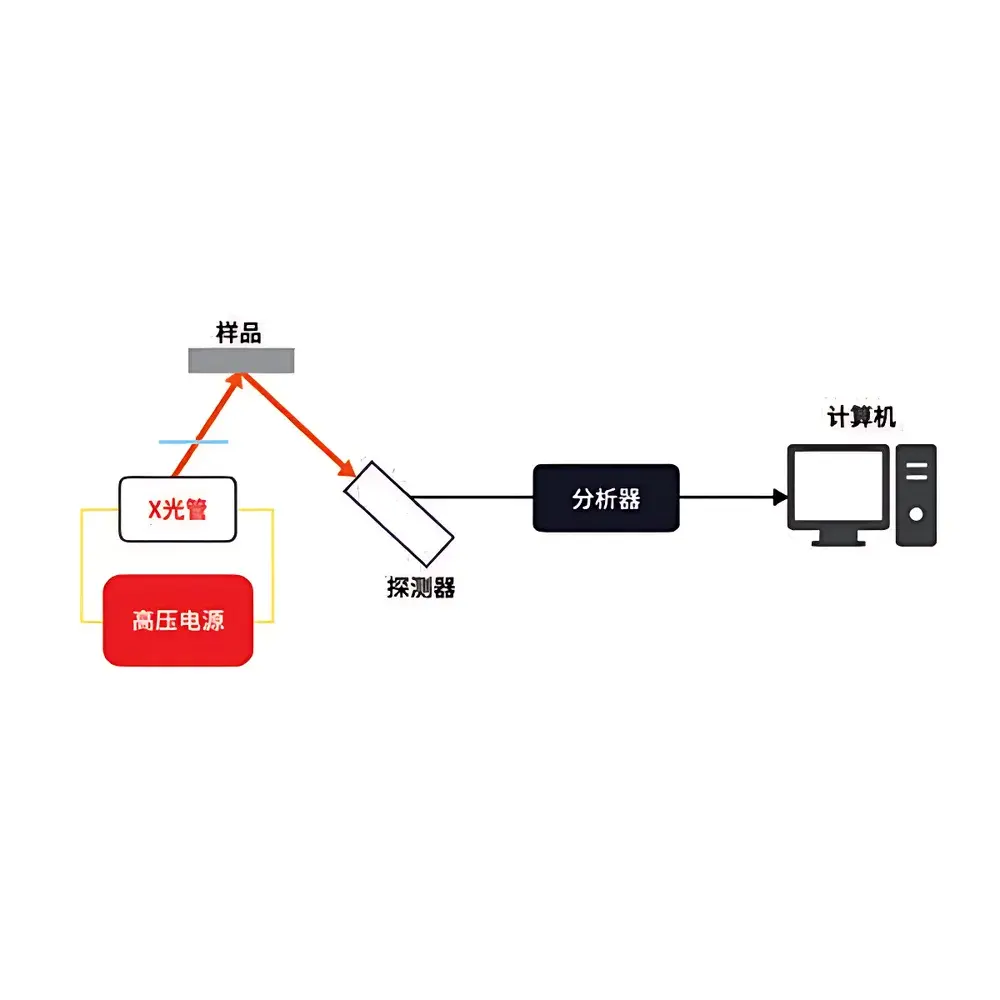
The Betop Scientific BRAGG110 Benchtop X-ray Diffractometer is an engineered solution for high-precision powder X-ray diffraction (XRD) analysis in academic, industrial, and quality control laboratories. Based on Bragg’s law and the fundamental principles of elastic X-ray scattering from crystalline lattices, the BRAGG110 employs a fixed-geometry θ/2θ goniometer with selectable Bragg-Brentano or Debye-Scherrer optical configurations—enabling rigorous phase identification, quantitative Rietveld refinement, crystallinity assessment, lattice parameter determination, and microstructural analysis (e.g., crystallite size via Scherrer analysis). Its compact benchtop architecture integrates a high-stability metal-ceramic X-ray tube (Cu anode standard, with optional anodes), a hybrid pixel photon-counting detector array, and a robust mechanical platform designed for long-term angular reproducibility (≤±0.001° 2θ repeatability) and thermal drift mitigation. Unlike conventional scanning diffractometers reliant on sequential point detection, the BRAGG110 captures full 2D diffraction frames across –3° to 150° 2θ simultaneously—preserving γ-angle information and enabling rapid acquisition of both conventional 1D patterns and azimuthally resolved data for texture or strain mapping.
Key Features
- Hybrid pixel photon-counting semiconductor detector array (11 or 21 modules), delivering single-photon sensitivity, >3 × 10⁶ cps/pixel linear dynamic range, and intrinsic energy discrimination (1000 eV resolution) to suppress fluorescence and scatter artifacts.
- Fixed-radius (150 mm) arc-shaped detector geometry ensuring seamless angular coverage from –3° to 150° 2θ without mechanical repositioning—eliminating goniometer hysteresis and calibration drift associated with moving detectors.
- Dual-mode data acquisition: high-throughput fixed-exposure 2D frame collection for kinetic studies or qualitative screening; and high-resolution 1D pattern generation via real-time radial integration for quantitative analysis.
- Switchable Bragg-Brentano (for bulk powder analysis) and Debye-Scherrer (for capillary/fiber samples or low-absorption matrices) geometries—configured via software-controlled optical path selection.
- Stabilized X-ray generator (≤0.01% voltage/current fluctuation tolerance) with digitally regulated 15–40 kV / 5–15 mA operation, supporting fine-step optimization of excitation conditions for diverse sample matrices.
- Integrated radiation safety architecture compliant with IEC 61010-1 and national Class II X-ray equipment regulations, including interlocked shielding door, redundant thermal cutoffs, and ≤0.2 µSv/h external dose rate under operational conditions.
Sample Compatibility & Compliance
The BRAGG110 accommodates a broad spectrum of solid-state samples—including free-flowing powders, pressed pellets, thin films, fibers, and slurries—without requiring specialized holders or vacuum environments. Its 150 mm sample-to-detector distance and large active detector area permit direct analysis of irregular or hydrated specimens with minimal preparation. The system supports ASTM E975 (Standard Practice for X-ray Diffraction Analysis of Metals), ISO 21377 (XRD for cementitious materials), and USP (XRD in pharmaceutical polymorph characterization). Data acquisition and processing workflows are structured to support GLP/GMP environments: audit trails, user access controls, electronic signatures, and raw-data immutability align with FDA 21 CFR Part 11 requirements when deployed with validated software configurations.
Software & Data Management
Controlled via Betop’s BRAGG-Studio suite—a Windows-based application built on Qt and Python scientific stack—the instrument provides intuitive method setup, real-time 2D/1D visualization, and integrated Rietveld refinement (using GSAS-II engine). All raw frame data are stored in vendor-neutral HDF5 format with embedded metadata (wavelength, geometry, exposure time, calibration parameters). Batch processing pipelines support automated phase identification (via ICDD PDF-4+ database integration), quantitative phase analysis (QPA), crystallite size/strain modeling (using Williamson-Hall or Warren-Averbach methods), and crystallinity index calculation (e.g., for semi-crystalline polymers). Export options include CIF, XYE, CSV, and industry-standard .raw formats compatible with TOPAS, FullProf, and HighScore Plus.
Applications
- Phase identification and impurity quantification in battery cathode/anode materials (e.g., NMC, LFP, graphite).
- Rietveld-based quantitative analysis of multi-phase geological samples (clays, zeolites, silicates) per ASTM D7686.
- Polymorph screening and stability monitoring in pharmaceutical development (API solid forms, hydrates, co-crystals).
- Crystallinity assessment of polymeric films and nanocomposites for packaging and barrier performance validation.
- In-situ/operando studies of structural evolution during thermal cycling or gas exposure (when paired with environmental stages).
- Residual stress and preferred orientation analysis in additive-manufactured metal components using sin²ψ methodology.
FAQ
Is the BRAGG110 compliant with international radiation safety standards?
Yes—the system meets IEC 61010-1 for laboratory equipment safety and complies with national Class II X-ray device licensing requirements, including mandatory interlock verification, dose rate certification (<0.2 µSv/h), and documented risk assessment protocols.
Can the instrument perform Rietveld refinement natively?
Yes—BRAGG-Studio includes embedded GSAS-II integration for full-pattern Rietveld refinement, site occupancy analysis, and microstructural parameter extraction without third-party software dependency.
What sample preparation is required for routine powder analysis?
Minimal preparation: typically involves gentle grinding, back-loading into a zero-background silicon or quartz sample holder, and surface leveling. No vacuum or cryogenic stages are required for standard ambient measurements.
Is remote operation and data export supported for regulated environments?
Yes—software supports role-based authentication, encrypted network communication, audit-trail logging, and export of raw + processed data in FDA 21 CFR Part 11–compliant formats when configured per validation protocol.
Are alternative anode materials (e.g., Co, Fe, Mo) available?
Yes—custom X-ray tubes with Co, Fe, or Mo targets can be factory-integrated upon order; anode selection is governed by absorption edge matching, fluorescence suppression needs, and required d-spacing resolution.





