
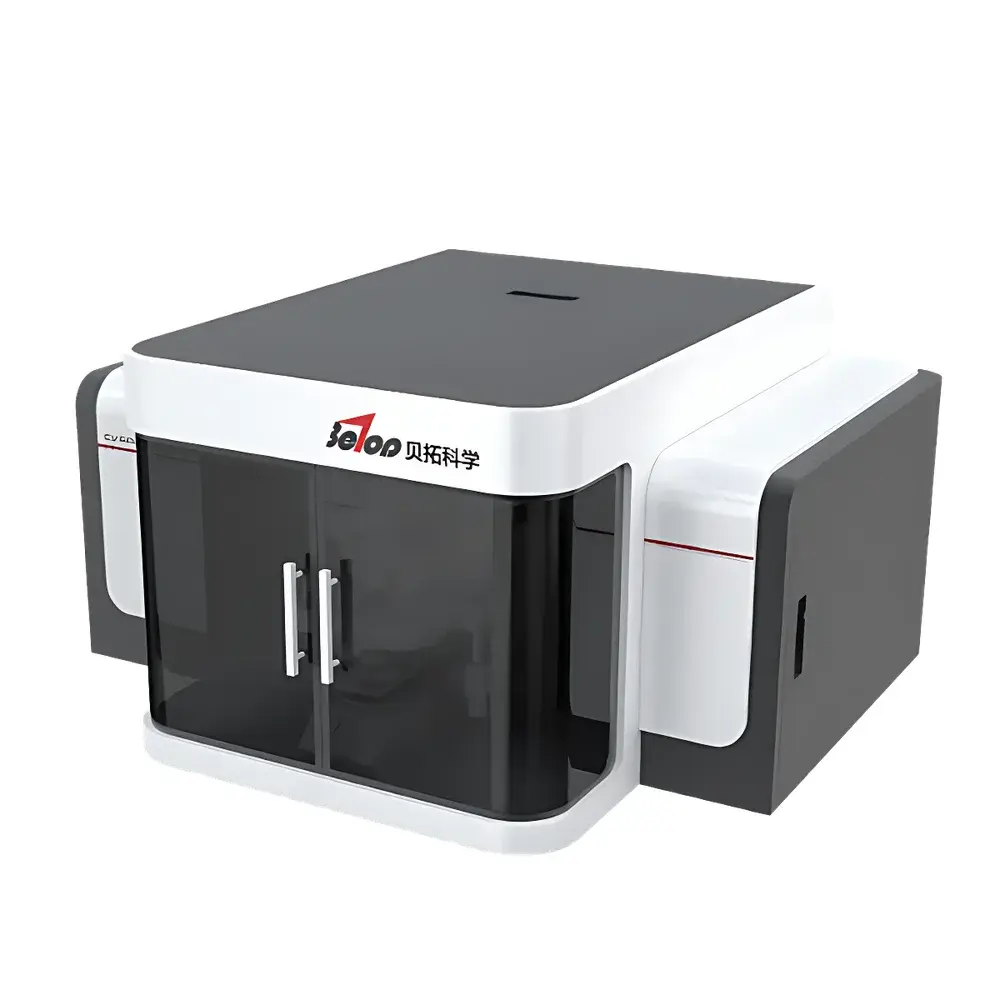
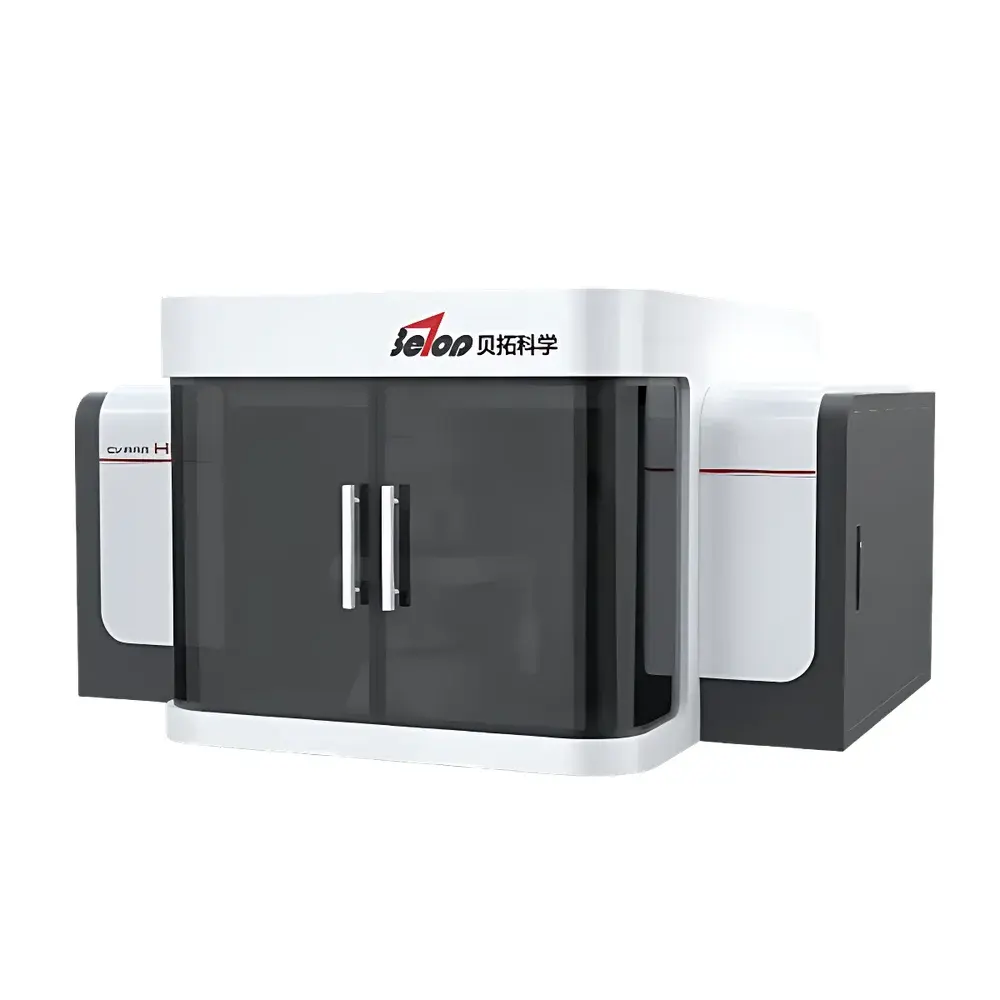
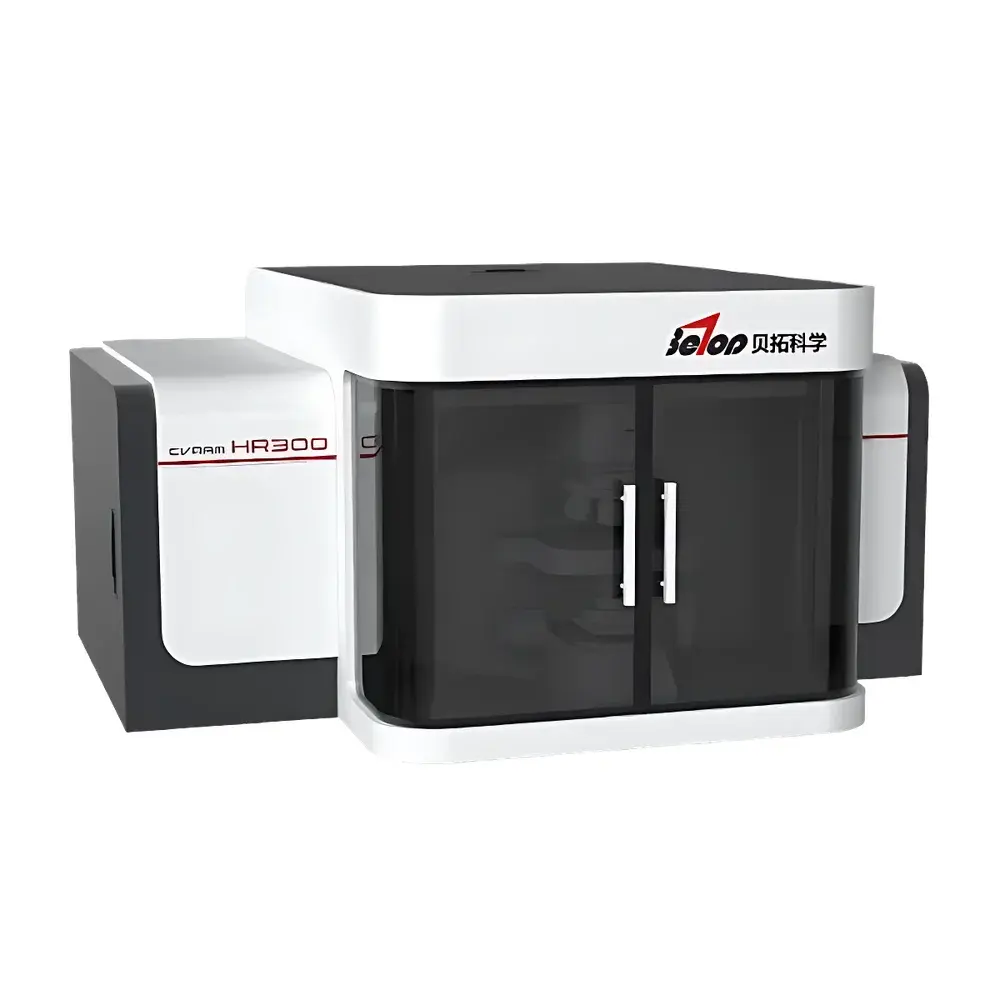
Betop Scientific CVRam HR300 Wide-Field High-Resolution Confocal Raman Microscope
| Brand | Betop Scientific |
|---|---|
| Origin | Guangdong, China |
| Manufacturer Type | OEM Manufacturer |
| Instrument Type | Confocal Raman Microscope |
| Spectral Range | 50–5000 cm⁻¹ |
| Spectral Resolution | <2 cm⁻¹ |
| Spatial Resolution | Lateral (XY) ≤500 nm @532 nm (100× dry objective, pinhole ≥50 μm) |
| Wavenumber Repeatability | <0.05 cm⁻¹ |
| Excitation Wavelengths | 532 nm (50 mW), 638 nm (50 mW), 785 nm (100 mW) |
| Detector | Back-illuminated TE-cooled CCD (−60 °C), QE >90% peak |
| Grating Options | 600, 1200, 1800 grooves/mm (software-controlled auto-switching) |
| Microscope | Research-grade upright microscope with LED epi-illumination |
| Stage | Motorized XYZ stage (60 × 55 × 50 mm travel) |
| Objectives | 10×, 50×, 100× dry |
Overview
The Betop Scientific CVRam HR300 is a wide-field, high-resolution confocal Raman microscope engineered for quantitative chemical imaging at the sub-micron scale. It integrates a research-grade optical microscope with a high-throughput, aberration-corrected spectrograph and a deep-cooled back-illuminated CCD detector to deliver spatially resolved vibrational spectra with exceptional signal fidelity. Based on spontaneous Raman scattering—where monochromatic laser light interacts with molecular vibrations to produce inelastically scattered photons—the system provides label-free, non-destructive molecular fingerprinting. Unlike fluorescence-based techniques, Raman spectroscopy is insensitive to water and requires no sample labeling or fixation, making it ideal for native-state analysis of hydrated biological tissues, pharmaceutical formulations, and functional materials. The CVRam HR300 employs true confocal optical architecture: a precisely aligned pinhole (≥50 μm selectable) in the detection path rejects out-of-focus light, ensuring depth sectioning capability and enabling volumetric chemical mapping with axial resolution down to 1000 nm under standard 532 nm excitation.
Key Features
- True confocal optical design with motorized XYZ stage and software-synchronized pinhole control for rigorous depth discrimination and 3D spectral reconstruction.
- Multi-laser excitation platform supporting 532 nm, 638 nm, and 785 nm lasers—optimized for minimizing fluorescence interference while maximizing Raman cross-section and detector quantum efficiency.
- High-throughput spectrograph with 300 mm focal length, f/3.9 aperture, and triple-grating turret (600/1200/1800 g/mm) enabling seamless trade-off between spectral resolution (<2 cm⁻¹), dispersion (2.38 nm/mm), and throughput.
- Back-illuminated, TE-cooled CCD detector operating at −60 °C with >90% peak quantum efficiency across 200–1100 nm—ensuring high signal-to-noise ratio (>20:1) even for weak scatterers such as carbon nanotubes or low-concentration biomolecules.
- Acton #1900 enhanced-aluminum mirror coatings and protected silver mirrors provide >98% reflectivity from NIR to 400 nm, maximizing photon collection efficiency across the full Raman shift range (50–5000 cm⁻¹).
- Automated spectral calibration using internal neon-argon reference lines ensures long-term wavenumber stability (<0.05 cm⁻¹ repeatability) required for regulatory-compliant longitudinal studies.
Sample Compatibility & Compliance
The CVRam HR300 accommodates diverse sample geometries and physical states without modification: solids (crystalline, amorphous, thin films), liquids (bulk, droplets, microfluidic channels), powders, gels, and biological specimens—including live cells cultured on standard glass substrates. Its ambient-pressure, room-temperature operation eliminates vacuum requirements and thermal stress artifacts. The system supports GLP/GMP-aligned workflows through hardware timestamping, user-access logs, and audit-trail-capable acquisition software compliant with FDA 21 CFR Part 11 principles. All spectral data files adhere to JCAMP-DX v6.00 format, ensuring interoperability with third-party chemometric platforms (e.g., MATLAB, Python scikit-learn, Unscrambler). For regulated environments, optional IQ/OQ documentation packages are available per ISO/IEC 17025 and ASTM E1840 guidelines.
Software & Data Management
Acquisition and analysis are performed via Betop’s proprietary RamanSuite Pro software—built on a modular, extensible architecture. Core modules include real-time spectral preview, hyperspectral cube acquisition (up to 1024 × 1024 pixels), multivariate curve resolution (MCR), principal component analysis (PCA), and cluster mapping with k-means or hierarchical agglomerative algorithms. All raw spectra are stored with embedded metadata: laser power, integration time, objective ID, pinhole size, grating selection, and environmental temperature/humidity (via optional sensor input). Data export supports HDF5, ASCII, and CSV formats; batch processing scripts can be written in Python using the provided SDK. Software validation reports—including performance verification against NIST-traceable polystyrene and silicon standards—are supplied with each instrument shipment.
Applications
- Materials Science: Strain mapping in 2D materials (MoS₂, graphene), phase identification in battery cathodes (NMC, LFP), interfacial chemistry in heterostructures, and defect quantification in CVD-grown semiconductors.
- Life Sciences: Label-free histopathology of unstained tissue sections, lipid/protein distribution mapping in single cells, crystallinity assessment of protein therapeutics, and real-time monitoring of drug dissolution kinetics.
- Pharmaceuticals: Polymorph screening, API-excipient interaction analysis, counterfeit tablet authentication, and stability-indicating assays per ICH Q5C and USP .
- Geosciences & Cultural Heritage: In situ mineral phase identification in fluid inclusions, stress state quantification in quartz-bearing rocks, pigment stratigraphy in historical paintings, and degradation product mapping in archaeological ceramics.
- Forensics & Food Safety: Trace fiber/paint chip identification, ink differentiation in questioned documents, adulterant detection in olive oil/honey, and pesticide residue profiling on fruit surfaces.
FAQ
What laser wavelengths are standard on the CVRam HR300, and can they be upgraded?
Standard configurations include 532 nm, 638 nm, and 785 nm diode-pumped solid-state lasers. Optional upgrades include 488 nm and 1064 nm modules—subject to optical path recalibration and detector compatibility verification.
Is the system compatible with cryogenic or environmental stages?
Yes—mechanical and electrical interfaces support third-party cryostats (e.g., Linkam LTS420), humidity chambers, and electrochemical cells. Custom optical coupling solutions are available upon request.
How is spectral calibration maintained during extended acquisitions?
An integrated neon-argon hollow-cathode lamp provides daily automated wavelength calibration; drift compensation algorithms correct for thermal expansion-induced pixel shifts in real time.
Can the CVRam HR300 perform time-resolved Raman measurements?
While not a time-domain instrument, it supports kinetic series acquisition with millisecond-level timing precision via TTL synchronization with external triggers (e.g., pump-probe lasers, reaction initiators).
Does the software support automated particle analysis for nanomaterial characterization?
Yes—RamanSuite Pro includes a dedicated Particle Analyzer module that correlates morphological features (from brightfield imaging) with spectral signatures to classify and quantify nanoparticle composition, crystallinity, and surface adsorbates.
Related Products






