
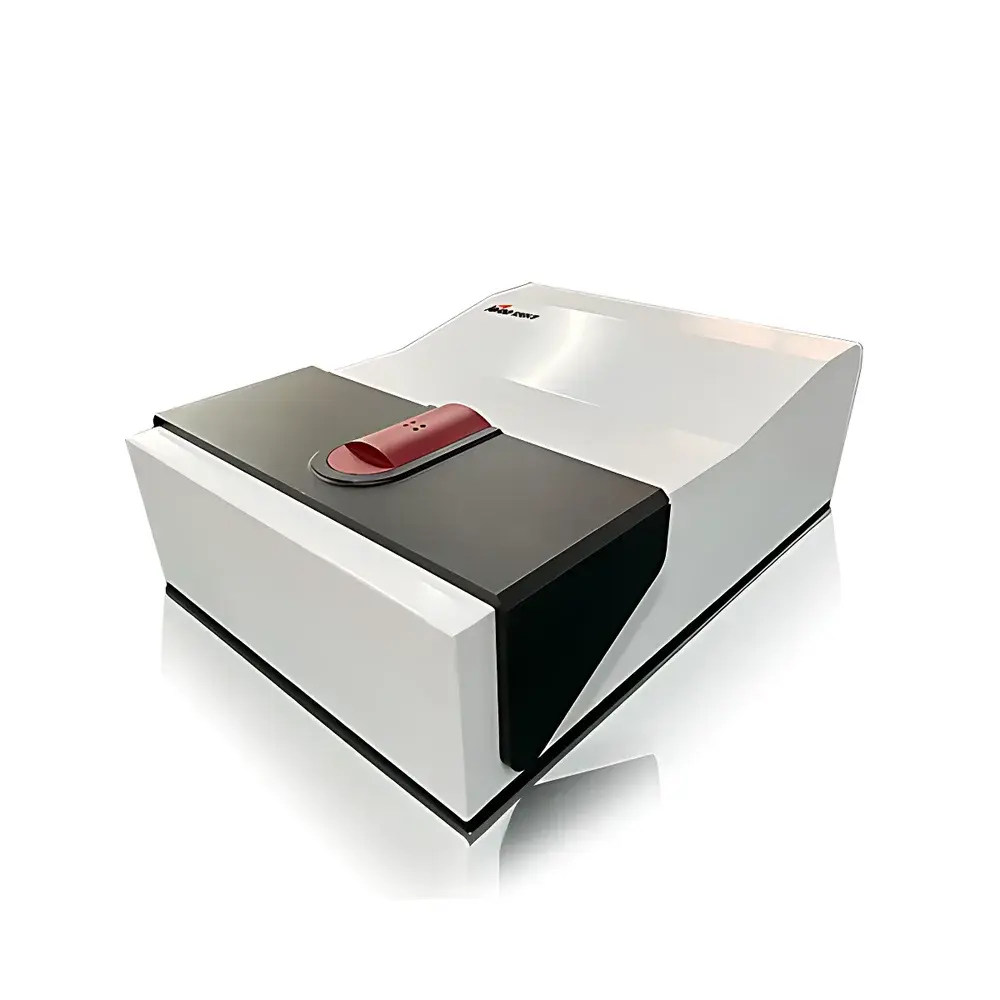
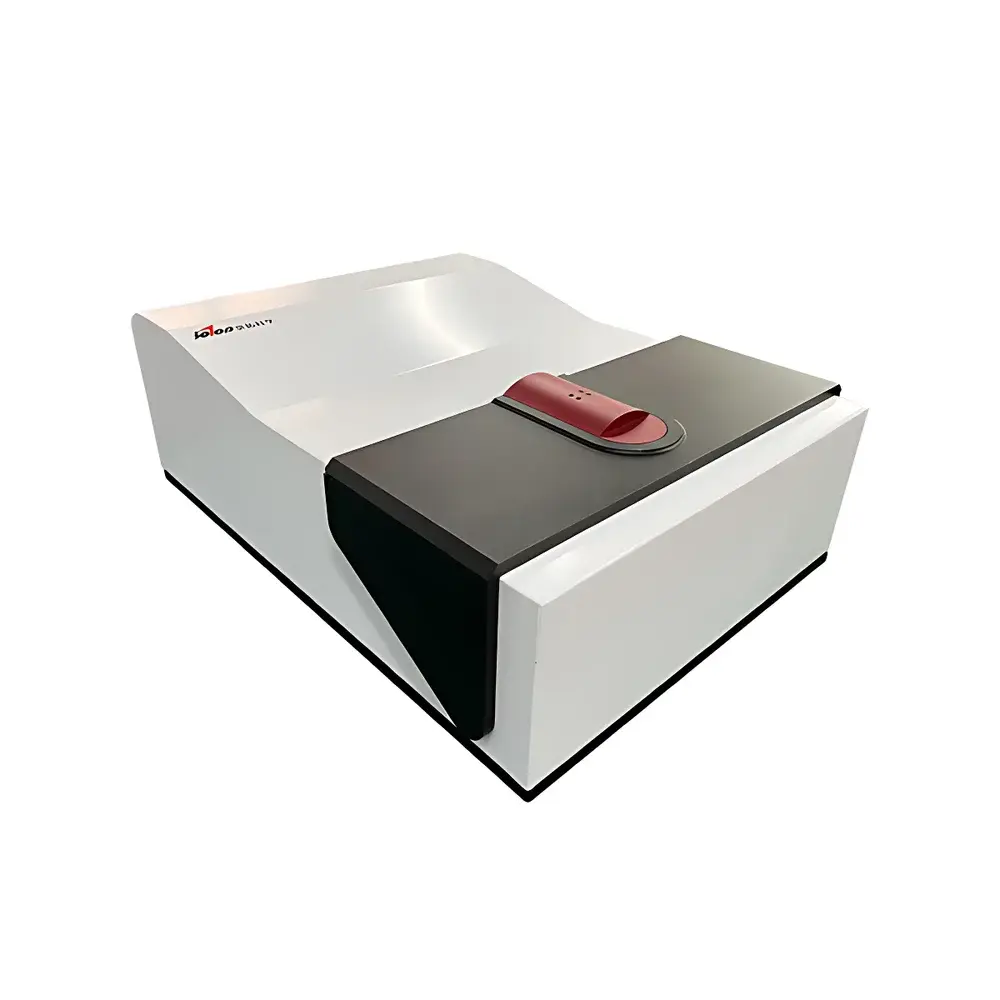
Betop Scientific DLS100 Zeta Potential and Nanoparticle Size Analyzer
| Brand | Betop Scientific |
|---|---|
| Origin | Guangdong, China |
| Manufacturer Type | Direct Manufacturer |
| Product Origin | Domestic (China) |
| Model | DLS100 |
| Price Range | USD 39,500 – 42,300 (FOB) |
| Particle Size Range | 0.7 nm – 10 μm |
| Size Measurement Repeatability | ±2% |
| Temperature Control Range | 10–50 °C |
| Temperature Stability | ±0.1 °C |
| Detection Angle (DLS) | 90° |
| Detection Angle (Zeta) | 18° |
| Zeta Potential Range | −500 to +500 mV |
| Sample Volume | 10 µL |
| Sample Concentration Range | 0.1–100 mg/L |
| Measurement Time (Typical) | 2 min per run |
| Light Source | 35 mW adjustable semiconductor laser, 635 nm |
| Detector | PMT photon counter |
| Correlator | Hardware-based multi-τ linear correlator |
| Analysis Algorithms | Cumulants, Non-Negative Least Squares (NNLS), CONTIN |
| Compliance | ISO 13321, ISO 22412, ISO 13099-2 |
Overview
The Betop Scientific DLS100 Zeta Potential and Nanoparticle Size Analyzer is a dual-mode optical instrumentation platform engineered for precision characterization of colloidal dispersions at the nanoscale. It integrates two complementary light-scattering techniques—Dynamic Light Scattering (DLS) for hydrodynamic diameter distribution analysis and Electrophoretic Light Scattering (ELS) for Zeta potential determination—within a single, thermally stabilized optical bench. The system operates on the physical principles of Brownian motion (for DLS) and electrophoretic mobility (for ELS), enabling quantitative assessment of colloidal stability, surface charge behavior, and dispersion homogeneity. Designed for rigorous laboratory environments, the DLS100 supports both research-grade method development and routine QC/QA workflows in regulated sectors including pharmaceutical formulation, biologics process monitoring, nanomaterial synthesis, and environmental colloid science.
Key Features
- Integrated dual-function architecture: Simultaneous or sequential DLS and ELS measurements without hardware reconfiguration
- High-stability temperature control system with ±0.1 °C accuracy across 10–50 °C range, utilizing solid-state Peltier cooling and active condensation suppression
- Optimized optical path design featuring fiber-coupled detection to maximize signal-to-noise ratio (SNR) in both 90° DLS and 18° ELS configurations
- 35 mW tunable 635 nm semiconductor laser with real-time intensity feedback control (0.0001–100% range), ensuring consistent photon flux across sample matrices
- Dedicated hardware correlator supporting multi-τ and linear correlation modes, enabling robust autocorrelation function acquisition under low-scatter conditions
- Photon-counting PMT detector with high quantum efficiency and low dark current, optimized for sub-micron particle detection sensitivity
- Adaptive analysis engine incorporating Cumulants (for polydispersity index and Z-average), NNLS (for multimodal resolution), and CONTIN (for broad distribution deconvolution)
Sample Compatibility & Compliance
The DLS100 accommodates aqueous and low-viscosity organic dispersions with particle concentrations spanning 0.1–100 mg/L and minimum sample volume of 10 µL—ideal for precious or synthetically limited nanomaterials. Its measurement protocols conform to internationally recognized standards: ISO 22412 for DLS-based size analysis, ISO 13321 for cumulant and distribution analysis, and ISO 13099-2 for electrophoretic mobility and Zeta potential reporting. The instrument’s thermal management, optical alignment stability, and signal processing architecture support GLP-compliant data generation. While not pre-certified for FDA 21 CFR Part 11, its audit-trail-capable software architecture enables validation for GMP-regulated environments when deployed with appropriate SOPs and electronic signature controls.
Software & Data Management
Control and analysis are performed via Betop’s proprietary ZetaSoft v4.x platform, a Windows-based application offering intuitive workflow navigation, real-time correlation curve visualization, and automated quality flagging (e.g., count rate deviation, baseline drift, or field strength instability). All raw correlator data, instrument parameters, and metadata (including operator ID, timestamp, temperature log, and laser power history) are stored in encrypted binary format with optional export to CSV, TXT, or ASTM E1447-compliant XML. Batch processing, report templating, and user-defined pass/fail criteria facilitate integration into LIMS environments. Audit trail functionality records all parameter modifications, analysis reruns, and export events with time-stamped, non-erasable entries—supporting traceability requirements in regulated laboratories.
Applications
- Formulation stability screening of protein therapeutics, liposomes, and polymeric nanoparticles
- Zeta potential mapping during pH titration or ionic strength variation to identify isoelectric points and colloidal stability windows
- Batch-to-batch consistency verification in nanomaterial manufacturing (e.g., quantum dots, metal oxides, carbon nanotubes)
- Surface modification efficacy assessment via charge reversal or magnitude shift after ligand grafting
- Aggregation kinetics monitoring under thermal or mechanical stress conditions
- Colloidal behavior evaluation in wastewater treatment sludge conditioning and membrane fouling studies
- Quality control of nanosuspensions in food-grade emulsifiers and nutraceutical delivery systems
FAQ
What is the minimum detectable particle size under DLS mode?
The DLS100 achieves reliable detection down to 0.7 nm for monodisperse standards in low-noise aqueous media; practical lower limits depend on sample refractive index contrast, viscosity, and scattering intensity.
Can the system measure Zeta potential for highly conductive or viscous samples?
Yes—electrophoretic mobility is measured at 18° using phase-analysis light scattering (PALS) methodology, which maintains accuracy up to ~20 mS/cm conductivity and kinematic viscosities ≤5 cSt.
Is calibration required before each measurement?
No routine calibration is needed; the system uses factory-characterized optical path geometry and laser wavelength. NIST-traceable polystyrene standard suspensions (e.g., 100 nm, 500 nm) are recommended for periodic performance verification.
Does the software support automated SOP execution?
ZetaSoft v4.x includes scriptable protocol modules that enforce predefined measurement sequences, parameter locks, and pass/fail logic—enabling unattended operation in production QC labs.
How is data integrity ensured during long-term deployment?
All measurement sessions generate immutable hash-verified archives containing raw correlator data, processed results, and full environmental logs—compatible with digital signature and archival validation per ALCOA+ principles.



