
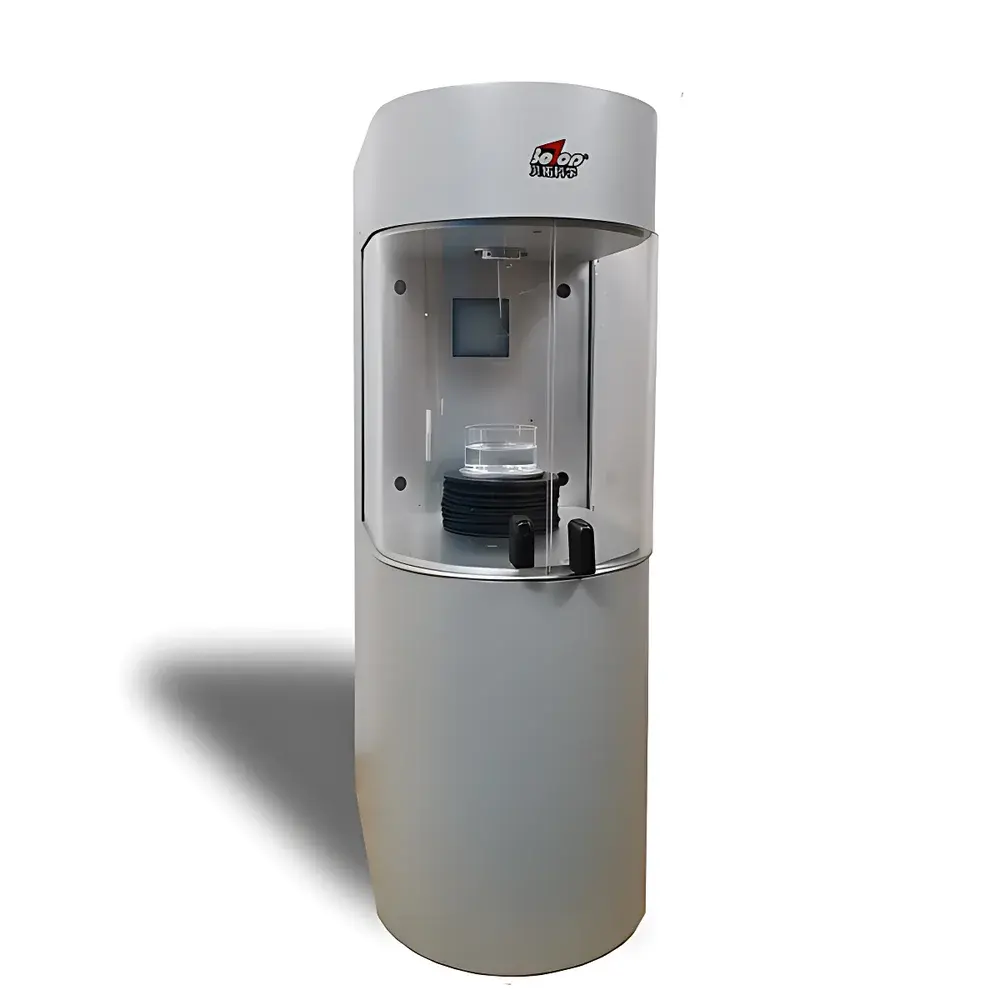
Betop Scientific KF100C Advanced Surface & Interfacial Tensiometer
| Brand | Betop Scientific |
|---|---|
| Origin | Guangdong, China |
| Manufacturer Type | Direct Manufacturer |
| Model | KF100C |
| Measurement Range | 1–1000 mN/m |
| Resolution | 0.01 mN/m |
| Accuracy | ±0.01 mN/m |
| Temperature Control Range | −10 °C to 130 °C |
| Temperature Display Accuracy | ±0.1 °C |
| Measurement Methods | Du Noüy Ring Method, Wilhelmy Plate Method |
| Balance Capacity | 210 g |
| Balance Sensitivity | ±0.1 mg |
| Liquid Density Range | 1–2200 kg/m³ |
| Density Resolution | 1 kg/m³ |
| Dynamic Contact Angle Range | 0–180° |
| Contact Angle Resolution | ±0.01° |
| Stage Vertical Travel | ~100 mm |
| Stage Speed | 0.099–500 mm/min |
| Data Acquisition Rate | up to 50 Hz (20 ms interval) |
| Illumination | Integrated white LED coaxial lighting |
| Software Suite | TENTION SW31 (tensiometry), SW32 (contact angle), SW34 (density), SW35 (colloidal stability) |
Overview
The Betop Scientific KF100C is a high-precision, dual-mode surface and interfacial tensiometer engineered for rigorous laboratory environments where reproducibility, traceability, and method compliance are non-negotiable. It operates on the fundamental principles of the Wilhelmy plate and Du Noüy ring methods—both standardized gravimetric techniques that quantify the force exerted on a calibrated solid probe (platinum plate or ring) as it interacts with the liquid–air or liquid–liquid interface. These methods rely on precise force measurement via a high-stability microbalance, combined with real-time positional control of the sample stage and thermally regulated sample environment. The KF100C integrates a German-sourced analytical balance with active auto-protection circuitry, ensuring long-term calibration integrity and resistance to mechanical shock or overload during routine operation. Its 50 Hz acquisition rate enables high-fidelity kinetic profiling of dynamic interfacial processes—including surfactant adsorption, film formation, and interfacial relaxation—making it suitable for both equilibrium and time-resolved investigations in R&D and QC settings.
Key Features
- High-resolution force detection: ±0.01 mN/m resolution and accuracy over the full 1–1000 mN/m range, validated per ISO 304 and ASTM D133 protocols
- Thermally controlled sample stage with programmable range from −10 °C to +130 °C (±0.1 °C display accuracy), supporting low-temperature formulation studies and high-temperature stability testing
- Precise, servo-driven vertical stage with 100 mm travel and continuously variable speed (0.099–500 mm/min), enabling optimized immersion/emersion profiles for both static and dynamic measurements
- Integrated coaxial white LED illumination system for enhanced meniscus visualization—critical for accurate baseline identification and operator-assisted validation
- Modular software architecture (TENTION platform) supporting concurrent operation of tensiometry (SW31), contact angle analysis (SW32), liquid density determination (SW34), and colloidal stability assessment (SW35)
- Comprehensive method library compliant with ASTM D971 (oil–water interfacial tension), ISO 1409 (polymer dispersions), ISO 4311 (CMC determination), and OECD 115 (chemical safety assessment)
Sample Compatibility & Compliance
The KF100C accommodates a broad spectrum of sample types—from low-viscosity aqueous surfactant solutions to high-boiling-point oils, molten polymers (with optional high-temp accessories), and multi-phase emulsions. Its platinum plate and ring probes meet ASTM E2072 specifications for material purity and dimensional tolerance. All measurement workflows support full audit trail generation, electronic signature capability, and user-access-level permissions—enabling alignment with GLP, GMP, and FDA 21 CFR Part 11 requirements when deployed in regulated pharmaceutical or cosmetic development labs. Calibration verification routines include built-in reference fluid checks (e.g., ultra-pure water at 20 °C = 72.75 mN/m) and automated zero-balance drift compensation.
Software & Data Management
TENTION software provides a unified, Windows-based interface with intuitive workflow navigation and configurable report templates exportable to PDF, CSV, or Excel. SW31 implements fully automated tensiometric analysis—including automatic meniscus detection, buoyancy correction, and Harkins–Jordan factor application for ring-method data. SW32 extends functionality to dynamic contact angle measurement using the Wilhelmy plate method, supporting advancing/receding angle tracking, hysteresis calculation, and multi-model surface energy decomposition (Owens–Wendt, Wu, Fowkes, van Oss–Chaudhury–Good). All modules generate timestamped, metadata-rich datasets with embedded instrument parameters, environmental conditions, and operator annotations—facilitating seamless integration into LIMS or ELN systems.
Applications
- Determination of critical micelle concentration (CMC) and surfactant efficiency (pC20) for formulation optimization
- Wettability assessment of pharmaceutical tablets, APIs, and excipients under controlled humidity and temperature
- Interfacial aging studies of lubricants and transformer oils per ASTM D971
- Coating adhesion prediction via surface energy mapping of substrates and primers
- Stability evaluation of pigment dispersions, nanosuspensions, and functional inks using SW35 time-series sedimentation analysis
- Surface modification validation in plasma-treated polymers, silanized glass, or deposited thin films
- Clean-in-place (CIP) efficacy monitoring in food-grade stainless steel tanks through interfacial tension decay kinetics
- Dynamic interfacial rheology proxy measurements via forced oscillation of the Wilhelmy plate (custom protocol support)
FAQ
Which international standards does the KF100C support out-of-the-box?
ASTM D971, D133, D1417; ISO 304, 1409, 4311, 6889; DIN EN 14210, 14370; OECD 115.
Can the KF100C measure interfacial tension between two immiscible liquids?
Yes—using the Du Noüy ring or Wilhelmy plate method with appropriate probe selection and density correction algorithms embedded in SW31.
Is temperature calibration traceable to national standards?
The integrated Pt100 sensor is factory-calibrated against NIST-traceable references; optional external calibration verification kits are available.
Does the system support automated CMC titration experiments?
Yes—via programmable syringe pump integration (third-party compatible) and SW31’s sequential concentration profiling module.
What maintenance is required for long-term accuracy?
Quarterly balance recalibration using certified weights, annual probe cleaning with chromic acid or piranha solution (per ISO 304 Annex B), and biannual firmware/software updates.



